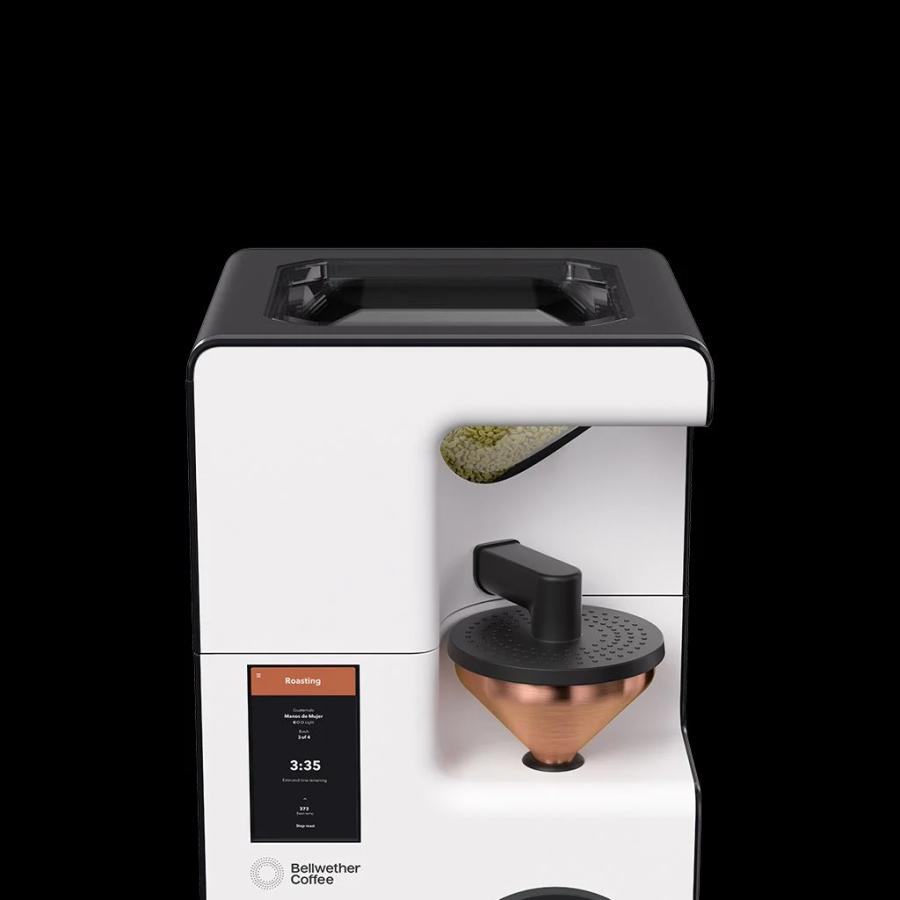
You already know roasting your own coffee is the most profitable way to serve great coffee. The question isn't whether to do it — it's which machine you tie your operation to for the next decade. And once you start comparing electric to gas, the spec sheets stop being the hard part. The buildout, the venting, the gas line, the person who has to stand at the machine all day — that's where the real money and the real headaches hide.
If you're weighing a Bellwether against a Typhoon, you're looking at two genuinely different philosophies of what a roaster should be. One is a gas, fluid-bed machine that needs venting and a hands-on operator. The other is the only electric, ventless, automatic commercial coffee roaster on the market. Here's the honest comparison, with the numbers that actually move the decision.
The Two Machines, Side by Side
The Typhoon is a fluid-bed roaster that runs on gas. It starts around $29,500 and, like every gas roaster, it needs a vent and the infrastructure that comes with it. It's semi-automated, which in practice means someone is paying attention to the roast.
The Bellwether Shop Roaster is the opposite by design: all-electric, ventless, and fully automatic. It plugs into a standard 220V / 30-amp single-phase outlet — the same kind of circuit your espresso machine uses — and an internal afterburner neutralizes smoke and VOCs so nothing vents outside. It was named SCA Best New Product 2024.
| Heat source | Electric | Gas |
|---|---|---|
| Roast style | Enclosed, automatic | Fluid bed, semi-automated |
| Venting required | No | Yes |
| Gas line required | No | Yes |
| Starting price (US) | $22,000 | ~$29,500 |
| Install | Plug in, same day | Buildout + venting |
| Operator attention | ~2 min per roast | Hands-on throughout |
| Certifications | UL 197, UL 710, NSF4, CE | Varies |
The Cost That Isn't on the Price Tag
The sticker price is the easy part. The Bellwether starts at $14,900 versus the Typhoon's ~$29,500, so Bellwether is already lower before you account for installation. And installation is where gas roasters get expensive.
A gas roaster needs a gas line and an exhaust path — ductwork, a hood, sometimes a rooftop penetration and the permits that come with it. Those costs can run thousands before you've roasted a single pound, and they lock you into a specific room in a specific building. The Bellwether eliminates all of it. A licensed electrician installs a dedicated 30-amp circuit, and you're roasting the same day. No gas, no venting, no construction.
That ventless design is the structural difference no gas roaster can match. It's why a Bellwether can live in a mall food court, a historic building, or right out front where your customers can watch — places a vented gas roaster simply can't go.
Labor: The Difference Between Babysitting and Pressing Start
This is the line item most operators underestimate. A semi-automated gas roaster needs someone present and engaged through the roast. That's a wage you pay on top of the coffee.
Jorge at Hey My Coffee in Madrid switched from exactly that kind of setup. As he put it: "With our previous machine, someone had to be physically present throughout the entire roasting process, but with Bellwether you only need time to prepare and handle the roasted coffee afterward, saving us a lot in labor costs."
With the Bellwether, a roast takes about 2 minutes of labor, and you can train a new operator in under 20 minutes. Doug at 1951 Coffee in Berkeley confirmed it: "We can teach someone in 20 minutes how to use the machine and roast. It really is that simple." That means you delegate roasting to existing staff instead of hiring or chaining yourself to the machine. With the Continuous Roasting upgrade, Tiffany at Tiabi Coffee & Waffle in Las Vegas got even more hands-off: "The continuous roasting is a game changer. We can literally just load it, and it just goes."
How much are you overpaying?
Calculate your savings
Your wholesaler takes 67% of the margin on every pound. See exactly how much you'd save roasting in-house with your current volume.
Capacity for a Real Operation
Small batch doesn't mean small business. The Bellwether roasts 1.5 kg (3.3 lb) per batch on demand, 15–20 kg (33–44 lb) in a standard 8-hour day, and with the Continuous Roasting upgrade and autoloader, 80+ kg (176+ lb) per day. That covers single cafés and serious wholesale alike.
Donovan at Anchor and Tree Coffee in Sacramento runs a wholesale operation on it: "I am doing between 3,000 and 4,000 pounds a month as a wholesale coffee roaster, and I still have extra time to roast." Capacity is rarely the thing that holds an established business back — the labor and infrastructure to use that capacity is. That's the gap electric, ventless, automatic roasting closes.
Does Electric Cost You Quality? No.
The honest worry with any switch is whether the coffee changes. The most respected names in specialty coffee have already tested this. Tom Flay at Square Mile Coffee Roasters in London ran a blind tasting: "We put our Bellwether roast on as well as production roast from our Probat machines. About 20-25 of our team were tasting. And no one could pick the production roast from the Bellwether roast. Most of them were the Bellwether roast as their favourite."
Your customers won't taste a downgrade. They'll taste fresher coffee, because you're roasting on demand instead of buying beans that have been sitting on a shelf.
The Margin Math
Here's why operators make the move at all. Roasters take roughly 67% of the gross margin in every pound of coffee. Roast in-house and that margin is yours. A 24 lb bag of green runs about $140 (roughly $5.83/lb) versus two 5 lb bags of roasted wholesale at about $75 each (roughly $15/lb) — more than double per pound. Most operators save up to 50%, or $1,000–$5,000 a month.
The savings are real and documented. Doug at 1951 Coffee: "We were paying anywhere from $9 to $11 per pound for roasted coffee. Now, we're paying closer to $4 or $5 per pound." Peter at Wellborn Coffee in Port Chester, NY: "We cut a lot out. At $20 a pound from our previous roaster, we'd lose money on every pound." And Tony at Function Coffee Co. on the bottom line: "At the end of the year, we're able to actually see profit that we would not have been able to unlock had we gone with the third party wholesale vendor."
At those numbers, payback comes in as little as 6 months, and you break even at about 25 lb a week. As Liam at High Grade Coffee in London put it: "Every coffee shop should eventually become its own roaster. It's the best way to control your margins. The coffee is one of the biggest costs in your cup."
If you want to compare the Typhoon to other options, our Bellwether vs Stronghold and electric vs gas coffee roaster breakdowns cover the rest of the field.
Ready to roast in-house?
Take control of your margins
Save $1,000–5,000/month on coffee costs. Your wholesaler takes 67% of the margin on every pound — it’s time to take it back.