For most large-scale food operators, coffee is invisible. It shows up on the invoice month after month as a line item nobody questions — pre-roasted, marked up by a vendor, delivered in bulk, poured out across dozens of cafés and micro kitchens without much thought. Volume is huge. Costs are high. Quality control is somebody else's problem.
One global food services company decided to look again. Managing distributed café and micro kitchen networks across multiple corporate locations, serving thousands of employees daily, they were buying tens of thousands of pounds of pre-roasted coffee every year. When they moved coffee roasting on-site with Bellwether, they cut per-pound costs by more than 50%, achieved full equipment payback in 3 months, and generated $200,000 in first-year savings at a single location.
This is the case for taking a second look.
The challenge: coffee as an invisible line item
The organization had a clear commitment to quality in every other food category — ingredients sourced with intent, chefs given the tools to do their best work, menus that reflected the values of the business. Coffee didn't get the same treatment. It arrived pre-roasted, from a vendor, at premium prices for a commoditised product.
The problems compounded at scale:
- Vendor markups on tens of thousands of pounds annually — coffee was priced like a premium product but treated like plumbing.
- No control over origin or freshness — by the time bags reached the café, the beans had been sitting for weeks.
- Inconsistent quality across locations — different sites, different vendors, different results.
- Zero story to tell employees — coffee had none of the traceability or intention the rest of the food program did.
Employees expected better. The organization deserved better economics. The status quo was the biggest cost of all.
The solution: on-site roasting, without the infrastructure
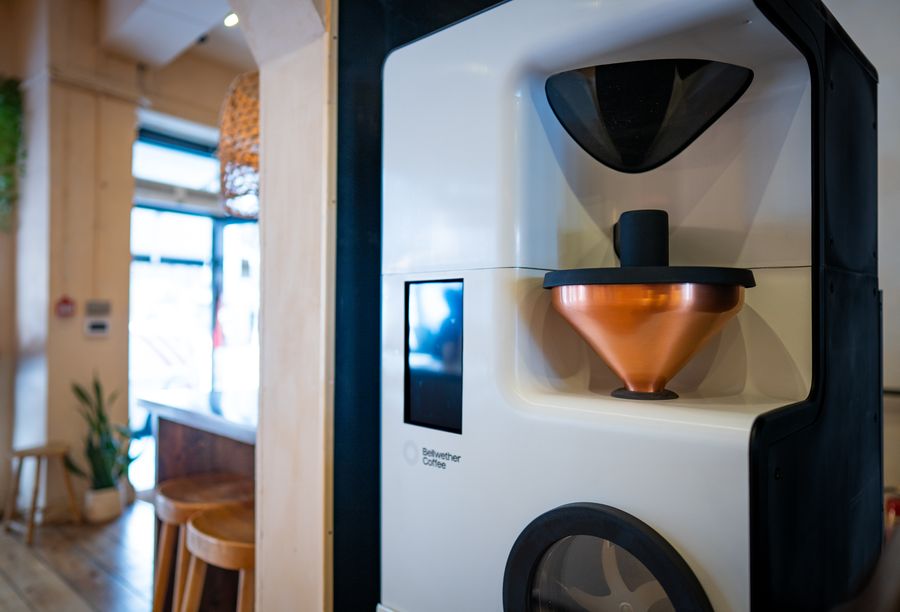
Bellwether's electric, closed-loop Shop Roaster made in-house roasting feasible for the first time at this scale. No gas lines. No exhaust hoods. No specialised roasting staff. No permits. Ventless, electric machines that plug into a standard commercial outlet and start roasting the same day they arrive.
What that unlocked, immediately:
- Minimal operational lift. Existing culinary staff operate the roasters as part of their standard workflow. No new hires, no dedicated roastmaster.
- No infrastructure required. Ventless, electric — plug in and start roasting. No construction, no permitting delays, no facility buildout.
- Consistency at scale. Standardised roast profiles mean the same coffee tastes the same across every location, every batch.
- Complete control. Green coffee sourced directly, roasted weekly, distributed fresh within days.
The results, by the numbers
From the first location, the numbers landed harder and faster than the internal projections had modelled.
| Metric | Result |
|---|---|
| Cost per pound | Reduced 50%+ vs. pre-roasted vendor pricing |
| Payback period | 3 months (against a conservative 6-month projection) |
| Roasting volume | 500+ lbs/week — 750 lbs in peak weeks |
| Year-one savings | $200,000 at a single location |
| Labour overhead | Zero additional — same culinary team |
| Facility changes | None — ventless, electric, plug-in |
The economics told the whole story: cost-per-pound cut in half, payback in a quarter of the projected time, no headcount added. The kind of numbers that get an enterprise coffee program funded and then replicated.
Don’t take our word for it
See how others made the switch
Established cafés saving $1,000–5,000/month. Fresher coffee. Bigger margins. Hear it from operators like you.
What in-house roasting actually unlocked
Cost reduction was the starting point, not the finish line. Once the roasters were installed and the culinary team was running weekly production, the program started opening doors that hadn't existed under the vendor model.
- Branded, origin-specific offerings. Coffee sourced and roasted for specific cultural moments, community causes, and internal campaigns.
- A story employees connect with. Sourcing, craftsmanship, and values — visible on the bag, tastable in the cup.
- A competitive differentiator for the organization itself. Coffee became a talking point in employee experience conversations, not a hidden operating cost.
Coffee moved from a commodity line item to a meaningful part of the workplace — and something people talked about with the same enthusiasm as the rest of the menu.
At scale, this is the big value. The bigger that you are, the more important it is to look at something like Bellwether.
— Food Program Operator
Why this matters for large-scale food operators
For enterprise food service programs, coffee economics have been invisible for decades. Tens of thousands of pounds ordered annually, distributed across dozens of sites, and nobody was asking the obvious question: could we do this better?
Bellwether changes that calculus in four ways that compound at scale:
- Savings are material. At vendor pricing, a 50% cut on tens of thousands of pounds is real money — the kind that funds other programs.
- Operational lift is minimal. Existing staff, existing space, existing workflow. The Shop Roaster fits into culinary operations, not around them.
- Employee impact is immediate. Fresh, origin-specific coffee is something people notice on day one — no ramp-up required.
- Differentiation is just beginning. Once you own the roast, you own the story: menu tie-ins, cultural moments, community sourcing, and internal brand moments the vendor model can't touch.
At the enterprise scale, this isn't a coffee decision. It's a program decision — and one worth putting the numbers to.
Ready to roast in-house?
Take control of your margins
Save $1,000–5,000/month on coffee costs. Your wholesaler takes 67% of the margin on every pound — it’s time to take it back.