You already serve good coffee. The question on the table isn't whether to care about quality — it's who gets to put their hands on the beans before they reach your cup, and who keeps the money. Most café owners are handed two choices that sound similar but aren't: white label and private label. Both let you slap your name on a bag. Neither lets you control what's inside it, or when it was roasted.
There's a third path that rarely makes the comparison chart, and it's the one with the most leverage. Before you sign another supplier agreement, it's worth knowing exactly what each option gives up — and what changes when the roasting happens in your own shop.
White Label vs. Private Label: The Real Difference
The terms get used interchangeably, but they describe two different relationships with a third-party roaster.
- White label coffee is a finished product the roaster already makes. You buy it, rebrand it with your label, and sell it. You didn't choose the beans, the origin, or the roast profile — you chose the bag.
- Private label coffee is closer to a custom order. You work with the roaster to spec something — a blend, a roast level, a story — and they produce it under your brand. More input, more control, usually a higher minimum order and a higher price.
Here's the honest summary:
| Factor | White Label | Private Label |
|---|---|---|
| Recipe control | None — you take what exists | Some — you spec it, they make it |
| Freshness | Roasted before you order it | Roasted to a production run |
| Minimums | Lower | Higher |
| Cost per pound | Lower of the two, still roasted-coffee pricing | Highest |
| Who owns the margin | The roaster | The roaster |
Notice the bottom row. With either option, you're still buying roasted coffee from someone else — and roasted coffee is where the money already left the building. In every pound, the roaster takes roughly 67% of the gross margin. A 24 lb bag of green coffee runs about $140 — roughly $5.83 a pound. Buy that coffee roasted instead and you're at wholesale prices like two 5 lb bags at $75 each, around $15 a pound — more than double per pound. White label or private label, you're paying that markup on every bag, every week, forever.
The Cost You Stop Noticing
When you buy roasted, the per-pound number gets quietly baked into your cost of goods and you stop questioning it. The operators who switched away from it remember the number exactly.
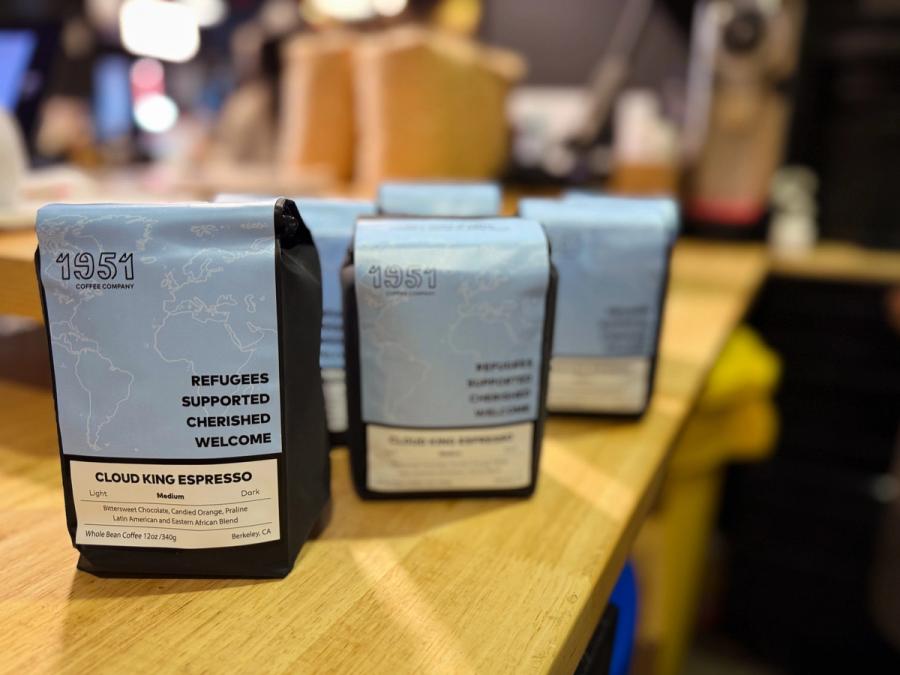
Doug at 1951 Coffee put it plainly: "We were paying anywhere from $9 to $11 per pound for roasted coffee. Now, we're paying closer to $4 or $5 per pound." That's not a coupon — that's the structural difference between buying the finished product and buying the green.
Peter at Wellborn Coffee had it worse before he changed: "We cut a lot out. At $20 a pound from our previous roaster, we'd lose money on every pound." When your supplier sets the price and you set the menu, a price increase isn't a negotiation. It's a bill.
And the savings aren't theoretical. Tony at Function Coffee Co. described what it did to his books: "Roasting in-house with the Bellwether has really unlocked a lot of margin for us because we're saving 40, 50% on what we would have otherwise spent, had we gone with third party beans for our cafe." He added the part that matters at year-end: "At the end of the year, we're able to actually see profit that we would not have been able to unlock had we gone with the third party wholesale vendor."
For most operators, roasting in-house saves $1,000–$5,000 per month and cuts coffee costs by up to 50%.
Sourcing made simple
Premium green coffee at wholesale prices
A global library of expertly sourced coffees with profiles ready to roast. Use our marketplace for plug-and-play convenience, or source your own — the roaster handles both.
When White Label or Private Label Actually Makes Sense
To be fair to both: if you sell almost no bagged coffee, have zero counter space, and only need an occasional retail SKU for the shelf by the register, a white-label or private-label arrangement is a reasonable shortcut. You avoid equipment, you avoid learning anything new, and you get a branded bag.
The trade-off is that you've capped your upside. You can't change the roast when a customer wants it darker. You can't react to a price hike. And the coffee on your shelf was roasted to a production schedule — not this week, for this customer. That gap between "roasted recently" and "roasted to order" is exactly what your regulars taste, even if they can't name it.
Roasting Your Own: The Option That Keeps the Margin
The reason roasting your own rarely makes the white-label-vs-private-label list is that it used to mean gas lines, ventilation, construction, and a skilled roaster on payroll. That's no longer the only way.
The Bellwether Shop Roaster is the only electric, ventless, automatic commercial roaster — named the Specialty Coffee Association's Best New Product of 2024. It runs on a standard 220V/30A single-phase outlet, the same kind your espresso machine uses. No gas, no venting, no construction. An internal afterburner handles the exhaust, so it can sit in the café, not a back room.
What that does to the workflow is the whole point. Jorge at Hey My Coffee compared it to his old machine: "With our previous machine, someone had to be physically present throughout the entire roasting process, but with Bellwether you only need time to prepare and handle the roasted coffee afterward, saving us a lot in labor costs." It's about 2 minutes of labor per roast, and staff train in under 20 minutes.
The numbers that matter for a switch decision:
- 1.5 kg (3.3 lb) per batch, with 15–20 kg (33–44 lb) in a standard 8-hour day
- Up to 80+ kg (176+ lb) per day with the Continuous Roasting kit and autoloader
- 2,000 average roasts before failure; UL 197, UL 710, NSF4, and CE certified
- Pricing: $14,900 (US Shop Roaster), $19,900 bundled; £11,900 UK; €13,900 EU
- Payback in as little as 6 months; break even selling about 25 lb/week
Capacity isn't the ceiling people assume. Donovan at Anchor and Tree Coffee runs a real wholesale operation on it: "I am doing between 3,000 and 4,000 pounds a month as a wholesale coffee roaster, and I still have extra time to roast."
And the strategic case is simple. Liam at High Grade Coffee said it best: "Every coffee shop should eventually become its own roaster. It's the best way to control your margins. The coffee is one of the biggest costs in your cup." Barry at Recent Coffee Roasters saw it compound: "We're minimum 55% like-for-like year-on-year every year. And actually this last year with Bellwether, we've grown exponentially because we've been able to focus on other aspects of the business."

White label rents you a bag. Private label rents you a recipe. Roasting your own is the only one where the margin, the freshness, and the brand all stay on your side of the counter.
Ready to roast in-house?
Take control of your margins
Save $1,000–5,000/month on coffee costs. Your wholesaler takes 67% of the margin on every pound — it’s time to take it back.