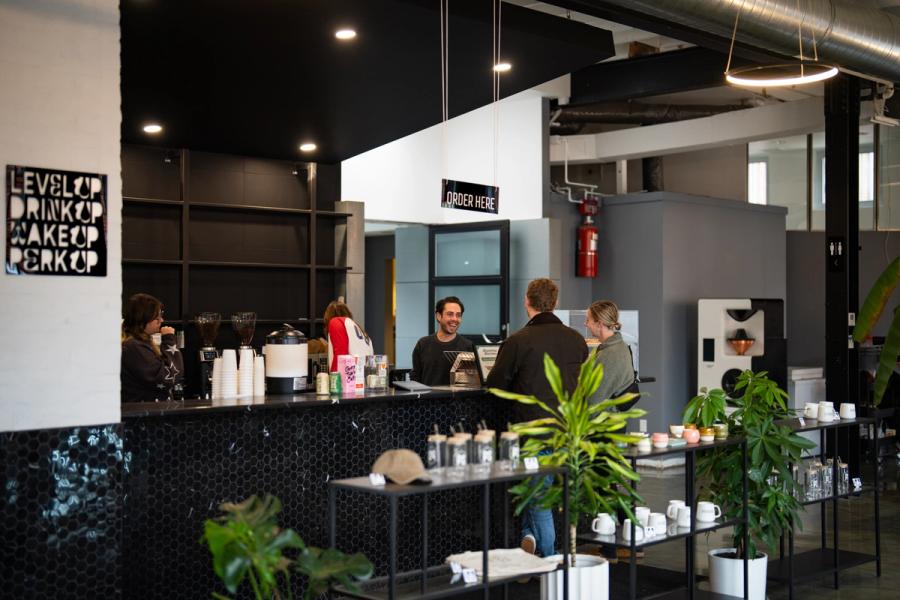
Ventless coffee roasters eliminate the need for exhaust hoods, ductwork, and rooftop penetrations by using internal filtration to neutralize smoke and emissions before air leaves the machine. That single technology shift — moving the afterburner inside the roaster — is what makes it possible to install a commercial coffee roaster in a shopping mall, an office building, a historic structure, or any space with standard 240V power. The Bellwether Shop Roaster is currently the only commercial ventless coffee roaster on the market, with 1.5 kg batch capacity and 200–240V electrical requirements.
This guide explains how the technology works, where you can install a ventless roaster, what it costs compared to traditional alternatives, and how to know if it's the right fit for your café.
How ventless roasting actually works
Traditional coffee roasters produce smoke, chaff, and volatile organic compounds (VOCs) during roasting, all of which have to vent outside through exhaust hoods and ductwork. Ventless roasters handle these byproducts internally — the smoke and VOCs are filtered out, and the chaff is collected and deposited in a removable container. The Bellwether Shop Roaster uses a multi-stage internal system to do this. Coffee roasts in a sealed chamber rather than an open drum exposed to room air. Smoke and VOCs pass through an integrated afterburner that neutralizes harmful compounds. Catalytic filtration removes remaining particulates. Filtered air releases into the room at safe, odor-reduced levels.
Ventless doesn't mean odorless. During roasting, you'll notice a mild coffee aroma similar to brewing — not the industrial roasting smell from a traditional drum — and no visible smoke or grease accumulation on surfaces. The scent is often compared to baked chocolate, and many café owners specifically choose customer-facing roaster placement because the gentle aroma adds to the atmosphere without overwhelming the space.
Where you can install a ventless roaster
Eliminating the exhaust requirement opens locations that are simply impossible for traditional roasters:
| Location type | Why it works |
|---|---|
| Shopping malls | No rooftop access needed, meets fire codes |
| Office building cafés | Standard electrical, no building modifications |
| Historic buildings | No structural changes required |
| Upper floor spaces | No exhaust routing through multiple floors |
| Shared commercial kitchens | No dedicated ventilation needed |
| Hotel restaurants | Quiet operation, no external exhaust |
| Airport terminals | Meets strict safety requirements |
| Food halls | Compact footprint, no hood system |
| Customer-facing retail | Enhances experience, no smoke |
On space, the Bellwether Shop Roaster has a compact footprint:
| Configuration | Width | Height | Depth | Weight |
|---|---|---|---|---|
| Roaster only | 24.6" (626mm) | 36.5" (925mm) | 28.2" (714mm) | 405 lbs |
| With autoloader & base | 24.6" (626mm) | 69.8" (1773mm) | 28.2" (714mm) | 527 lbs |
Minimum clearance is two inches on both sides for airflow and service access. The countertop roaster fits in roughly five square feet — the same footprint as a commercial espresso machine. That makes it feasible to place behind the bar, in a prep area, or prominently in customer view.
Ventless vs. traditional: the actual differences
Installation requirements:
| Requirement | Traditional gas | Ventless electric (Bellwether) |
|---|---|---|
| Gas line | Required | Not needed |
| Exhaust hood | Required | Not needed |
| Ductwork to exterior | Required | Not needed |
| Rooftop penetration | Required | Not needed |
| External afterburner | Often required | Internal (included) |
| Make-up air system | Often required | Not needed |
| Dedicated room | Often required | Not needed |
| Electrical circuit | 120V for controls | 200–240V, 30A dedicated |
Installation costs:
| Cost category | Traditional (1–3 kg) | Ventless (Bellwether) |
|---|---|---|
| Gas line | $5,000–$15,000 | $0 |
| Exhaust system | $5,000–$15,000 | $0 |
| Afterburner | $10,000–$30,000 | Included |
| Electrical | $500–$1,000 | $500–$2,000 |
| Construction / permits | $5,000–$20,000 | $200–$500 |
| Total installation | $25,500–$81,000 | $700–$2,500 |
The infrastructure savings often exceed the equipment cost difference, which makes ventless the more economical total investment for most café applications. Installation timeline tracks the same way — 1–2 weeks for ventless vs. 6–14 weeks for traditional, with most of the difference coming from gas work, exhaust installation, and the permitting process.
Your customers can taste the difference
Fresher coffee starts here
Coffee roasted this week vs. last month — your customers notice. The most profitable way to serve great coffee, with zero disruption.
Bellwether Shop Roaster specifications
Capacity and throughput:
| Specification | Standard roaster | With continuous upgrade |
|---|---|---|
| Batch capacity | 1.5 kg (3.3 lb) | 1.5 kg per batch |
| Roasts per hour | 3–4 | Up to 13 continuous |
| Labor per roast | 2 minutes per 1.5 kg | 5 minutes per 20 kg |
| Daily throughput (8 hr) | 36–48 kg | 80+ kg |
For most single-location cafés using 5–20 kg of roasted coffee daily, the standard configuration provides plenty of capacity with room for growth or a wholesale program.
Electrical:
| Specification | Requirement |
|---|---|
| Circuit | Single phase, 200–240 VAC |
| Amperage | 30 amp (5 kW) |
| Frequency | 50–60 Hz |
| Plug (US) | NEMA L6-30P (8 ft cable included) |
| Receptacle | NEMA L6-30R at wall |
Most commercial spaces have 240V service available, and a licensed electrician can install the dedicated circuit in 2–4 hours, typically costing $500–$2,000. The roaster itself is all-electric (no gas lines, no venting, no construction), ventless (the first and only commercial roaster designed this way), automatic (fully automated roasting, no experience required), and integrated with an internal afterburner, cloud-connected profiles, and the Bellwether Green Coffee Marketplace. CO2 from the roast cycle is reduced by 87%, harmful VOCs are eliminated, and the unit is UL 197, UL 710, and NSF4 Food Safety certified.
Is ventless roasting right for your café?
It's a strong fit if your location can't accommodate gas lines or exhaust systems, you're in a multi-tenant building, mall, or historic structure, you want customer-facing roasting as part of your brand experience, you don't have prior roasting experience (the operation is automated), you need to be roasting within weeks rather than months, your daily volume is under 50 kg, or you want to minimize upfront infrastructure investment.
Traditional may still be the better fit if you're an experienced roaster who prefers manual drum control, you have existing gas infrastructure and exhaust systems already in place, your volume consistently exceeds 80 kg per day, or you're primarily a wholesale operation with a dedicated roasting facility.
Four practical questions to answer before you commit: does your space have 240V power available (most commercial spaces do), can your floor or counter support 405+ lbs (standard commercial construction can), do you have five-plus square feet of space with two inches of clearance on each side, and is your daily coffee volume under 50 kg (Bellwether's standard capacity covers it). If yes to all four, ventless is likely a strong fit.
Total cost of ownership
Equipment investment runs in line with traditional small-batch roasters. The Shop Roaster includes the unit, a NEMA L6-30P power cable (8 ft), cloud platform access, initial training, and ongoing support. The optional continuous roasting upgrade — a 20 kg autoloader and base cabinet — is available for higher-volume operations.
Over three years, the cumulative cost picture looks like this:
| Category | Traditional gas (3 kg) | Ventless (Bellwether) |
|---|---|---|
| Equipment | $18,000–$30,000 | $25,000–$35,000 |
| Installation | $25,500–$81,000 | $700–$2,500 |
| Annual energy | $5,000–$7,000 | $1,000–$1,500 |
| Annual maintenance | $2,000–$5,000 | $200–$500 |
| 3-year total | $60,500–$140,000 | $29,100–$43,000 |
The lower installation and operating costs typically make ventless the more economical option over time, even when equipment pricing is comparable. Beyond the equipment economics, in-house roasting reduces coffee costs by 30–50% compared to buying pre-roasted. For a café spending $2,000–$5,000 a month on roasted coffee, that savings alone pays for the roaster within 12–24 months.
Ready to roast in-house?
Take control of your margins
Save $1,000–5,000/month on coffee costs. Your wholesaler takes 67% of the margin on every pound — it’s time to take it back.