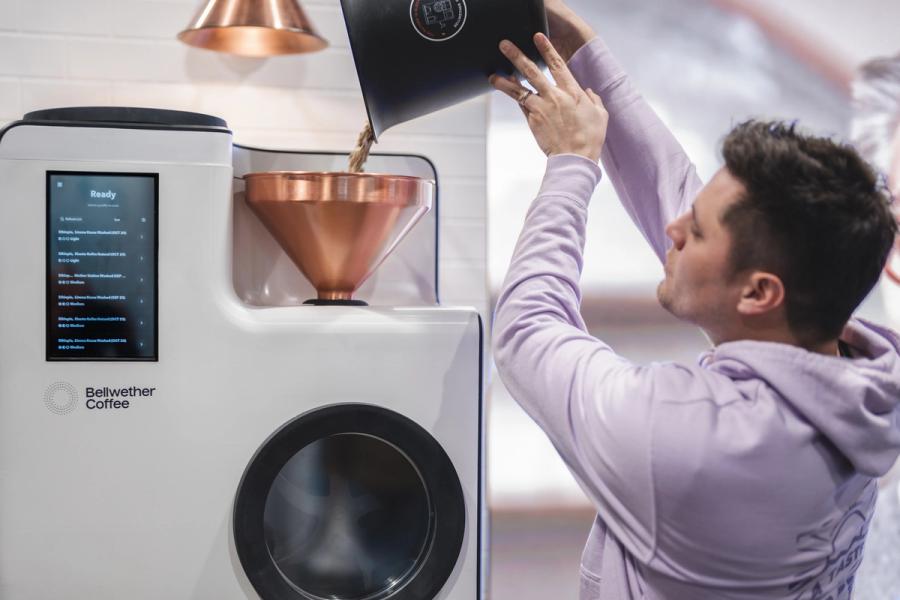
Electric and ventless coffee roasters are transforming how cafés approach in-house roasting. By eliminating the need for gas lines, exhaust hoods, and external afterburners, these roasters make it possible to roast fresh coffee in locations where traditional equipment simply cannot operate—shopping malls, office buildings, hotels, historic structures, and standard retail spaces.
The Bellwether Shop Roaster is currently the only commercial ventless coffee roaster available, featuring a 1.5 kg batch capacity, fully automated operation, and 200-240V electrical requirements. With installation costs of $700-$2,500 (compared to $25,000-$80,000+ for traditional roasters), electric ventless roasting has become accessible for café owners who want the benefits of fresh-roasted coffee without the infrastructure complexity.
This comprehensive guide covers everything you need to know about electric and ventless coffee roasting: how the technology works, equipment specifications, costs and ROI, installation requirements, and how to determine if in-house roasting is right for your business.
What Is Electric Ventless Coffee Roasting?
Electric ventless coffee roasting combines two innovations that together eliminate traditional roasting infrastructure requirements:
Electric heating replaces gas burners, removing the need for gas line installation and the associated permits, costs, and safety considerations.
Ventless operation uses internal afterburner and filtration systems to neutralize smoke and VOCs before air exits the machine, eliminating exhaust hoods, ductwork, and rooftop penetrations.
The result: a commercial coffee roaster you can plug in and start using immediately, in virtually any commercial space with standard electrical service.
How Ventless Technology Works
The Bellwether Shop Roaster uses a multi-stage internal system:
- Enclosed Roasting: Coffee roasts in a sealed chamber rather than an open drum
- Internal Afterburner: Integrated afterburner neutralizes smoke and VOCs
- Catalytic Filtration: Additional filtration removes remaining particulates
- Clean Output: Filtered air exits at safe, odor-reduced levels
- Chaff Collection: Internal collection system captures chaff for easy disposal
During operation, you'll notice mild coffee aroma (similar to brewing) but no smoke, no industrial smell, and no grease accumulation—making customer-facing placement both safe and desirable.
What Makes Electric Different from Gas
Traditional gas roasters use direct flame for heating, which requires:
- Gas line connection to the building
- Combustion exhaust ventilation
- External afterburner to meet air quality standards
- Often a dedicated roasting room
Electric roasters use heating elements for cleaner, more controlled heat application. Combined with ventless technology, this eliminates all infrastructure requirements except a standard 240V electrical circuit.
Benefits of Electric Ventless Roasting
1. Location Flexibility
Roast coffee in places traditional roasters can't go:
| Location | Why Traditional Can't | Why Ventless Can |
|---|---|---|
| Shopping malls | No rooftop exhaust access | No exhaust needed |
| Office buildings | No gas service, no exhaust routing | Electric only, ventless |
| Historic buildings | Can't modify structure | No modifications needed |
| Upper floors | Exhaust routing prohibitive | No exhaust to route |
| Multi-tenant spaces | Shared building limitations | Self-contained operation |
| Customer-facing retail | Smoke/heat/noise issues | Clean, quiet operation |
2. Dramatically Lower Installation Costs
| Cost Category | Traditional Gas | Electric Ventless |
|---|---|---|
| Gas line | $5,000-$15,000 | $0 |
| Exhaust system | $5,000-$15,000 | $0 |
| External afterburner | $10,000-$30,000 | Included internally |
| Make-up air | $2,000-$5,000 | $0 |
| Electrical work | $500-$1,000 | $500-$2,000 |
| Construction/permits | $5,000-$20,000 | $200-$500 |
| Total Installation | $27,500-$86,000 | $700-$2,500 |
The installation savings alone often cover a significant portion of equipment cost.
3. Faster Time to Roasting
| Phase | Traditional | Electric Ventless |
|---|---|---|
| Permits & design | 2-8 weeks | 1-2 weeks |
| Gas installation | 1-2 weeks | N/A |
| Exhaust construction | 1-2 weeks | N/A |
| Equipment setup | 1-2 days | Same day |
| Total | 6-14 weeks | 1-2 weeks |
4. Simplified Operation
Electric ventless roasters like Bellwether are designed for automated operation:
- No roasting experience required: Cloud-connected profiles handle temperature and timing
- 2 minutes of labor per roast: Load beans, select profile, press start
- Consistent results: Same profile produces identical results every time
- Multi-location consistency: Profiles sync across all your roasters
5. Lower Operating Costs
| Operating Cost | Traditional Gas | Electric Ventless |
|---|---|---|
| Energy (annual) | $5,000-$7,000 | $1,000-$1,500 |
| Maintenance (annual) | $2,000-$5,000 | $200-$500 |
| Exhaust cleaning | $500-$1,500/year | $0 |
| Afterburner service | $500-$2,000/year | Included |
6. Environmental Advantages
- Reduces CO2 from roast cycle by 87% compared to traditional gas roasters
- Eliminates harmful VOCs through internal afterburner
- No direct combustion emissions (all-electric operation)
- Quieter operation than traditional drum roasters
Bellwether Shop Roaster: Complete Specifications
The Bellwether is currently the only commercial ventless coffee roaster available. Here are the complete technical specifications:
Capacity & Production
| Specification | Countertop Roaster | With Continuous Upgrade |
|---|---|---|
| Batch capacity | 1.5 kg (3.3 lb) | 1.5 kg per batch |
| Roasts per hour | 3-4 | Up to 13 continuous |
| Labor per roast | 2 minutes | 5 minutes per 20 kg |
| Daily throughput | 36-48 kg (8 hr) | 80+ kg (8 hr) |
For context: Most single-location cafés use 5-20 kg of roasted coffee daily. The standard roaster provides 2-4x that capacity, leaving room for growth, wholesale accounts, or retail bag sales.
Physical Dimensions
| Configuration | Width | Height | Depth | Weight |
|---|---|---|---|---|
| Roaster | 626mm (24.6") | 925mm (36.5") | 714mm (28.2") | 183.7kg (405 lb) |
| Autoloader | 626mm (24.6") | 390mm (15.4") | 608mm (24") | 21.4kg (47 lb) |
| Base cabinet | 626mm (24.6") | 460mm (18.1") | 640mm (25.2") | 34kg (75 lb) |
| Full config | 626mm (24.6") | 1773mm (69.8") | 714mm (28.2") | 239kg (527 lb) |
Clearance: Minimum 2 inches (50mm) on both sides for airflow and service access.
Electrical Requirements
| Specification | Requirement |
|---|---|
| Circuit | Single phase, 200-240 VAC |
| Amperage | 30 amp (5 kW) |
| Frequency | 50-60 Hz |
| US plug | NEMA L6-30P (8 ft / 2.4m cable included) |
| US receptacle | NEMA L6-30R required at wall |
| International | 2.4m pigtail; consult local electrician |
Most commercial spaces have 240V service available. Installation typically takes 2-4 hours and costs $500-$2,000.
Key Features
- All-Electric: No gas lines, venting, or construction—plug in and roast from day one
- Ventless: First and only commercial roaster designed for ventless use
- Automatic: Fully automated operation with cloud-connected profiles
- Integrated: Internal afterburner, web app management, green coffee marketplace
- Sustainable: 87% reduction in CO2 from roast cycle, eliminates harmful VOCs
Certifications
- UL 197 (Commercial electric coffee-making equipment)
- UL 710 (Exhaust hoods for commercial cooking equipment)
- NSF4 (Food safety)
Maintenance Requirements
| Task | Frequency |
|---|---|
| Empty chaff container | After each roast session |
| Empty water reservoir | As prompted |
| Clean prefilter | As prompted |
No gas systems, exhaust hoods, or external afterburners to service—significantly reduced maintenance compared to traditional roasters.
Who Should Consider Electric Ventless Roasting?
Ideal Candidates
New café owners opening their first location who want to differentiate with fresh-roasted coffee without the complexity of traditional roasting infrastructure.
Existing cafés looking to reduce coffee costs (30-50% savings), create unique customer experiences, or differentiate from competitors.
Multi-location operators who need consistent quality across locations—cloud-synced profiles ensure identical roasts everywhere.
Non-traditional locations including hotels, office buildings, hospitals, airports, and retail spaces where gas lines or exhaust systems aren't feasible.
Owners without roasting experience who want automated, consistent results without months of training.
When Traditional May Be Better
High-volume wholesale operations consistently roasting 100+ kg daily may need larger-batch traditional equipment.
Experienced roasters who prefer manual drum control and the craft aspects of traditional roasting.
Existing infrastructure situations where gas lines and exhaust systems are already in place and paid for.
Quick Decision Framework
| Your Situation | Recommendation |
|---|---|
| New café, no infrastructure | Electric ventless |
| Location can't accommodate gas/exhaust | Electric ventless |
| Volume under 50 kg/day | Electric ventless |
| No roasting experience | Electric ventless |
| Multi-location consistency priority | Electric ventless |
| Volume over 100 kg/day | Consider traditional |
| Existing gas/exhaust infrastructure | Either (evaluate costs) |
| Experienced roaster wanting manual control | Traditional |
Your customers can taste the difference
Fresher coffee starts here
Coffee roasted this week vs. last month — your customers notice. Discover the most profitable way to serve great coffee.
Costs and ROI of Electric Ventless Roasting
Equipment Investment
The Shop Roaster is $14,900, or $19,900 bundled with the Continuous Roasting Kit. Equipment includes:
- Roaster unit with 8 ft power cable
- Cloud platform access
- Initial training
- Ongoing support
- Optional: Continuous roasting upgrade (20 kg autoloader + base cabinet)
Total Cost of Ownership: 3-Year Comparison
| Cost Category | Traditional Gas (3 kg) | Electric Ventless |
|---|---|---|
| Equipment | $18,000-$30,000 | $14,900-$19,900 |
| Installation | $27,500-$86,000 | $700-$2,500 |
| Year 1 energy | $5,000-$7,000 | $1,000-$1,500 |
| Year 1 maintenance | $2,000-$5,000 | $200-$500 |
| Years 2-3 energy | $10,000-$14,000 | $2,000-$3,000 |
| Years 2-3 maintenance | $4,000-$10,000 | $400-$1,000 |
| 3-Year Total | $66,500-$152,000 | $19,200-$28,400 |
ROI from Coffee Cost Savings
The bigger financial benefit often comes from reduced coffee costs:
| Metric | Buying Pre-Roasted | Roasting In-House |
|---|---|---|
| Green coffee cost | N/A | $4-$8/lb |
| Roasted coffee cost | $10-$20/lb | $5-$10/lb (after roast loss) |
| Savings | — | 30-50% |
Example calculation:
- Café uses 500 lbs roasted coffee/month
- Current cost at $14/lb = $7,000/month
- In-house cost at $8/lb = $4,000/month
- Monthly savings = $3,000
- Annual savings = $36,000
- Equipment payback = about 5 months
Additional Revenue Opportunities
In-house roasting enables:
- Retail bag sales: Sell your fresh-roasted coffee to take home
- Wholesale accounts: Supply other businesses with your roasted coffee
- Subscription programs: Recurring revenue from home customers
- Premium pricing: Fresh-roasted commands higher prices
- Private label: Roast for other brands
Installation Process
Timeline: Electric Ventless
Week 1: Planning
- Confirm 240V availability and panel capacity
- Select placement location
- Verify floor/counter load capacity (405+ lbs)
- Schedule electrician
Week 2: Installation
- Electrician installs NEMA L6-30R receptacle (2-4 hours)
- Roaster delivered and positioned
- Connect power and internet
- Calibration and test roast
- Staff training
Ongoing
- Set up green coffee ordering through platform
- Develop or select roast profiles
- Begin production roasting
Site Requirements Checklist
- 240V single-phase power available
- 30A capacity on electrical panel
- Location for NEMA L6-30R receptacle within 8 ft of roaster position
- 5+ square feet floor/counter space
- 2" clearance on both sides
- 405+ lb load capacity (527 lbs for full configuration)
- Internet connection (Ethernet or WiFi)
- Standard HVAC (no special ventilation needed)
Getting Started with Electric Ventless Roasting
Step 1: Assess Your Situation
Consider:
- Current coffee costs and volume
- Available space and electrical infrastructure
- Location limitations (can you add gas/exhaust?)
- Roasting experience (or lack thereof)
- Business goals (differentiation, cost savings, experience)
Step 2: Contact Bellwether
Request:
- Current pricing and financing options
- Site assessment support
- ROI calculation for your specific volume
- References from similar operations
Step 3: Prepare Your Site
Typically requires only:
- Electrician to install dedicated circuit ($500-$2,000)
- Space preparation (clearing, positioning)
- Internet connectivity verification
Step 4: Launch
Once equipment arrives:
- Setup and calibration (same day)
- Staff training (2-4 hours)
- Begin roasting immediately
Related Resources
Equipment & Specifications
- Bellwether Roaster Specifications: Power, Space & Capacity Guide
- Electric vs Gas Coffee Roasters: Complete Comparison
Installation & Setup
- Ventless Coffee Roasters: Complete Guide
- Indoor Coffee Roasting: How to Roast Inside Your Café
Business Planning
- How Much Does It Cost to Start a Coffee Shop?
- Coffee Shop Equipment List & Startup Essentials
- Automated Coffee Roasting Systems Explained
Ready to roast in-house?
Take control of your margins
Save up to 50% on coffee costs with in-house roasting. Talk to our team about what Bellwether can do for your business.