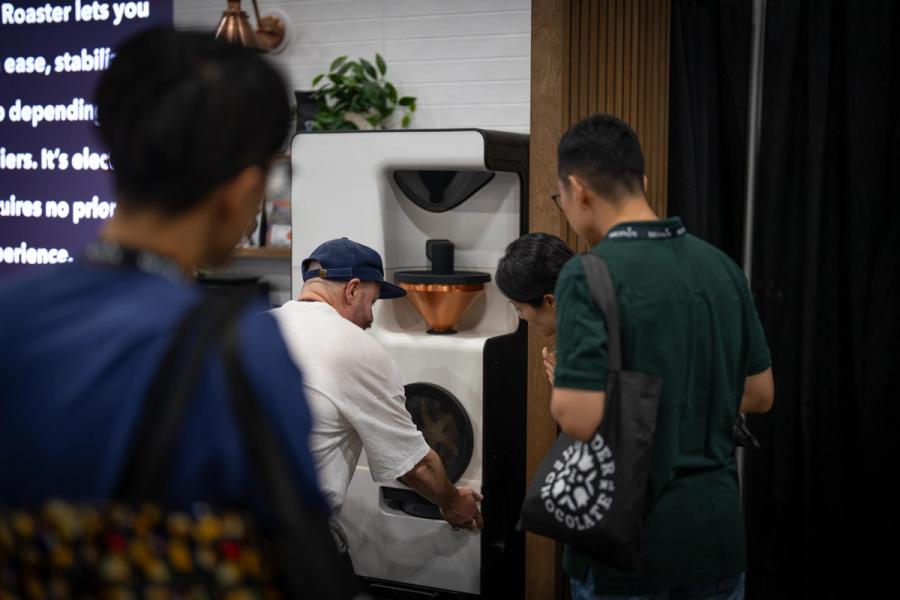
Automated coffee roasting systems handle temperature control, timing, and roast profile execution without requiring an operator to constantly adjust the machine. Instead of standing over a drum and managing heat throughout the roast, you load green coffee, select a profile, and press start. The machine takes it from there. For café owners without professional roasting experience, this is the difference between in-house roasting being aspirational and being practical — systems like the Bellwether Shop Roaster need just two minutes of operator labor per 1.5 kg batch.
This guide covers how automated roasting actually works, how it compares to traditional manual roasting, and how to decide whether automated equipment is the right fit for your café.
How automated coffee roasting works
In a traditional manual setup, the operator loads green coffee, manually controls heat throughout the roast, adjusts airflow based on visual and auditory cues (color shifts, the first crack of the beans, smoke), monitors temperature curves in real time, decides when to end the roast, and develops the proficiency to do all of this consistently over 6–12 months of training.
Automated roasting reduces that workflow to four operator steps: load the green coffee, select a roast profile (either a pre-built one or a custom one you've saved), press start, and collect the roasted coffee when the cycle ends. Everything in between — heat application, airflow, timing, the moment the roast ends — happens automatically. Training drops from months to hours.
Automation isn't binary; it exists on a spectrum:
| Level | Description | User control | Examples |
|---|---|---|---|
| Manual | All parameters controlled by operator | Complete | Traditional drum roasters |
| Semi-automatic | Profile guides but operator can override | Significant | Most mid-range drum roasters |
| Profile-automatic | System executes profiles, minimal intervention | Limited | Aillio Bullet, some production roasters |
| Fully automatic | Complete hands-off operation | Select profile only | Bellwether Shop Roaster |
The rest of this guide focuses on fully automatic systems built specifically for café-scale operations.
The Bellwether automated system
The Bellwether Shop Roaster is currently the most fully automated commercial coffee roaster on the market, designed specifically for café-scale production. The platform includes hundreds of roast profiles developed by professional roasters — each one defining temperature curves throughout the roast, timing for each phase, endpoint parameters, and the specific coffee origin and processing method it was designed for. You can use pre-built profiles immediately or develop and save your own.
During a roast, the system preheats to the specified temperature, the operator loads up to 1.5 kg of green coffee and presses start, the system controls heat application and airflow continuously, monitors internal sensors throughout, ends the roast at the profile's defined parameters, initiates the cooling cycle, and discharges roasted coffee into the collection tray. The only operator tasks are loading green coffee, selecting a profile, pressing start, and collecting the result — about two minutes of work per batch.
Bellwether's specifications:
| Specification | Value |
|---|---|
| Batch capacity | 1.5 kg (3.3 lb) |
| Roasts per hour | 3–4 |
| Labor per roast | 2 minutes |
| Daily throughput (8-hour day) | 36–48 kg |
| With autoloader | 80+ kg/day, up to 13 continuous roasts |
| Dimensions | 24.6" W × 36.5" H × 28.2" D |
| Weight | 405 lbs (roaster) |
| Electrical | 200–240V, 30A, single phase |
| Ventilation | None required (internal afterburner) |
The cloud platform layered on top of the hardware is what makes the system genuinely turnkey: a profile library organized by origin and process, custom profile creation and saving, multi-location sync (the same profiles across all your roasters), remote monitoring of roast status, inventory tracking for green coffee usage and roasted output, quality analytics on every roast, and integrated ordering through the Bellwether Green Coffee Marketplace where every coffee comes with a matched roast profile.
Your customers can taste the difference
Fresher coffee starts here
Coffee roasted this week vs. last month — your customers notice. Discover the most profitable way to serve great coffee.
Why automated roasting changes the café math
There are five economic reasons automated roasting is showing up in cafés that previously couldn't justify the investment.
First, no roasting experience is required. Traditional roasting needs 6–12 months of training to develop proficiency. With automated systems, you produce quality roasted coffee from day one:
| Learning curve | Manual roasting | Automated roasting |
|---|---|---|
| Basic operation | 1–2 weeks | 2–4 hours |
| Consistent results | 3–6 months | Day 1 |
| Profile development | 6–12 months | Use library |
| Troubleshooting | Ongoing | System-guided |
Second, consistency. Automation eliminates human variability — the same profile produces identical results every batch, with no operator-to-operator drift, no quality decay over time, and identical product across multiple locations.
Third, labor cost. The math:
| Comparison | Manual (per batch) | Automated (per batch) |
|---|---|---|
| Active roasting time | 12–15 minutes | 2 minutes |
| Monitoring time | 10–12 minutes | 0 minutes |
| Total labor | 22–27 minutes | 2 minutes |
For a café doing 10 roasts a day, that's roughly 3.5 hours of labor saved every day. Over a month, that's a whole part-time position back on the schedule.
Fourth, simplified operations. Automated roasting fits into a café workflow — you load and start between rushes, you don't need dedicated roasting staff, the system doesn't require constant monitoring, and any trained employee can run it. Roasting becomes a feature of your operation rather than a separate job.
Fifth, the barrier to in-house roasting drops dramatically. Traditional roasting requires an experienced roaster (salary $44,000–$71,000/year per Glassdoor 2026) or extensive training, gas infrastructure ($5,000–$15,000), exhaust systems ($5,000–$15,000), an external afterburner ($10,000–$30,000), and a dedicated roasting area. Automated ventless roasting requires any café employee with minimal training, a 240V electrical circuit ($500–$2,000 to install), about five square feet of space, and standard HVAC. The total infrastructure cost gap between the two approaches is often larger than the equipment cost itself.
Manual vs. automated: the honest trade-off
Manual roasting has a higher ceiling with a master roaster at the controls. The expert can make real-time adjustments based on weather, bean variability, and personal taste — the kind of nuanced control that produces show-stopping single batches. Automated roasting has a much higher floor: consistent baseline quality every batch, exact replication every time, no risk of a distracted operator ruining 1.5 kg of coffee.
For café-scale operations where consistency matters more than artisanal experimentation, automated typically produces better business outcomes. The cost picture lines up the same way:
| Factor | Manual (traditional) | Automated (Bellwether) |
|---|---|---|
| Equipment | $15,000–$30,000 | $14,900–$19,900 |
| Infrastructure | $20,000–$80,000 | $500–$2,000 |
| Training costs | $5,000–$15,000 | Minimal |
| Dedicated staff | Often required | Not required |
| Maintenance | $2,000–$5,000/year | $200–$500/year |
Who should choose automated roasting
Automated roasting is a strong fit for café owners without roasting experience who want in-house roasting benefits without the learning curve, multi-location operators who need identical quality across all sites without training roasters at each one, operations prioritizing consistency where every customer should get the same product every time, lean staffing models where you can't dedicate someone to roasting, spaces that can't accommodate traditional equipment (no gas, no exhaust capability), and owners who want roasting as a feature of their café rather than as their primary job.
Manual is still the better fit if you're an experienced roaster who values hands-on craft and real-time adjustment, if roasting is the business (you're opening primarily as a roastery, not a café), if you want maximum creative control and have time to invest in mastering the craft, if you already have gas infrastructure and exhaust systems paid for and permitted, or if your volume exceeds 80 kg/day consistently — at that scale, larger-batch equipment may be more efficient.
Getting started
Before evaluating equipment, take stock of your situation: current coffee costs and volume, space and infrastructure availability, staff bandwidth for roasting, your own roasting experience (or lack of it), and how important consistency is to your operation. For café-scale automated roasting, the Bellwether Shop Roaster is currently the primary option offering fully automated operation, ventless capability (no exhaust required), cloud-connected profiles, and 1.5 kg batch capacity at standard 200–240V power.
Installation is straightforward: a dedicated 240V, 30A circuit ($500–$2,000 to install), about five square feet of floor or counter space, structural capacity for 405 lbs, an internet connection, and 2–4 hours for setup and training. From there, you select profiles from the library or develop your own, integrate roasting into your café workflow, train relevant staff on operation, and begin regular production.
Ready to roast in-house?
Take control of your margins
Save up to 50% on coffee costs with in-house roasting. Talk to our team about what Bellwether can do for your business.