Foodtech — the intersection of food, beverage, and technology — is reshaping how the industry produces, prepares, serves, and sells food. From farm to table, technology companies are addressing the long-standing operational pain points that have shaped the business for decades: labor efficiency, sustainability, food safety, and customer experience. The global foodtech market exceeds $250 billion and continues to grow as the industry adopts solutions to challenges that haven't moved much in twenty years.
This guide highlights the most impactful foodtech companies across the categories that matter most for coffee businesses, cafés, and restaurants — including the technology that's making in-house coffee roasting possible at café scale for the first time.
What foodtech actually covers
Foodtech spans the full lifecycle of food: production (how food and beverages are grown, raised, or manufactured), processing (how raw materials become finished products), preparation (how food is cooked, assembled, or served), distribution (how food moves from producer to consumer), and consumption (how customers order, receive, and experience food). The companies that matter for café and restaurant operators sit somewhere on that spectrum.
Coffee and beverage technology
Bellwether Coffee
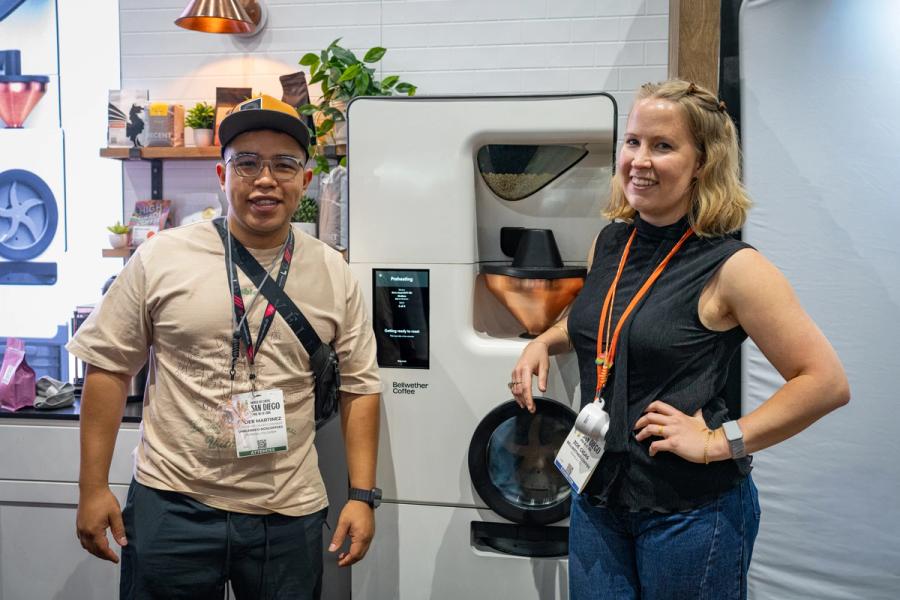
Bellwether builds ventless electric coffee roasting systems for cafés and small roasteries. Traditional coffee roasting requires expensive infrastructure — gas lines, exhaust systems, external afterburners, and a stack of permits that can easily run $30,000–$80,000 just to get a roaster operational. Bellwether's technology eliminates all of that. The roaster runs on a 240V outlet, uses an internal catalytic afterburner instead of an external one, and reduces CO2 output by 87% versus traditional roasting. Cloud-connected profiles let any trained café employee execute professional-grade roasts in two minutes of operator labor per 1.5 kg batch.
The 1.5 kg batch capacity, 3–4 roasts per hour throughput, 24.6" × 36.5" × 28.2" footprint, and 200–240V/30A/5kW electrical requirements make in-house roasting accessible to cafés that couldn't realistically consider it before due to space, cost, or infrastructure constraints. That accessibility is the company's actual contribution to the industry.
Other coffee technology worth knowing
Cropster builds roast profiling and production management software widely used by traditional roasters for quality control and inventory tracking. Perfect Daily Grind operates as a digital media and education platform — industry news, training resources, and the connective tissue for coffee professionals globally. Tastify uses AI to match consumers to coffees based on flavor preferences, working on the consumer-discovery side of the industry.
Restaurant technology
Toast
Toast is the dominant restaurant point-of-sale and management platform built specifically for restaurants rather than adapted from generic retail software. The unified system covers payments, ordering, inventory, staffing, and reporting, and integrates kitchen display systems, online ordering, payroll, and analytics. Toast is the easiest pick for operators who want everything in one stack.
Square for Restaurants
Square's restaurant-focused offering is the accessible entry point for small restaurants and cafés. Hardware is easy to set up, software pricing is approachable, and the platform grows with the business. Inventory, employee management, and basic marketing tools are included; processing fees are simple.
MarketMan
MarketMan handles restaurant inventory and purchasing — automated tracking, purchase order management, recipe costing, waste tracking, and supplier management. Food costs are one of the largest expenses in food service, and the operators who track them precisely outperform the operators who don't.
Delivery and logistics
DoorDash has become essential infrastructure for many restaurants, with significant U.S. market share. For operators, third-party delivery means expanded reach without delivery staff, marketing exposure to new customers, integrated ordering, and data on delivery performance — at the cost of platform fees that can be substantial. Olo provides digital ordering infrastructure for restaurant brands that want to manage their own direct ordering across channels while still integrating with delivery partners. Starship Technologies operates autonomous delivery robots that navigate sidewalks on college campuses and in select cities, addressing last-mile delivery costs at the experimental edge of the category.
Kitchen automation
Miso Robotics' Flippy automates repetitive cooking tasks like frying and grill management — an answer to the labor challenges that have shaped food service for the last decade. Picnic builds automated pizza assembly systems, addressing the high-volume, labor-intensive nature of pizza production. Chowbotics (now part of DoorDash) handles automated salad and bowl assembly: robots that build made-to-order fresh food 24/7.
Your customers can taste the difference
Fresher coffee starts here
Coffee roasted this week vs. last month — your customers notice. Discover the most profitable way to serve great coffee.
Sustainable food technology
Impossible Foods and Beyond Meat (BYND) are the two highest-visibility plant-based meat companies, both with widespread distribution across restaurants and grocery. The category has matured from novelty to standard menu option in many segments. Apeel Sciences extends produce shelf life with a plant-based coating, addressing food waste — one of the largest sustainability problems in the supply chain. Bowery Farming builds vertical indoor farms that produce leafy greens with 95% less water than traditional farming, year-round, close to population centers.
Food safety technology
Therma provides IoT temperature monitoring for food storage — sensors that automate the constant temperature monitoring that food safety actually requires, with alerts that reduce both spoilage and compliance risk. FoodLogiQ handles supply chain traceability for food safety and recall management, increasingly important as regulations tighten. PathSpot uses sensors to verify hand hygiene, automating one of the most critical and most often skipped food safety touchpoints.
The trends shaping where foodtech goes next
Five forces are driving where the category invests. Labor efficiency is the biggest — the restaurant industry's persistent labor challenges are pulling investment toward automation of repetitive tasks, self-service ordering, simplified operations through integration, and equipment that requires less skill to operate (Bellwether's two-minute labor per roast is one example). Sustainability concerns are driving energy-efficient equipment, waste reduction systems, sustainable sourcing tools, and alternative proteins. Data and personalization let connected systems track customer preferences, generate personalized recommendations, manage inventory predictively, and optimize pricing dynamically. Ghost kitchens and virtual brands enable delivery-only facilities running multiple brands from one kitchen with lower overhead and tech-native operations. And vertical integration is producing companies that ship hardware, software, and services together as complete operational systems.
How to evaluate foodtech for your business
The same questions apply across categories. About the problem: what specific problem does this solve, how significant is that problem for your business, and what's your current cost or pain from it? About the solution: does it actually solve the problem, what's the learning curve, what's the total cost (purchase, implementation, ongoing), and what's the realistic ROI timeline? About the company: how established are they, who else uses their product, what's their support model, and what's their roadmap?
Red flags worth taking seriously: solutions looking for problems, unclear ROI or vague benefits, complicated implementation with murky timelines, companies without food industry experience, and technology that creates new dependencies. Green flags: a clear measurable problem being solved, testimonials from businesses like yours, reasonable implementation timelines, support and training included, and technology that reduces complexity rather than adding to it.
Where foodtech goes from here
Three categories are getting most of the next wave of investment. AI and machine learning will drive predictive demand forecasting, automated menu optimization, computer vision for quality control, and personalized nutrition. Robotics will continue to expand into food preparation, delivery, and collaborative human-robot workflows. Sustainability tech will mature around carbon tracking and reduction, circular economy solutions, alternative protein expansion, and waste-to-value systems.
The most impactful foodtech in the next five years will be the technology that solves real operational problems (not just creates impressive demos), works within existing workflows (not requires complete overhaul), provides clear measurable ROI, supports rather than replaces human workers, and addresses sustainability genuinely rather than as marketing language.
Ready to roast in-house?
Take control of your margins
Save up to 50% on coffee costs with in-house roasting. Talk to our team about what Bellwether can do for your business.