Coffee is one of the biggest costs in every cup you serve. When you buy roasted beans wholesale, the roaster keeps the largest share of the margin — and you keep paying it, week after week. At some point most café owners start asking the same question: what would it take to roast our own?
That question usually leads to a confusing search. Traditional roasters need gas lines, exhaust hoods, permits, and a trained operator. The price tags swing wildly. This guide breaks down what a commercial coffee roaster actually is, the main types, what to look for, and what it really costs — so you can decide what fits your space, your volume, and your budget.
What a commercial coffee roaster actually is
A commercial coffee roaster takes raw green coffee beans and roasts them in batches for a business — a café, a roastery, a wholesale operation — rather than for home use. The output is measured in pounds per day, and the machine is built to run on a schedule, day after day.
The reason to own one comes down to math. Roasters take roughly 67% of the gross margin in every pound of coffee. When you buy roasted beans, that margin walks out the door. When you roast in-house, you capture it. A 24 lb bag of green coffee runs about $140 — roughly $5.83/lb — versus two 5 lb bags of roasted wholesale at about $75 each (around $15/lb), more than double per pound. Multiply that across your weekly volume and the savings add up fast.
As Liam at High Grade Coffee in London put it: "Every coffee shop should eventually become its own roaster. It's the best way to control your margins. The coffee is one of the biggest costs in your cup."
The three main types
Not all commercial roasters work the same way. The biggest practical differences come down to fuel, ventilation, and how much hands-on labor each one demands.
Gas drum roasters. The traditional choice. A gas flame heats a rotating drum. They produce excellent coffee in skilled hands, but they require a gas line, an exhaust hood, ductwork, and often a rooftop penetration. Operation is manual — someone watches the roast the whole way through. Machines like Typhoon (~$29,500+, fluid bed, gas + venting) and Mill City (~$8,000–$50,000+, gas drum, full buildout and manual operation) fall here. Budget for the buildout, not just the machine.
Electric drum roasters. These swap the gas flame for electric heating elements, which removes the gas line. Most still require exhaust venting, and many are only semi-automated. Stronghold (~$42,000+) is electric but still needs exhaust venting and doesn't come with green coffee sourcing or a support team.
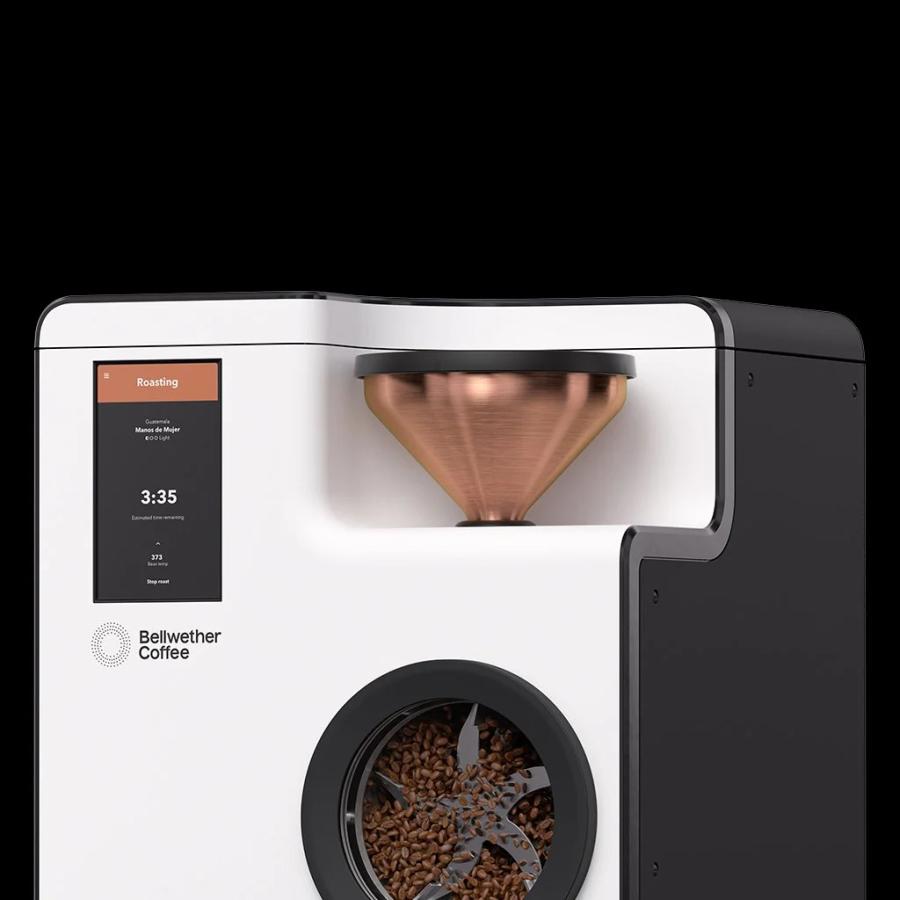
Electric, ventless, automatic roasters. This is the newest category, and as of now the Bellwether Shop Roaster is the only commercial machine that is electric, ventless, and fully automatic at once. It plugs into a standard 220V / 30-amp single-phase outlet — the same kind of circuit your espresso machine uses. An internal afterburner neutralizes smoke and VOCs, so there's no gas, no venting, and no construction. It earned SCA Best New Product 2024.
What to look for before you buy
The spec sheet matters less than how the machine fits your actual operation. A few questions cut through most of the noise:
- What does installation really cost? Gas and venting can add thousands in buildout before you roast a single pound. A roaster that plugs into an existing outlet can run on day one.
- How much labor per roast? Manual roasting ties up a person for the whole cycle. Automated roasting frees that person to make drinks and serve customers.
- Can your staff run it? If only one trained person can operate the roaster, you have a single point of failure.
- Is it certified? Look for proper safety and food-safety certifications. The Bellwether carries UL 197, UL 710, NSF4, and CE.
- Does it come with support? Green coffee sourcing, roast profiles, and a coffee team turn a machine into a working program.
Jorge at Hey My Coffee in Madrid felt the labor difference immediately: "With our previous machine, someone had to be physically present throughout the entire roasting process, but with Bellwether you only need time to prepare and handle the roasted coffee afterward, saving us a lot in labor costs."
400 lbs/week. Zero construction.
See the Shop Roaster
Plugs into a standard 240V outlet. 528 lbs/hr labor efficiency with continuous roasting. No gas burners to service, no exhaust system to clean. Built for businesses that need it to just work.
Capacity: matching the machine to your volume
Buy for the volume you have plus a little room to grow — not for a fantasy. The Bellwether roasts 1.5 kg (3.3 lb) per batch on demand. In a standard 8-hour day that's 15–20 kg (33–44 lb), which covers most single-location cafés with room to spare. Add the Continuous Roasting upgrade and autoloader and you're at 80+ kg (176+ lb) per day for wholesale or multi-location work.
Tiffany at Tiabi Coffee & Waffle in Las Vegas described scaling up: "The continuous roasting is a game changer. We can literally just load it, and it just goes." And the ceiling is higher than most people expect — Donovan at Anchor and Tree Coffee in Sacramento said, "I am doing between 3,000 and 4,000 pounds a month as a wholesale coffee roaster, and I still have extra time to roast."
What it costs — and what it saves
Sticker price is only half the story. The other half is what you stop paying your wholesaler.
| Shop Roaster (US) | $14,900 |
|---|---|
| Shop Roaster + Continuous Roasting Kit | $19,900 |
| UK | £11,900 |
| EU | €13,900 |
Most operators save up to 50% on coffee costs — roughly $1,000–$5,000/month — and reach payback in as little as 6 months. You break even at about 25 lb/week. The savings are real and specific. Doug at 1951 Coffee in Berkeley said, "We were paying anywhere from $9 to $11 per pound for roasted coffee. Now, we're paying closer to $4 or $5 per pound."
Tony at Function Coffee Co. saw it land on the bottom line: "At the end of the year, we're able to actually see profit that we would not have been able to unlock had we gone with the third party wholesale vendor." And Peter at Wellborn Coffee in Port Chester was blunt about the old math: "We cut a lot out. At $20 a pound from our previous roaster, we'd lose money on every pound."
Does automated coffee taste as good?
It's a fair worry — that a push-button roaster trades quality for convenience. The answer comes from one of the most respected names in specialty coffee. Tom Flay of Square Mile Coffee Roasters in London ran a blind tasting: "We put our Bellwether roast on as well as production roast from our Probat machines. About 20-25 of our team were tasting. And no one could pick the production roast from the Bellwether roast. Most of them were the Bellwether roast as their favourite."
You design the profile. The machine executes it consistently, batch after batch — averaging 2,000 roasts before failure — so the quality you dial in is the quality you serve.
Ready to roast in-house?
Take control of your margins
Save $1,000–5,000/month on coffee costs. Your wholesaler takes 67% of the margin on every pound — it’s time to take it back.