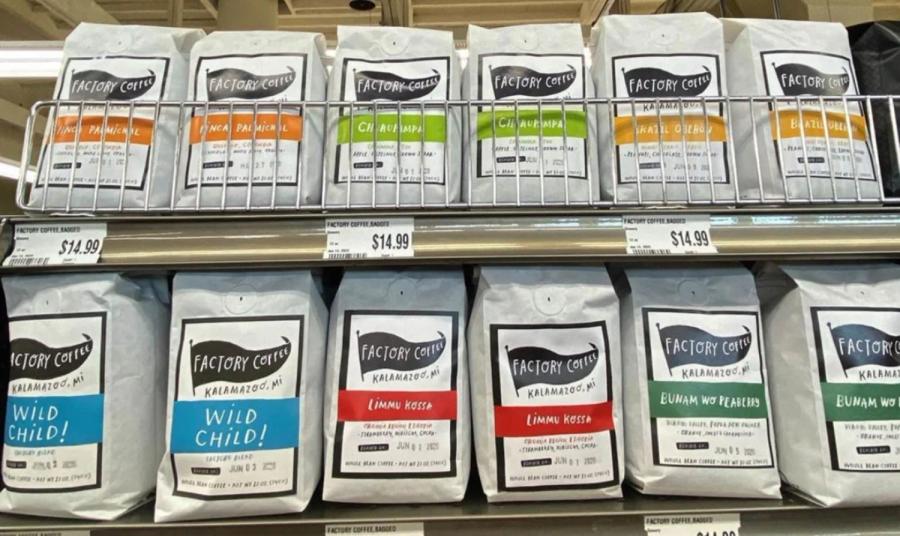
You already know how to run a coffee business. You're buying roasted beans at $10 to $20 a pound, marking them up, and watching most of the margin walk out the door before it ever reaches your register. The question isn't whether you can sell coffee — it's whether the plan you're operating on is actually the most profitable one available to you.
Most wholesale coffee business plans get written backward. They start with revenue projections and work down to costs, when the real leverage lives in the cost line itself. This guide walks through a plan built around the one number that changes everything: who captures the roaster's share of the margin. If you're an established café or roaster evaluating in-house roasting, this is the math that decides whether you keep renting your coffee or start owning it.
Start With the Margin Problem, Not the Revenue Goal
Here's the uncomfortable part of the existing plan: in every pound of coffee, the roaster takes roughly 67% of the gross margin. You're paying for that whether you notice it or not. A 24 lb bag of green coffee runs about $140 — roughly $5.83 a pound. Buy that same coffee roasted and you're paying around $15 a pound (about $75 for a 5 lb bag), more than double per pound, and the difference is almost entirely the roaster's cut.
Operators who moved that line in-house describe the shift in plain terms. Doug at 1951 Coffee put it this way: "We were paying anywhere from $9 to $11 per pound for roasted coffee. Now, we're paying closer to $4 or $5 per pound." Peter at Wellborn Coffee was blunter about what the old arrangement was doing to him: "We cut a lot out. At $20 a pound from our previous roaster, we'd lose money on every pound."
A good wholesale coffee business plan names this gap on page one. Your savings target isn't a vague "reduce COGS" — it's $1,000 to $5,000 a month, or up to 50% off your coffee costs, depending on volume. That's the number lenders, partners, and your own gut want to see.
Model the Economics Honestly
Build the plan around three figures: your current per-pound roasted cost, your projected green cost, and your weekly volume. Then layer in the equipment.
- Break-even on roasting your own lands around 25 lb/week — most established cafés clear that before lunch on a busy day.
- Payback on the equipment can come in as little as 6 months.
- Savings of 40–50% on coffee costs is the realistic band for most operators at scale.
Tony at Function Coffee Co. described both halves of the equation. On the margin: "Roasting in-house with the Bellwether has really unlocked a lot of margin for us because we're saving 40, 50% on what we would have otherwise spent, had we gone with third party beans for our cafe." And on what it does to the bottom line at year's end: "At the end of the year, we're able to actually see profit that we would not have been able to unlock had we gone with the third party wholesale vendor."
That last line is what a wholesale coffee business plan is really for — turning a recurring cost into recurring profit.
More than a roaster
A better way to do what you’re already doing
Bellwether handles the sourcing, profiles, and support — so you can focus on serving better coffee and capturing better margins.
Plan the Equipment Around Your Real Volume
The equipment section of your plan is where most operators overthink it. You don't need a gas roaster, a vent hood, or a construction project. The Bellwether Shop Roaster — the only electric, ventless, automatic commercial roaster, and SCA Best New Product 2024 — runs on a standard 220V / 30A single-phase outlet, the same kind you already have for an espresso machine. No gas, no venting, no buildout. An internal afterburner handles the smoke.
Capacity scales with the plan — 15–20 kg (33–44 lb) a day on the countertop unit, 80+ kg (176+ lb) a day with Continuous Roasting and the autoloader:
| Configuration | Batch | Per 8-hour day |
|---|---|---|
| Shop Roaster (countertop) | 1.5 kg (3.3 lb) | 15–20 kg (33–44 lb) |
| With Continuous Roasting + autoloader | 1.5 kg/batch | 80+ kg (176+ lb) |
Labor is roughly 2 minutes per roast, and staff train in under 20 minutes — meaning this fits existing payroll, not a new hire. Reliability runs to 2,000 average roasts before failure, and the unit is UL 197, UL 710, NSF4, and CE certified. Jorge at Hey My Coffee summed up the labor difference against his old machine: "With our previous machine, someone had to be physically present throughout the entire roasting process, but with Bellwether you only need time to prepare and handle the roasted coffee afterward, saving us a lot in labor costs."
Pricing for the plan's CapEx line: $14,900 for the Shop Roaster in the US ($19,900 for the bundle with Continuous Roasting); £11,900 for the Shop Roaster in the UK; €13,900 in the EU.
Write the Growth Section Around Capacity You Already Have
The strongest wholesale plans don't assume you'll max out the machine on day one — they show headroom. Donovan at Anchor and Tree Coffee proves how much room there is: "I am doing between 3,000 and 4,000 pounds a month as a wholesale coffee roaster, and I still have extra time to roast." That's a single operator running real wholesale volume with capacity to spare.
Growth in your plan should show three moves: serving your own cafés first, adding wholesale accounts as volume climbs, and reinvesting the freed-up time. Barry at Recent Coffee Roasters tied growth directly to the time roasting in-house gave back: "We're minimum 55% like-for-like year-on-year every year. And actually this last year with Bellwether, we've grown exponentially because we've been able to focus on other aspects of the business."
The strategic case is one Liam at High Grade Coffee makes simply: "Every coffee shop should eventually become its own roaster. It's the best way to control your margins. The coffee is one of the biggest costs in your cup." Build that conviction into the plan's thesis.
A note on geography: this model applies to direct-sales markets — the US, Canada, and Europe.
Ready to roast in-house?
Take control of your margins
Save $1,000–5,000/month on coffee costs. Your wholesaler takes 67% of the margin on every pound — it’s time to take it back.