You've been buying wholesale for years. The coffee is fine, the relationship is fine, and every month you cut a check that's bigger than it used to be. Then you start doing the math on roasting your own — and the first thing you run into is a listing for a "commercial coffee roaster for sale" that doesn't tell you half of what you actually need to know.
The sticker price on a roaster is the smallest part of the decision. What you really need to understand is what it costs to *run* one, how much labor it eats, what it takes to install, and whether it'll actually pay for itself. This guide walks through what to look for so you can compare options honestly — and so the machine you buy makes you money instead of headaches.
Start With the Real Cost — Not the Price Tag
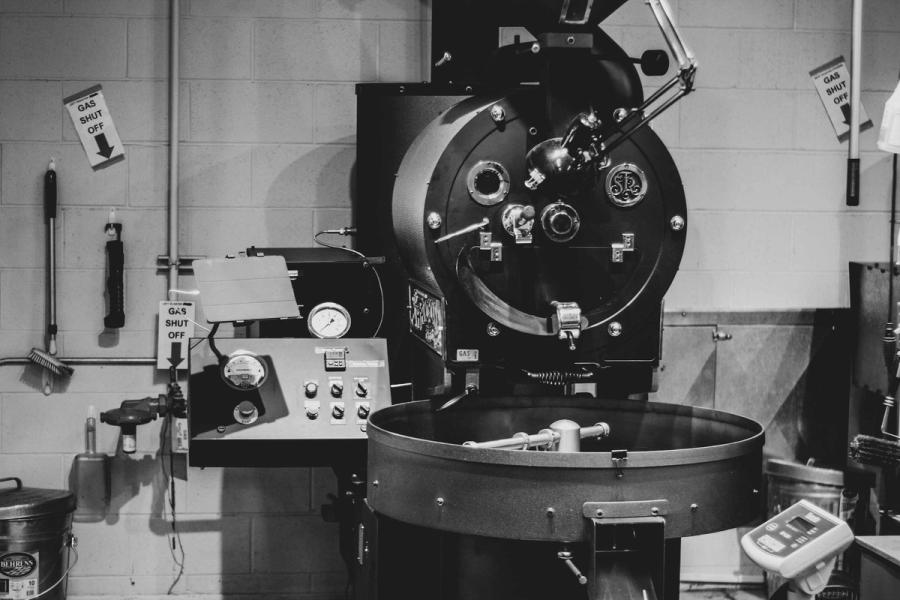
A roaster listed at $8,000 can end up costing more than one at $22,000 once you add everything in. Traditional gas drum roasters need a gas line, an exhaust hood, ductwork, and often a rooftop penetration — that's a full buildout before you roast a single pound. A machine listed at $8,000–$50,000+ from a vendor like Mill City is a drum roaster that requires that buildout plus manual operation. The "for sale" number is just the down payment on a much larger project.
Here's the honest list of what total cost of ownership includes:
- The machine itself
- Installation — gas, venting, electrical, permits, construction
- Labor — how many minutes a person stands at the machine per roast
- Maintenance — burners, exhaust systems, afterburners, parts
- Sourcing — where green coffee comes from and at what price
When you compare a few machines side by side, you find that the spec sheet is only the opening line. The thing that actually moves your P&L is the margin you capture by roasting at all. As Liam at High Grade Coffee in London put it: "Every coffee shop should eventually become its own roaster. It's the best way to control your margins. The coffee is one of the biggest costs in your cup."
New vs. Used: What to Verify Either Way
Used roasters look tempting because the number is lower. But a used gas roaster carries hidden risk — worn burners, an aging afterburner, an exhaust system you didn't install and can't fully inspect, and no warranty when something fails mid-service. You're inheriting someone else's wear and someone else's buildout.
If you're looking at any roaster, new or used, verify these before you commit:
- Certifications. Look for UL 197, UL 710, NSF4, and CE. These aren't paperwork — they're what your local inspector and your insurance care about.
- Reliability data. Ask for an honest number on roasts before failure. The Bellwether Shop Roaster averages 2,000 roasts before failure, which is the kind of figure you want on record.
- Installation requirements. Does it need gas? Venting? A dedicated circuit? This is where "cheap" machines get expensive.
- Operator training time. A roaster that takes days to learn is a roaster that limits who on your staff can run it.
- Support and sourcing. When it breaks or you need green coffee, who picks up the phone?
400 lbs/week. Zero construction.
See the Shop Roaster
Plugs into a standard 240V outlet. 528 lbs/hr labor efficiency with continuous roasting. No gas burners to service, no exhaust system to clean. Built for businesses that need it to just work.
Gas, Electric, or Ventless — The Install Decides a Lot
Most commercial roasters for sale are gas drum machines. They roast well, but they tie you to infrastructure. A Typhoon fluid-bed runs around $29,500+ and still needs gas and venting. A Stronghold is electric — around $42,000+ — but it still requires exhaust venting and runs semi-automated, with no marketplace or coffee-team support behind it.
The Bellwether Shop Roaster is the only electric, ventless, automatic commercial coffee roaster, and it was named SCA Best New Product of 2024. It plugs into a standard 220V / 30-amp single-phase outlet — no gas, no venting, no construction. An internal afterburner neutralizes smoke and VOCs inside the machine, so nothing exits to a roof. That's the difference between roasting on day one and waiting weeks for a buildout.
It also changes who can operate it and how much it costs in labor. Jorge at Hey My Coffee in Madrid switched from a previous machine and said: "With our previous machine, someone had to be physically present throughout the entire roasting process, but with Bellwether you only need time to prepare and handle the roasted coffee afterward, saving us a lot in labor costs." That's roughly 2 minutes of labor per roast, and an operator you can train in under 20 minutes. Doug at 1951 Coffee in Berkeley said it plainly: "We can teach someone in 20 minutes how to use the machine and roast. It really is that simple."
Match Capacity to Your Volume — Without Overbuying
A big drum roaster is overkill for a café doing a few hundred drinks a day, and it'll sit half-empty while you maintain a full exhaust system. Buy for the volume you actually have, with room to grow.
| Configuration | Throughput | Best for |
|---|---|---|
| Shop Roaster (countertop) | 1.5 kg (3.3 lb) per batch; 15–20 kg (33–44 lb)/day | Single-location cafés, in-house roasting |
| + Continuous Roasting Kit | 80+ kg (176+ lb)/day with autoloader | Multi-location, wholesale, growing volume |
Capacity scales with your business instead of forcing you to commit upfront. Tiffany at Tiabi Coffee & Waffle in Las Vegas described the continuous setup: "The continuous roasting is a game changer. We can literally just load it, and it just goes." And Donovan at Anchor and Tree Coffee in Sacramento proves the ceiling is high: "I am doing between 3,000 and 4,000 pounds a month as a wholesale coffee roaster, and I still have extra time to roast."
Run the Margin Math Before You Buy Anything
This is the part that turns a purchase into a decision. Roasters take roughly 67% of the gross margin in every pound of coffee — and right now your wholesale supplier is keeping it. A 24 lb bag of green runs about $140 (≈$5.83/lb), versus roughly $15/lb buying it roasted wholesale (about $75 per 5 lb bag) — more than double per pound. Roast it yourself and you capture the difference.
The Bellwether Shop Roaster is $14,900, or $19,900 bundled with the Continuous Roasting Kit (UK £11,900 / EU €13,900 for the base Shop Roaster). Most operators save $1,000–$5,000/month, up to 50% on coffee costs, and reach payback in as little as 6 months — break-even lands around 25 lb/week.
The owners who've done it say the numbers are real. Doug at 1951 Coffee: "We were paying anywhere from $9 to $11 per pound for roasted coffee. Now, we're paying closer to $4 or $5 per pound." Peter at Wellborn Coffee in Port Chester: "We cut a lot out. At $20 a pound from our previous roaster, we'd lose money on every pound." And Tony at Function Coffee Co.: "At the end of the year, we're able to actually see profit that we would not have been able to unlock had we gone with the third party wholesale vendor."
Quality holds up too. At Square Mile Coffee Roasters in London, Tom Flay ran a blind tasting: "We put our Bellwether roast on as well as production roast from our Probat machines. About 20-25 of our team were tasting. And no one could pick the production roast from the Bellwether roast. Most of them were the Bellwether roast as their favourite."
Ready to roast in-house?
Take control of your margins
Save $1,000–5,000/month on coffee costs. Your wholesaler takes 67% of the margin on every pound — it’s time to take it back.