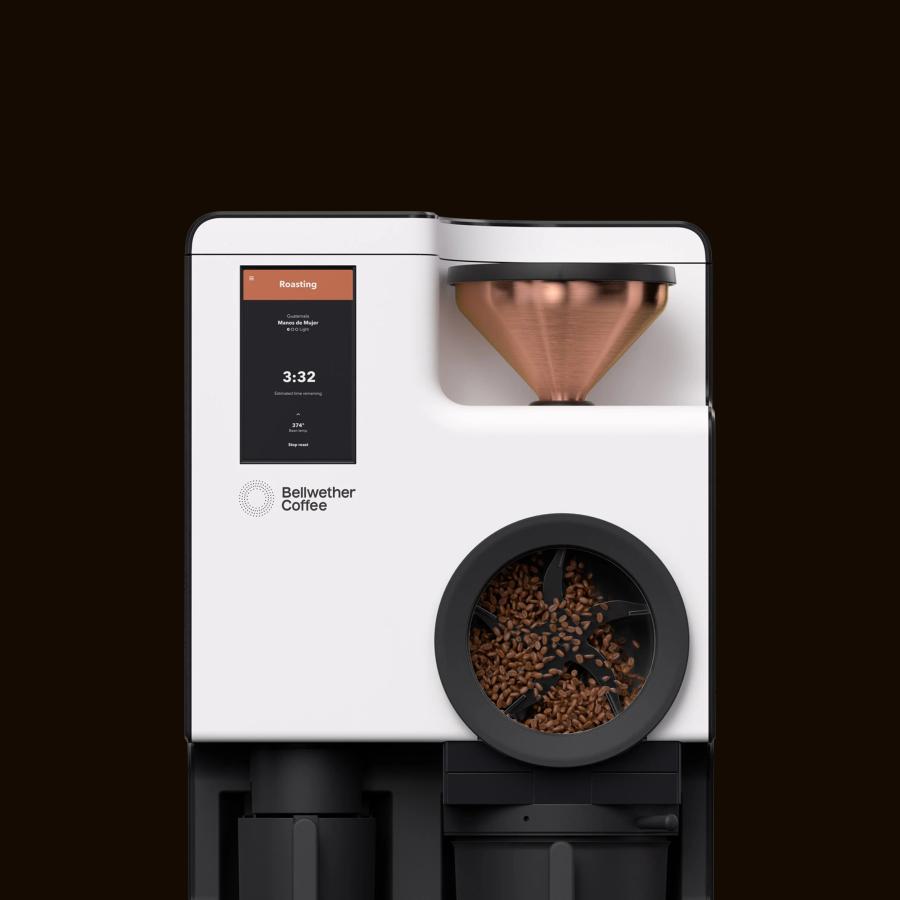
You already buy good coffee. The question on the table isn't whether to keep serving it — it's whether you should be roasting it yourself, and if so, on what. If you've gotten as far as comparing Bellwether and Stronghold, you've already crossed the hardest line: you've decided in-house roasting is worth a serious look.
Both are electric roasters, which is why they end up on the same shortlist. But that's roughly where the similarity ends. The real differences — venting, automation, price, and what you get besides a machine — are the ones that determine whether this becomes a quiet new profit center or a project that eats your floor space and your time. Here's an honest side-by-side.
The short version
If you want the comparison in one breath: both roasters run on electricity, but the Stronghold still needs exhaust venting and runs semi-automated, while the Bellwether is fully ventless, fully automatic, and arrives as a complete coffee business program — roaster, green coffee marketplace, coffee-team support, and packaging help. The Stronghold starts around $42,000+. The Bellwether Shop Roaster is $14,900, or $19,900 bundled with the Continuous Roasting Kit.
That price gap matters, but it's not the headline. The headline is what each machine asks of your building and your staff.
Venting: the difference between "plug it in" and "build it out"
This is the single biggest practical split between the two.
The Stronghold is electric, which spares you a gas line — a real advantage over a traditional drum roaster. But it still requires exhaust venting. That means ductwork, a path to the outside, and in many spaces, a landlord conversation, a contractor, and a permit. If you're in a strip mall, a historic building, a food court, or a shared kitchen, that venting requirement can quietly kill the whole idea.
The Bellwether is the only electric, ventless, automatic commercial coffee roaster on the market — and it earned SCA Best New Product 2024. An internal afterburner neutralizes smoke and VOCs inside the machine, so nothing vents outside. It plugs into a standard 220V / 30-amp single-phase outlet — the same kind of circuit your espresso machine uses. No gas, no ductwork, no rooftop penetration, no construction.
In practice, that means the Bellwether can go places a Stronghold simply can't. Including, often, right behind your counter where customers can watch.
Automation: who has to babysit the roast?
The Stronghold is semi-automated. Someone with roasting knowledge still drives it. The Bellwether is fully automatic: load green coffee, pick a profile, press start, and walk away. That gap shows up directly in your labor line.
Jorge at Hey My Coffee in Madrid had run a different roasting machine before switching:
"With our previous machine, someone had to be physically present throughout the entire roasting process, but with Bellwether you only need time to prepare and handle the roasted coffee afterward, saving us a lot in labor costs."
It also changes who can run it. You're not hiring a roaster or pulling your best barista off the bar for an afternoon. Doug at 1951 Coffee in Berkeley put it plainly:
"We can teach someone in 20 minutes how to use the machine and roast. It really is that simple."
That's roughly 2 minutes of labor per roast, with an operator trained in under 20 minutes. For an owner-operator, that's the difference between roasting being a job and roasting being a button you press between rushes.
Capacity: enough for a café, room for wholesale
A single Shop Roaster handles 1.5 kg (3.3 lb) per batch on demand, which adds up to 15–20 kg (33–44 lb) in a standard 8-hour day — plenty for most single cafés. Add the Continuous Roasting Kit and autoloader and you're at 80+ kg (176+ lb) per day, into real wholesale territory.
Tiffany at Tiabi Coffee & Waffle in Las Vegas leans on that upgrade:
"The continuous roasting is a game changer. We can literally just load it, and it just goes."
And it scales further than people expect. Donovan at Anchor and Tree Coffee in Sacramento:
"I am doing between 3,000 and 4,000 pounds a month as a wholesale coffee roaster, and I still have extra time to roast."
How much are you overpaying?
Calculate your savings
Your wholesaler takes 67% of the margin on every pound. See exactly how much you'd save roasting in-house with your current volume.
The part Stronghold doesn't sell: the program
Here's the difference that doesn't show up on a spec sheet. The Stronghold is a roaster — a good one. The Bellwether is a roaster plus a green coffee marketplace, a coffee team to help you dial in profiles and choose origins, and a packaging program if you want to sell retail bags. It's a way to run a coffee business, not just a way to roast.
That distinction matters most when you're skeptical the coffee will actually be good enough. Tom Flay at Square Mile Coffee Roasters in London — a company that roasts on Probat — ran a blind test:
"We put our Bellwether roast on as well as production roast from our Probat machines. About 20-25 of our team were tasting. And no one could pick the production roast from the Bellwether roast. Most of them were the Bellwether roast as their favourite."
The economics: where the decision actually gets made
Freshness opens the door. The numbers close it. A roaster takes roughly 67% of the gross margin in every pound of coffee you buy — capturing that is the whole point of bringing roasting in-house.
The math is blunt. A 24 lb bag of green coffee runs about $140 (roughly $5.83/lb), versus roughly $15/lb bought roasted wholesale — two 5 lb bags at $75 each — more than double per pound. Most operators save up to 50%, which works out to $1,000–$5,000/month, and the Shop Roaster pays for itself in as little as 6 months. You break even roasting just ~25 lb/week.
Operators describe it the same way. Doug at 1951 Coffee:
"We were paying anywhere from $9 to $11 per pound for roasted coffee. Now, we're paying closer to $4 or $5 per pound."
Peter at Wellborn Coffee in Port Chester, NY, on the supplier he left:
"We cut a lot out. At $20 a pound from our previous roaster, we'd lose money on every pound."
And Tony at Function Coffee Co., on what it does to the year-end picture:
"At the end of the year, we're able to actually see profit that we would not have been able to unlock had we gone with the third party wholesale vendor."
That higher upfront Stronghold price isn't just a bigger check — it's a longer road to payback, and it doesn't come with the marketplace or coffee team that make those savings easy to capture.
So which one wins?
If your space already has exhaust infrastructure, you have an experienced roaster on staff, and you want a standalone electric drum, the Stronghold is a capable machine. For most established cafés and small roasters, though, the deciding factors line up behind Bellwether: no venting, no construction, anyone on staff can run it, a lower price, and a faster payback — plus the marketplace and support that the hardware-only path leaves you to figure out alone.
Liam at High Grade Coffee in London framed the bigger picture:
"Every coffee shop should eventually become its own roaster. It's the best way to control your margins. The coffee is one of the biggest costs in your cup."
The only real question is which machine gets you there with the least friction. If you want to put hard numbers against your own volume, the ROI calculator does exactly that — and the "Wholesale Coffee vs. Roasting In-House" breakdown is worth a read alongside this one.
Ready to roast in-house?
Take control of your margins
Save $1,000–5,000/month on coffee costs. Your wholesaler takes 67% of the margin on every pound — it’s time to take it back.