Starting a coffee business means choosing from multiple viable paths—each with different capital requirements, operational complexity, and profit potential. You could open a traditional café, launch an online coffee brand, add roasting to an existing business, or start a mobile operation. The right choice depends on your budget, skills, and lifestyle goals.
This comprehensive guide covers every aspect of starting a coffee business: evaluating business models, calculating startup costs, securing licenses and permits, selecting equipment, choosing locations, and building operations that generate sustainable profit. Whether you're opening your first café or expanding into roasting, you'll find the specific guidance you need.
Coffee Business Models: Which Is Right for You?
Before diving into costs and logistics, clarify which type of coffee business matches your situation:
Traditional Café or Coffee Shop
A brick-and-mortar café serves espresso drinks, brewed coffee, and often food items to customers in a dedicated retail space.
Best for: Entrepreneurs who want a community gathering space and enjoy face-to-face customer interaction.
Capital required: $80,000–$300,000+ depending on size and location.
Key considerations: Location is critical. Lease negotiations, buildout costs, and staffing represent the largest ongoing challenges. Success depends heavily on foot traffic and repeat customers.
Coffee Roasting Business
A roasting operation purchases green coffee beans, roasts them in-house, and sells roasted coffee wholesale, retail, or online.
Best for: Those passionate about coffee craft who want to control product quality from bean to cup.
Capital required: $30,000–$150,000+ for traditional roasting; $25,000–$50,000 for ventless electric roasting.
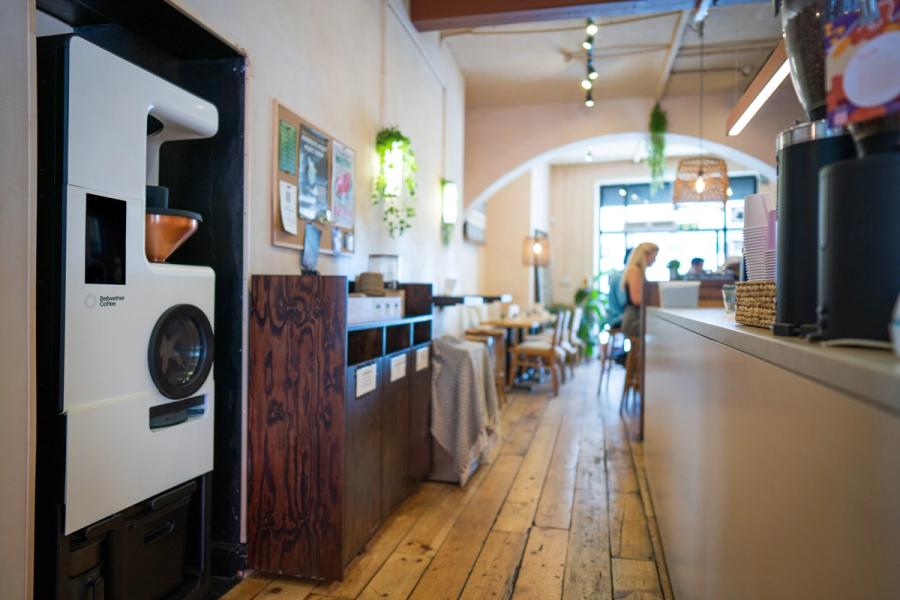
Key considerations: Traditional roasting requires gas lines, exhaust systems, and often a dedicated facility. Ventless electric roasters like the Bellwether (1.5 kg batch capacity, 200-240V electrical) eliminate these infrastructure requirements, allowing you to roast in any commercial space.
Online Coffee Brand
An e-commerce coffee business sells roasted coffee directly to consumers through a website, often using a subscription model.
Best for: Entrepreneurs who want lower overhead and geographic flexibility, or existing roasters expanding their reach.
Capital required: $10,000–$50,000 if roasting yourself; $5,000–$15,000 if using white-label or dropshipping.
Key considerations: Customer acquisition costs are high online. Success requires strong branding, quality product, and either exceptional marketing skills or capital to invest in advertising.
Coffee Kiosk or Cart
A mobile or semi-permanent operation serving coffee from a kiosk, cart, or trailer in high-traffic locations.
Best for: Entrepreneurs seeking lower startup costs and location flexibility, or those testing concepts before opening a full café.
Capital required: $20,000–$75,000 depending on setup.
Key considerations: Permits vary significantly by location. Volume is limited by space and equipment capacity. Weather and foot traffic patterns directly impact revenue.
Adding Coffee to an Existing Business
Bakeries, restaurants, hotels, and retail stores can add coffee service as a complementary revenue stream.
Best for: Existing businesses wanting to increase average ticket size and customer visit frequency.
Capital required: $5,000–$50,000 depending on scope.
Key considerations: Space constraints often dictate equipment choices. Ventless roasters and compact espresso setups make this feasible in spaces where traditional equipment won't fit.
Understanding Coffee Business Costs
Your total investment includes one-time startup costs plus ongoing operational expenses. Here's what to budget:
Startup Costs by Business Type
| Business Type | Equipment | Buildout/Setup | Inventory | Licenses/Legal | Marketing | Total Range |
|---|---|---|---|---|---|---|
| Full café | $30,000–$80,000 | $50,000–$150,000 | $5,000–$15,000 | $2,000–$10,000 | $3,000–$10,000 | $90,000–$265,000 |
| Small café | $15,000–$40,000 | $20,000–$60,000 | $3,000–$8,000 | $1,500–$5,000 | $2,000–$5,000 | $41,500–$118,000 |
| Coffee kiosk | $10,000–$25,000 | $10,000–$30,000 | $2,000–$5,000 | $1,000–$3,000 | $1,500–$3,000 | $24,500–$66,000 |
| Roasting (traditional) | $30,000–$80,000 | $30,000–$100,000 | $5,000–$15,000 | $2,000–$8,000 | $3,000–$8,000 | $70,000–$211,000 |
| Roasting (ventless) | $14,900–$19,900 | $1,000–$5,000 | $3,000–$10,000 | $1,500–$5,000 | $2,000–$5,000 | $22,400–$44,900 |
| Online only | $0–$35,000 | $1,000–$5,000 | $2,000–$8,000 | $500–$2,000 | $5,000–$15,000 | $8,500–$65,000 |
Monthly Operating Costs
Beyond startup investment, plan for recurring expenses:
| Category | Small Café | Full Café | Roasting Operation |
|---|---|---|---|
| Rent | $2,000–$5,000 | $4,000–$12,000 | $1,500–$5,000 |
| Labor | $4,000–$10,000 | $10,000–$30,000 | $3,000–$10,000 |
| Cost of goods | $3,000–$8,000 | $8,000–$25,000 | $5,000–$20,000 |
| Utilities | $500–$1,500 | $1,000–$3,000 | $500–$2,000 |
| Marketing | $500–$2,000 | $1,000–$5,000 | $500–$3,000 |
| Insurance | $300–$800 | $500–$1,500 | $300–$1,000 |
| Supplies/misc | $500–$1,500 | $1,000–$3,000 | $300–$1,000 |
| Total Monthly | $10,800–$28,800 | $25,500–$79,500 | $11,100–$42,000 |
Cost Reduction Strategies
Several approaches can significantly reduce your startup investment:
Start smaller: A 500 sq ft café costs far less than 1,500 sq ft but can generate meaningful revenue while you build your customer base.
Choose the right equipment: Ventless electric roasters eliminate $25,000–$80,000 in infrastructure costs (gas lines, exhaust systems, afterburners) while enabling in-house roasting.
Lease equipment initially: Many suppliers offer leasing programs that reduce upfront capital requirements and include maintenance.
Build incrementally: Start with core capabilities and add equipment as revenue supports expansion.
Licenses and Permits for Coffee Businesses
Legal requirements vary by location and business type. Budget 4–12 weeks for the complete permitting process.
Essential Licenses (Most Locations)
| License/Permit | Purpose | Typical Cost | Timeline |
|---|---|---|---|
| Business license | General operating authority | $50–$500 | 1–2 weeks |
| Food service license | Permission to serve food/beverages | $100–$1,000 | 2–6 weeks |
| Health department permit | Food safety compliance | $100–$500 | 2–8 weeks |
| Fire department permit | Safety compliance for cooking equipment | $50–$300 | 1–4 weeks |
| Sales tax permit | Authority to collect sales tax | Free–$50 | 1–2 weeks |
| Employer ID (EIN) | Federal tax identification | Free | Immediate |
Additional Permits (Situation-Dependent)
| Permit Type | When Required | Cost Range |
|---|---|---|
| Liquor license | Serving alcohol (beer, wine, spirits) | $300–$14,000 |
| Sidewalk café permit | Outdoor seating on public property | $100–$2,000 |
| Music license (ASCAP/BMI) | Playing copyrighted music | $300–$1,500/year |
| Sign permit | Exterior signage | $50–$500 |
| Building permit | Construction or major renovations | $500–$5,000+ |
| Roasting permit | Coffee roasting (some jurisdictions) | $100–$500 |
Roasting-Specific Considerations
Traditional gas roasting often requires additional permits:
- Air quality permits (AQMD/EPA) for emissions
- Gas installation permits
- Exhaust system inspections
- Higher fire department scrutiny
Ventless electric roasters typically require only standard food service permits and a 240V electrical connection, significantly simplifying the permitting process.
Equipment Essentials by Business Type
Your equipment needs depend entirely on your business model. Here's what each type requires:
Coffee Shop Equipment
Espresso and brewing:
- Commercial espresso machine ($5,000–$25,000)
- Commercial grinder(s) ($1,000–$4,000)
- Batch brewer or pour-over station ($500–$3,000)
- Water filtration system ($500–$2,000)
Storage and display:
- Refrigeration (reach-in, under-counter) ($2,000–$8,000)
- Display cases for pastries ($1,000–$5,000)
- Dry storage shelving ($500–$1,500)
Operations:
- POS system ($1,000–$3,000)
- Furniture and fixtures ($5,000–$25,000)
- Smallwares (cups, pitchers, tools) ($1,000–$3,000)
Roasting Equipment
Traditional gas roasting:
- Roaster (3–15 kg capacity) ($15,000–$60,000)
- Afterburner ($10,000–$30,000)
- Exhaust system installation ($5,000–$15,000)
- Gas line installation ($5,000–$15,000)
- Destoner/cleaning equipment ($2,000–$5,000)
- Packaging equipment ($1,000–$5,000)
Ventless electric roasting:
- Bellwether Shop Roaster (from $14,900)
- 1.5 kg batch capacity
- 3–4 roasts per hour (36–48 kg daily)
- Internal afterburner included
- 200-240V, 30A electrical requirement
- Electrical installation ($500–$2,000)
- Packaging equipment ($1,000–$5,000)
The total equipment investment for ventless roasting is typically 50–70% lower than traditional roasting when accounting for all infrastructure.
Choosing a Location
Location selection can determine success or failure for any coffee business with a physical presence.
Key Location Factors
Traffic and visibility:
- Foot traffic count (measure at different times/days)
- Vehicle traffic and parking availability
- Visibility from street and neighboring businesses
- Proximity to complementary businesses
Demographics:
- Income levels in surrounding area
- Age distribution of nearby residents and workers
- Density of target customer segments
- Competition within walking/driving distance
Practical considerations:
- Lease terms and rent relative to expected revenue
- Buildout condition (existing café vs. raw space)
- Utility availability (especially 240V for roasting equipment)
- Loading access for deliveries
- Trash and recycling logistics
Location Types and Trade-offs
| Location Type | Advantages | Challenges |
|---|---|---|
| Urban street front | High foot traffic, visibility | Expensive rent, limited parking |
| Shopping center | Built-in traffic, shared marketing | CAM fees, restricted hours |
| Office district | Weekday volume, corporate accounts | Dead on weekends |
| Residential area | Community loyalty, lower rent | Less walk-in traffic |
| Mixed-use building | Live-work synergy | May limit hours/noise |
Space Requirements
Minimum space needs by business type:
| Business Type | Minimum Space | Comfortable Space |
|---|---|---|
| Espresso bar only | 200–400 sq ft | 400–600 sq ft |
| Small café (counter service) | 400–800 sq ft | 800–1,200 sq ft |
| Full café (table service) | 1,000–1,500 sq ft | 1,500–2,500 sq ft |
| Café + roasting | 1,200–2,000 sq ft | 2,000–3,000 sq ft |
| Roasting only | 500–1,000 sq ft | 1,000–2,000 sq ft |
Note: Ventless roasters require only 5 square feet of floor space plus 2 inches clearance on each side, making roasting feasible even in compact café settings.
More than a roaster
Everything you need to roast, brand, and sell
From sourcing to packaging, Bellwether gives you a complete coffee program. Launch faster, with fewer mistakes, and predictable margins from day one.
Building Your Team
Staffing represents your largest ongoing expense and directly impacts customer experience.
Staffing Models by Size
Solo operation (kiosk/small café):
- Owner handles most shifts initially
- 1–2 part-time employees for coverage
- Monthly labor: $0–$4,000
Small café (2–4 employees):
- Owner manages + works shifts
- 2–3 baristas (mix of full/part-time)
- Monthly labor: $6,000–$12,000
Full café (5–10 employees):
- Manager (may be owner initially)
- Lead barista/shift supervisors
- 3–6 baristas
- Monthly labor: $12,000–$25,000
Key Roles and Pay Ranges
| Role | Typical Pay | Key Skills |
|---|---|---|
| Barista | $12–$18/hour | Customer service, drink preparation |
| Lead barista | $15–$22/hour | Training, quality control, opening/closing |
| Shift supervisor | $17–$25/hour | Team management, problem-solving |
| Manager | $40,000–$60,000/year | Operations, hiring, P&L responsibility |
| Roaster | $18–$30/hour | Technical skills, palate, consistency |
Training Essentials
Invest in training for:
- Espresso technique and drink standards
- Customer service and upselling
- Food safety and hygiene
- POS system operation
- Opening and closing procedures
With automated roasting equipment like the Bellwether, roasting training requires only 2–4 hours rather than the weeks or months needed for manual roasting proficiency.
Marketing Your Coffee Business
Effective marketing builds awareness before opening and drives traffic once you're operational.
Pre-Opening Marketing
3–6 months before opening:
- Secure social media handles
- Create website with coming soon page
- Begin email list building
- Announce location and concept
1–3 months before opening:
- Document buildout progress on social media
- Partner with local influencers
- Plan soft opening and grand opening events
- Prepare press release for local media
Ongoing Marketing Strategies
Low-cost, high-impact:
- Consistent social media presence
- Google Business Profile optimization
- Customer loyalty program
- Community partnerships and events
- User-generated content encouragement
Paid marketing:
- Local social media advertising
- Google Local Services ads
- Neighborhood direct mail
- Local publication advertising
Marketing Budget Guidelines
| Business Stage | Monthly Budget | Focus |
|---|---|---|
| Pre-opening | $500–$2,000 | Awareness, anticipation |
| First 3 months | $1,000–$3,000 | Grand opening, trial visits |
| Months 4–12 | $500–$2,000 | Retention, word-of-mouth |
| Ongoing | 3–5% of revenue | Balanced acquisition/retention |
Financial Planning and Profitability
Understanding coffee business economics helps you plan for profitability.
Revenue Potential
| Business Type | Monthly Revenue Range | Factors Affecting Revenue |
|---|---|---|
| Small café | $15,000–$40,000 | Location, hours, menu |
| Full café | $40,000–$120,000 | Size, seating, food program |
| Coffee kiosk | $10,000–$30,000 | Location, hours, traffic |
| Roasting wholesale | $20,000–$100,000+ | Customer count, volume |
| Roasting + retail | $30,000–$80,000 | Distribution channels |
Profit Margins
| Revenue Category | Typical Margin |
|---|---|
| Espresso drinks | 65–80% |
| Brewed coffee | 75–85% |
| Roasted coffee (retail) | 50–65% |
| Roasted coffee (wholesale) | 30–45% |
| Pastries/food | 50–65% |
Break-Even Analysis
To calculate your break-even point:
- Fixed costs: Rent, insurance, loan payments, base labor
- Variable costs: Cost of goods, hourly labor, supplies
- Average ticket: Total revenue ÷ number of transactions
- Break-even transactions: Fixed costs ÷ (Average ticket − Variable cost per transaction)
Most coffee shops need 6–18 months to reach consistent profitability, depending on location, concept, and execution.
Step-by-Step Launch Timeline
Here's a realistic timeline for launching a coffee business:
Months 1–2: Planning and Validation
- Define business concept and model
- Research market and competition
- Create detailed business plan
- Establish legal entity (LLC recommended)
- Begin location search
Months 3–4: Securing Resources
- Finalize location and sign lease
- Secure financing (if needed)
- Apply for licenses and permits
- Order major equipment
- Hire designer/contractor (if needed)
Months 5–6: Buildout and Setup
- Complete construction/renovation
- Install equipment
- Hire and train initial team
- Set up systems (POS, accounting, inventory)
- Execute pre-opening marketing
Month 7: Launch
- Soft opening (friends/family)
- Staff refinement and menu adjustments
- Grand opening event
- Activate full marketing plan
Months 8–12: Optimization
- Analyze sales data and adjust
- Refine operations based on experience
- Build community presence
- Evaluate expansion opportunities
The In-House Roasting Advantage
For café owners considering roasting, in-house production offers significant benefits:
Cost Savings
Roasting your own coffee reduces cost of goods by 30–50% compared to buying pre-roasted. A café spending $2,500 monthly on roasted coffee could save $750–$1,250 per month by roasting in-house.
Quality and Freshness
Roast-to-order capability means serving coffee at peak freshness (3–14 days post-roast) rather than coffee that may be weeks old when it arrives.
Differentiation
In-house roasting creates a compelling story and experience that distinguishes you from competitors serving commodity coffee.
New Revenue Streams
Roasted coffee becomes a retail product you can sell in bags, offer wholesale to other businesses, or ship directly to consumers online.
Ventless Roasting: The Accessible Path
Traditional roasting infrastructure costs $30,000–$100,000 before equipment and requires dedicated space with specific ventilation. Ventless electric roasters like the Bellwether change this equation:
- No gas lines required
- No exhaust systems needed
- No external afterburner
- Installation in days, not months
- Any commercial space with 240V power
The Bellwether Shop Roaster specifications:
- 1.5 kg (3.3 lb) batch capacity
- 3–4 roasts per hour
- 2 minutes of labor per roast
- 24.6" × 36.5" × 28.2" footprint
- 405 lbs weight
- 200-240 VAC, 30A, 5kW electrical
- Optional 20 kg autoloader for continuous operation
This makes roasting accessible for cafés that couldn't previously justify the infrastructure investment.
Ready to build your coffee brand?
Take control of your margins
Save up to 50% on coffee costs with in-house roasting. Break even in month one, payback in six. Talk to our team about launching your roastery.