Commercial coffee equipment is a significant investment that affects drink quality, workflow efficiency, and long-term profitability. This guide helps you make informed decisions: what to prioritize, what to skip, when to buy new vs. used, and how to avoid expensive mistakes. Whether you're opening a new café, upgrading existing equipment, or adding roasting capability, you'll find specific recommendations, price ranges, and decision frameworks for each category.
Equipment priority framework
Not all equipment is equally important. Tier 1 is critical — you cannot open without it. Espresso machine takes 25–30% of budget (core product, brand identity). Espresso grinder takes 10–15% (affects quality more than the machine does). Water filtration takes 2–5% (protects equipment, affects taste). POS system takes 3–5% (you cannot transact without it). Basic refrigeration takes 5–10% (food safety requirement).
Tier 2 is important but you can open with basics and upgrade later: batch brewer (3–5% of budget — start with one, add as needed), display case (3–5% — can start without if no food), furniture (10–15% — start minimal, add over time). Tier 3 is optional and added as the business grows: pour-over station (when customer demand supports), cold brew system (when cold brew sales justify), roasting equipment (when ready to roast in-house), additional grinders (when menu complexity requires).
Espresso machines
Your espresso machine is your most visible equipment investment. Three machine categories cover the realistic range. Semi-automatic ($3,000–$12,000): the barista controls extraction time, more skill required, more variation — examples include La Marzocco Linea Mini and Rancilio Classe. Best for skilled baristas and lower volume. Automatic ($8,000–$20,000): programmable volume and time, more consistent shots — examples include La Marzocco Linea PB and Victoria Arduino Eagle One. Best for most coffee shops. Super-automatic ($10,000–$25,000): bean-to-cup automation, minimal barista skill required — examples include Eversys, Schaerer, WMF. Best for high volume operations or settings where minimal training is essential.
Specific recommendations by budget. Under $8,000: Rancilio Classe 9 USB ($5,000–$7,000) is a reliable workhorse, Nuova Simonelli Appia Life ($5,500–$7,500) is a good entry point, La Marzocco Linea Mini ($5,500–$6,500) is premium at lower price (smaller). $8,000–$15,000: La Marzocco Linea PB ($12,000–$15,000) is the industry standard, Victoria Arduino Eagle One ($10,000–$13,000) is modern and efficient, Nuova Simonelli Aurelia Wave ($10,000–$14,000) for temperature stability. Above $15,000: Synesso MVP Hydra ($18,000–$25,000) for pressure profiling, Slayer Steam ($18,000–$24,000) for design and performance, La Marzocco KB90 ($16,000–$20,000) for ergonomic design.
Decision factors: volume (drinks per hour at peak), barista skill level, drink menu (milk-focused operations need strong steam power), brand image (does visible brand matter to customers), service availability (who services this brand locally), and your budget for equipment plus ongoing service. On new vs. used: new comes with warranty, latest features, and financing options; used saves 40–60% but carries risk of hidden issues; refurbished from a dealer is the middle ground with limited warranty. On used equipment, verify hours of use, maintenance history, boiler condition, group head wear, and electrical and plumbing compatibility.
Grinders
Never underinvest in grinders. A great grinder with a good machine outperforms a great machine with a mediocre grinder. Entry-level espresso grinders ($1,200–$2,000): Mazzer Mini (reliable, small footprint), Eureka Mignon Specialita (good home-crossover option). Best for low-volume, budget-conscious operations. Mid-range ($2,000–$3,500): Mazzer Major V (industry workhorse), Mahlkönig E65S (excellent grind quality), Eureka Atom Pro (quiet, fast). Best for most coffee shops. Premium ($3,500–$6,000): Mahlkönig Peak (top-tier performance), Mazzer Kold (temperature management), Victoria Arduino Mythos 2 (gravimetric dosing). Best for high-volume, quality-focused operations.
Batch and filter grinders:
| Grinder | Price | Best for |
|---|---|---|
| Mahlkönig EK43S | $2,800–$3,500 | Multi-purpose, high quality |
| Mahlkönig Guatemala | $1,500–$2,000 | Dedicated batch grinding |
| Bunn G Series | $800–$1,200 | Budget batch grinding |
| Ditting 804 | $2,000–$2,500 | High-volume batch |
Considerations: dosing type matters — on-demand grinding is preferred for espresso (fresh per shot), hopper-based is acceptable for batch brew. Burr type: flat burrs give consistent particle size and more clarity, conical burrs produce a bimodal distribution and more body — both work well. Retention (how much coffee stays in the grinder between doses) should be low; under 1g is preferred for freshness. Speed matters — faster grinding means more capacity but potentially more heat, so balance speed with heat management.
Brewers and brewing equipment
Batch brewers. Budget ($400–$1,000): Bunn CW15 Series, Curtis Alpha — basic, reliable, low-volume. Mid-range ($1,000–$2,500): Fetco CBS-2141, Curtis G4 ThermoPro — most coffee shops live here. Premium ($2,500–$5,000): Curtis G4TP2T, Fetco XTS, Marco Jet — top-tier batch quality and precision.
Pour-over stations:
| Option | Price | Notes |
|---|---|---|
| Modbar | $4,000–$8,000 | Under-counter, premium |
| Marco SP9 | $1,500–$2,500 | Consistent hot water |
| Kalita Wave (manual) | $30–$50 each | Low cost, labor intensive |
| V60 drip station | $200–$500 | Manual, customer-facing |
Cold brew systems range from a $50–$100 DIY setup (Cambro plus filter) to commercial systems at $1,000–$2,000 like the Bravilor concentrate system. Toddy Cold Brew at $100–$200 covers 1–2 gallons; Curtis TCN at $800–$1,500 handles 3+ gallons.
Freshness is your edge
Open as a roastery from day one
Your customers will taste the difference from the very first cup. Roast on demand, serve at peak freshness, and build a brand around quality.
Roasting equipment
Adding roasting creates significant value if you choose the right equipment. Traditional gas roasters:
| Capacity | Price range | Examples |
|---|---|---|
| 1–3 kg | $8,000–$20,000 | Aillio Bullet, Mill City 3kg |
| 3–6 kg | $20,000–$40,000 | Mill City 6kg, Probat P Series |
| 6–15 kg | $35,000–$80,000 | Diedrich, Probat, Giesen |
| 15+ kg | $60,000–$150,000+ | Loring, Probat, Diedrich |
Traditional roasters need additional infrastructure: afterburner ($10,000–$30,000), exhaust system ($5,000–$20,000), gas line installation ($5,000–$15,000), air quality permits ($500–$2,000), and dedicated roasting space. Total traditional setup cost: $50,000–$150,000+.
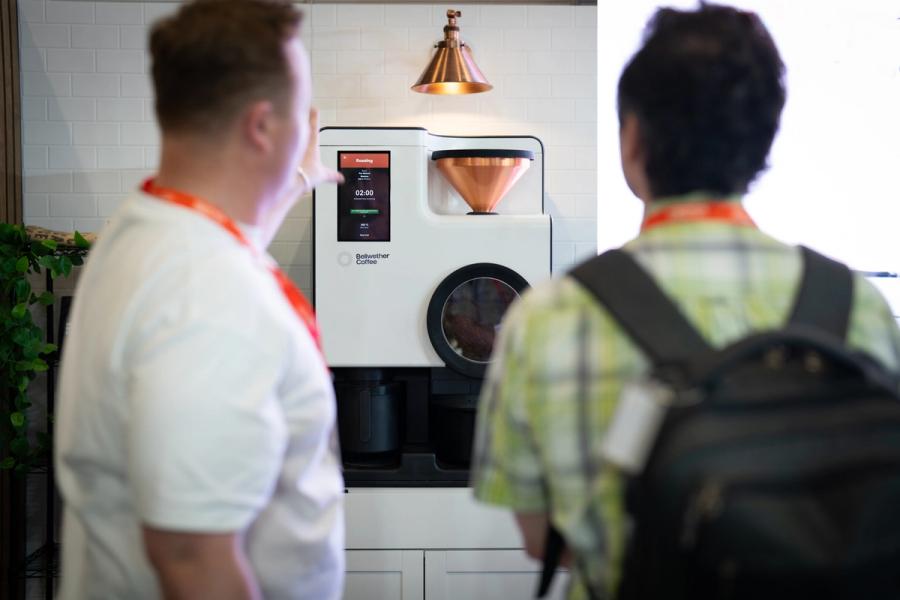
Ventless electric roasters bypass most of that. The Bellwether Shop Roaster runs $14,900 (or $19,900 with the Continuous Roasting Kit) at 1.5 kg batch capacity with continuous roasting capability. Specifications: 3–4 roasts per hour, 2 minutes labor per roast, 24.6" × 36.5" × 28.2" footprint, 405 lbs (527 lbs with autoloader), 200–240 VAC at 30A and 5kW, NEMA L6-30P plug with 8 ft cable, 2" clearance on both sides, internal afterburner — no external afterburner, no gas, no exhaust, no air permits. Total ventless setup cost: $15,400–$21,900.
Decision framework:
| Factor | Traditional gas | Ventless electric |
|---|---|---|
| Total cost | $50,000–$150,000+ | $15,400–$21,900 |
| Infrastructure | Gas, exhaust, permits | 240V outlet only |
| Space needed | Dedicated room | Corner of café |
| Installation time | Weeks to months | Days |
| Capacity | Higher ceiling | 36–80+ kg daily |
| Operating cost | Gas + maintenance | Electricity only |
| Labor per roast | 30–60 minutes | 2 minutes |
Ventless is ideal for cafés adding roasting, limited space, limited capital, urban locations, and first-time roasters. Traditional may be better for high-volume production (500+ lbs/week), dedicated production facilities, and experienced roasters wanting hands-on control.
Refrigeration
Under-counter refrigeration: worktop refrigerators ($1,500–$3,500) for bar areas and prep surfaces; under-counter reach-ins ($1,000–$2,500) for back-of-house storage; dedicated milk coolers ($800–$1,500) for milk storage. Recommended brands: True, Turbo Air, Beverage-Air.
Reach-in refrigerators: 1-door ($1,500–$2,500) for small operations, 2-door ($2,500–$4,500) for most cafés, 3-door ($3,500–$6,000) for high volume or food programs. Prioritize glass doors for visibility, adjustable shelving, digital temperature control, and energy efficiency.
Display cases: countertop pastry cases ($500–$1,500) for minimal food programs; refrigerated displays ($2,000–$5,000) for fresh pastries and sandwiches; dry display cases ($500–$2,000) for packaged goods and merchandise.
Water filtration
Never skip water filtration. Bad water ruins equipment and coffee. Filtration options: carbon filter ($100–$300, 6-month lifespan, basic taste improvement), scale prevention ($300–$800, 6–12 month lifespan, equipment protection), reverse osmosis ($1,000–$3,000, ongoing cost, precise water control), complete system ($1,500–$4,000, full protection plus taste). Recommended brands: Everpure, 3M, Pentair, BWT.
Water quality targets: TDS 75–150 ppm (flavor extraction), hardness 50–175 ppm (scale prevention), chlorine 0 ppm (taste, equipment), pH 6.5–7.5 (extraction, taste). Place the filter before all equipment, ensure flow rate meets equipment needs, plan for filter changes (set calendar reminders), and test water quarterly.
New vs. used equipment
Buy new on espresso machines (warranty matters), anything with software or technology, water filtration systems, and POS systems. Used makes sense for refrigeration (test before buying), grinders (easy to assess condition), batch brewers (simple mechanics), furniture and fixtures, and dishwashers.
Where to find used equipment: restaurant equipment auctions, dealers with refurbished options, Craigslist or Facebook Marketplace, coffee forums and communities, closing businesses. Before purchasing used, test operation if possible, verify electrical and plumbing compatibility, check for damage or excessive wear, research fair market value, ask about maintenance history, factor in any needed repairs, and consider transport logistics.
Financing
Most equipment suppliers offer financing — 10–20% down payment, 3–7 year terms, equipment as collateral, interest typically 8–15%. The lease vs. buy question depends on cash flow needs, tax treatment, and how quickly you'd want to upgrade. Leasing preserves capital and often includes maintenance; buying builds equity and ends payments. SBA loans, equipment financing, and supplier financing are all worth comparing on total cost over the equipment's expected life.
Ready to build your coffee brand?
Take control of your margins
Save up to 50% on coffee costs with in-house roasting. Break even in month one, payback in six. Talk to our team about launching your roastery.