Starting a coffee business with no money isn't about finding a magic loophole. It's about choosing the right model, leveraging other people's resources creatively, and building incrementally instead of trying to launch everything at once. If you have zero dollars and zero access to credit or partners, you cannot open a café next month — that's just real. But you can start a coffee business now, build a track record, and unlock funding that wasn't available to you on day one.
This guide covers the realistic paths: which models start cheap, which funding sources don't require existing wealth, how to structure partnerships that reduce your investment, and the step-by-step approaches that have worked for low-capital coffee entrepreneurs.
The truth about "no money" coffee businesses
Opening a traditional coffee shop costs $75,000–$300,000 depending on size and location. There's no shortcut around that. What there are shortcuts around is the assumption that you need to do a traditional café first.
If you're starting with little or nothing, you can pick a coffee business model that requires minimal capital, access funding sources that don't require you to already be wealthy, structure partnerships where someone else provides the capital, build incrementally by reinvesting profits, and create a track record that unlocks future financing. The entrepreneurs who actually pull this off share a few traits: they choose appropriate models for their resources, they get creative, and they accept that the path is slower without capital.
Five low-capital coffee business models
1. Online coffee brand (lowest capital)
You can launch an online coffee business for $1,000–$10,000 depending on whether you dropship, white label, or roast yourself. Dropshipping ($1,000–$3,000) means a partner roaster ships under your brand — you handle marketing and customer acquisition, they handle production and fulfillment, and your investment goes mostly to website, branding, and marketing. White label ($3,000–$8,000) means you buy pre-roasted coffee with your labels and handle your own fulfillment — better margins than dropshipping, but you're carrying inventory. Home roasting ($5,000–$15,000) means you roast small batches yourself with a $500–$3,000 sample roaster, which gives you the highest margins and the most control if cottage food laws in your state permit it.
The upside is the lowest overhead in the industry. The downside is high customer acquisition costs and a competitive market — your margins are usually thin until you build an audience.
2. Wholesale roasting
Supplying roasted coffee to cafés, restaurants, and offices needs roasting equipment but no retail space. Total startup with a ventless roaster runs $15,000–$40,000.
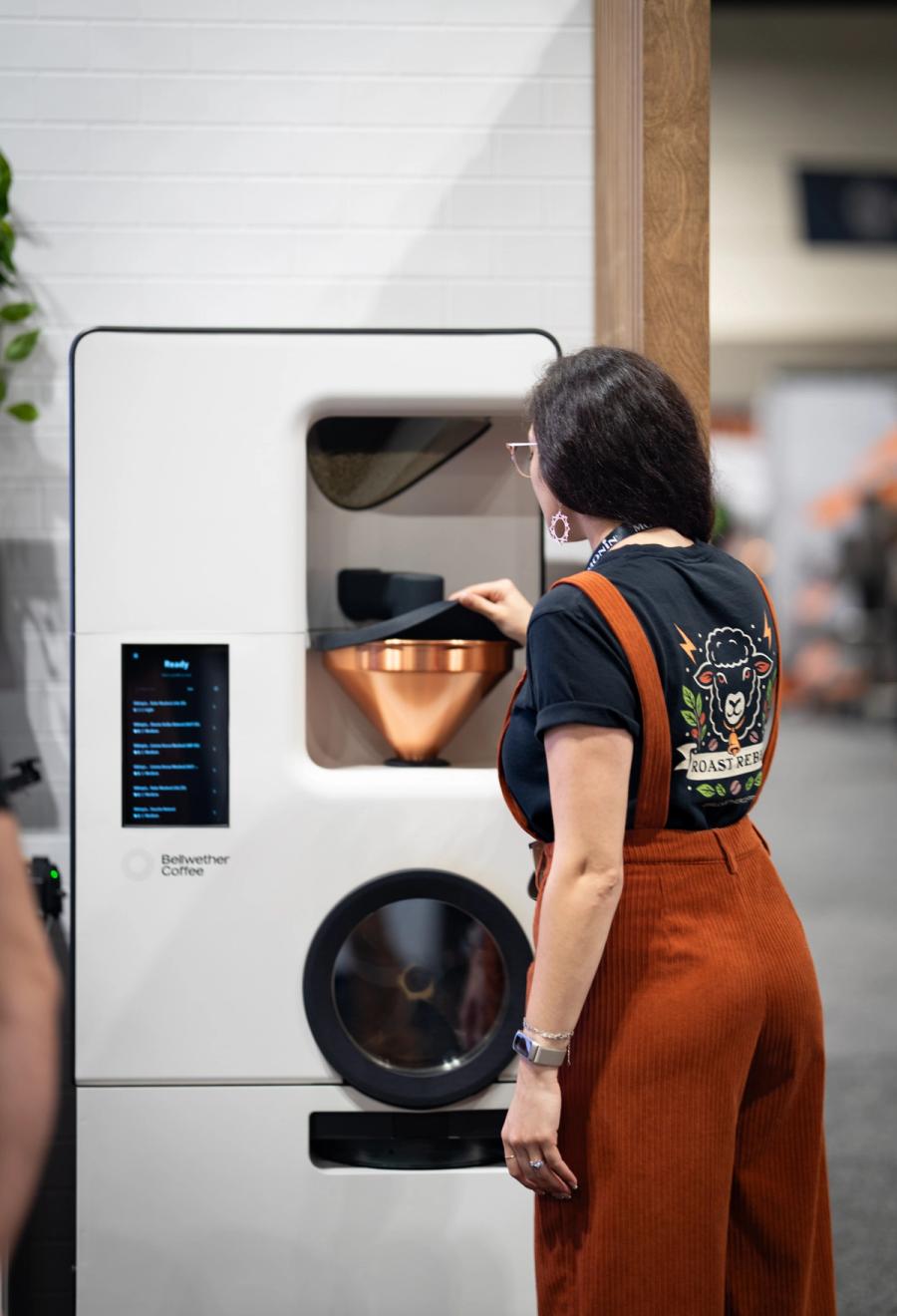
The reason this model works at low capital is that ventless electric roasters like Bellwether eliminate $30,000–$80,000 in traditional infrastructure — no gas lines, no exhaust hoods, no afterburners. You can operate from any commercial space with 240V power, which means commissaries and shared spaces are viable. A typical setup: $25,000–$35,000 for the roaster, $500–$2,000 for electrical installation, $1,000–$3,000 for packaging equipment, and $2,000–$5,000 in initial green coffee inventory. With equipment financing, your out-of-pocket might be $5,000–$10,000.
Recurring B2B revenue is the other reason this model works without much capital — you're not chasing every cup of coffee individually. The trade-off is that you need real sales skills and patience for longer sales cycles.
3. Coffee cart or pop-up
A mobile cart or rotating pop-up gives you location flexibility for $10,000–$35,000. A cart setup typically runs $5,000–$12,000 for a used or custom-built cart, $2,000–$5,000 for a portable espresso machine, $1,000–$3,000 for grinder and other equipment, and $500–$1,500 for permits. A pop-up is even cheaper — $3,000–$8,000 for portable equipment, $500–$1,500 for opening inventory, $500–$2,000 for permits, and a vehicle if you don't already have one.
Low overhead and the ability to test markets are the real advantages. The downsides are weather dependence, limited capacity, and permit complexity that varies wildly by jurisdiction.
4. Coffee catering and events
Serving coffee at events, offices, and private functions runs $5,000–$20,000 to start: $3,000–$8,000 for a portable espresso setup, an existing personal vehicle to transport everything, $500–$1,000 in marketing materials, and $500–$1,500 in insurance. Per-event margins are high, the schedule is flexible, and every event you serve is a sales pitch for the next one.
The trade-off is inconsistent income, the need for sales and networking skills, and the physical demands of setup and teardown.
5. Coffee kiosk inside an existing business
Partnering with an existing business — a bookstore, gym, office building — to operate a coffee station inside their space starts at $8,000–$25,000. You provide equipment and staff; they provide space, utilities, and built-in foot traffic. The arrangement is usually 70/30 or 80/20 revenue share in your favor, or a flat monthly fee.
This works well because you skip the build-out cost, you get a customer base that's already walking through the door, and the equipment footprint stays small. The trade-off is that you're dependent on the host business's traffic and rules. If they have a bad year, you have a bad year.
Creative funding strategies
When personal savings aren't an option, several funding paths can still work.
Microloans
The SBA Microloan Program lends up to $50,000 through nonprofit intermediaries, with more accessible criteria than traditional bank loans, and it often comes with business training and support. Community Development Financial Institutions (CDFIs) focus on underserved entrepreneurs and provide more flexible criteria than banks, often pairing capital with mentorship. Kiva offers crowdfunded microloans up to $15,000 at 0% interest — you need some initial traction or a strong story, and the loan is funded by individual lenders.
Equipment financing
Many equipment suppliers offer financing that requires little or no down payment, uses the equipment itself as collateral, and doesn't demand extensive credit history. For a $30,000 roaster, 10% down is $3,000 out of pocket, with a monthly payment of $500–$700 over 5 years — and the equipment pays for itself through operation.
Crowdfunding
Reward-based platforms like Kickstarter and Indiegogo let you presell coffee subscriptions or merchandise. Typical coffee campaigns raise $5,000–$50,000, and the model works best when you have a compelling story and an existing audience to launch into. Investment crowdfunding through Wefunder or Republic lets you sell equity to many small investors — more formal documentation, better suited for larger raises ($50,000+).
Partnerships
The cleanest no-capital path is a partnership where someone else provides the money and you provide the operating expertise and labor. A typical structure: Partner A invests $50,000 and gets 50% equity; Partner B (you) provides all the labor, management, and expertise and gets 50% equity. Partner A receives a return on investment from distributions; Partner B receives a salary plus the ownership share. Done right, both sides have skin in the game and aligned incentives.
Friends, family, and sweat equity
If you're approaching friends and family for capital, treat it as professionally as you would a bank: legal documents, clear terms, fair interest or equity, transparent expectations about risk, and a real repayment plan. Sweat equity arrangements are another path — partner with an existing café that needs help and earn ownership over time, or trade skills (marketing, design, construction) for startup services.
More than a roaster
Everything you need to roast, brand, and sell
From sourcing to packaging, Bellwether gives you a complete coffee program. Launch faster, with fewer mistakes, and predictable margins from day one.
Building without capital, step by step
The most common successful path is the side hustle. In months 1–6, you start selling online (dropshipping or small-batch roasting), keep your day job, invest $1,000–$3,000, and focus on proving the concept and building a customer base. In months 6–12, you reinvest all profits, add farmers markets and pop-ups, and grow your email list and social following. From month 12 to 24, revenue starts supporting a part-time transition, you upgrade equipment with maybe $10,000–$25,000 mostly financed against your track record. By year 2 or 3, you're full-time, considering a physical location, and your track record enables traditional financing for whatever comes next.
A faster path is the partnership route: spend 1–2 years working in the coffee industry to develop expertise, create a detailed business plan that demonstrates your knowledge, find a capital partner through networking events or small business development centers, structure a fair deal with clear roles and exit provisions, and launch together with combined resources.
The earn-in path is rarer but real: join an existing coffee business with a path to ownership. Owners looking to retire, cafés seeking growth partners, roasters needing operations people — these are all situations where you can negotiate performance-based equity vesting, a purchase option at a fixed price, a revenue share that converts to ownership, or a gradual buyout over years. A typical example: Year 1 you manage the café and prove results, Year 2 you start purchasing equity at 10–15%, Years 3–5 you continue toward majority ownership, Year 6+ you own it outright.
Before any of these, the lowest-risk move is to test cheaply. A farmers market booth ($500–$1,500) lets you sell pour-over coffee for 3–6 months and validate demand, pricing, and your own commitment before bigger investment. A pop-up partnership ($1,000–$3,000) with an existing restaurant or retail business lets you test the concept with minimal equipment. Office coffee service ($2,000–$5,000) gives you recurring revenue, predictable demand, simple equipment requirements, and B2B relationships that pay off later.
Reducing costs at every stage
Used equipment is the single biggest lever. Espresso machines run 40–60% of new price; grinders 30–50% of new; refrigeration 30–50% of new. Restaurant auctions, closing businesses, eBay, and Facebook Marketplace are the four sources worth checking. Leasing instead of buying preserves capital and often includes maintenance — easier to qualify for than loans, and easier to upgrade. Starting minimal works too: begin with pour-over and batch brew (lower equipment cost), and add espresso once revenue supports it.
On space, commissary kitchens at $500–$1,500 a month, shared commercial spaces at $300–$800 a month, and partner spaces (often free or revenue share) all beat a traditional retail lease. Where cottage food laws permit it, home-based costs zero in rent. Mobile and temporary options like farmers markets ($20–$100 a day) or pop-ups (often free or revenue share) let your customers fund your presence.
Operating costs come down further when you do everything yourself initially — labor, marketing, basic bookkeeping, deliveries. Negotiate everything: supplier terms (net 30 vs prepay), equipment payment plans, lease terms and rent, service contracts. Every percentage point matters when margins are thin.
Three real paths from nothing
A teacher with $2,000 in savings started selling roasted coffee at farmers markets with a $600 sample roaster. Year 1 revenue: $18,000, all reinvested. Year 2: upgraded to a Bellwether roaster (financed), added wholesale accounts, quit teaching mid-year — revenue $85,000. Year 3: dedicated roasting space, 15 wholesale accounts, launched a subscription program — revenue $180,000.
A barista with coffee expertise but no capital created a detailed business plan, found an investor through a local small business network, and structured a deal: 40% equity for the investor's $75,000, 60% equity plus operations salary for the barista. The café opened in month 6, broke even by month 10, the investor recovered their investment through distributions, and the operator built equity with no personal capital at risk.
A coffee professional with no savings was hired as manager at a struggling café and negotiated a base salary plus 2% equity annually if profitable. They turned the café around over 18 months. Four years in, they'd earned 8% ownership; the original owner offered a buyout, and a bank financed it based on the operator's track record and the café's improved performance.
What won't work
Be realistic about what doesn't actually work. "I'll just get investors" — investors want a track record, not just an idea, and coffee shops aren't attractive to most investors due to the low return profile. Build something small first. Maxing credit cards generates high-interest debt that destroys cash flow and creates a personal financial crisis if the business struggles. Legitimate financing is almost always better. "Build it and they will come" ignores the role of location, marketing, and operations — underfunded businesses fail fastest. Better to start smaller than to launch underfinanced. And ignoring profitability with the assumption that you'll "figure it out later" is the most common failure mode in coffee. No amount of volume fixes bad unit economics.
If you have under $5,000
With under $5,000, your realistic options are an online dropship business ($1,000–$2,000), a farmers market booth ($1,500–$3,000), or coffee catering ($2,000–$4,000). Whichever you pick, register the business properly: $50–$500 for LLC formation depending on state, $50–$200 for a business license, and $300–$600 a year for insurance.
Then start selling. Launch with a minimum viable setup. Focus on learning and customer feedback rather than perfection. Document everything — every dollar in and out, customer acquisition cost, product costs and margins. That data is what you'll use to prove viability to future lenders and partners. Reinvest all profits back into the business, build a track record over 6–12 months, and then approach microloans, partners, or equipment financing to take the next step.
Ready to build your coffee brand?
Take control of your margins
Save up to 50% on coffee costs with in-house roasting. Break even in month one, payback in six. Talk to our team about launching your roastery.