Opening a coffee shop is a 6-to-12-month process that starts long before you sign a lease. From the day you commit to the idea through the day you flip the open sign, you're going to move through eight overlapping phases: developing your concept, writing the business plan, securing funding, finding the location, designing and building out the space, ordering equipment and inventory, hiring and training staff, and finally a soft opening that turns into a launch.
Total startup costs run $80,000 to $300,000 depending on format and how much build-out the space needs. Here's the timeline most operators actually run:
| Phase | Timeline | Key deliverables |
|---|---|---|
| 1. Concept development | Weeks 1–4 | Vision, format, differentiation |
| 2. Business planning | Weeks 3–8 | Business plan, financial projections |
| 3. Securing funding | Weeks 6–16 | Capital secured |
| 4. Finding location | Weeks 8–20 | Lease signed |
| 5. Design & build-out | Weeks 16–32 | Space ready for equipment |
| 6. Equipment & inventory | Weeks 28–36 | Equipped and stocked |
| 7. Hiring & training | Weeks 30–38 | Team ready |
| 8. Soft open & launch | Weeks 36–40 | Doors open |
Streamlined execution gets you to opening day in 6–10 months. Realistic timelines with permit delays and construction surprises usually run 10–12 months. The phases overlap; you'll be working on multiple at once.
Step 1: Develop your concept (Weeks 1–4)
Before you do anything else, you have to define what kind of coffee shop you're actually building. Format dictates roughly half of every other decision you'll make — startup cost, space requirements, staffing, hours, and the kind of customer you'll attract.
| Format | Startup cost | Space needed | Best for |
|---|---|---|---|
| Coffee kiosk | $50,000–$100,000 | 100–300 sq ft | Quick service, high-traffic locations |
| Small café | $100,000–$200,000 | 500–1,000 sq ft | Focused menu, manageable operations |
| Full café | $150,000–$300,000 | 1,000–2,000 sq ft | Full experience, seating, expanded menu |
| Café + kitchen | $200,000–$400,000+ | 1,500–3,000 sq ft | Full food menu, higher ticket average |
Once format is settled, your differentiation answer is the next thing: what makes your coffee shop worth visiting over the five other options on the same block? It can be product quality (specialty coffee, single-origin focus, expert preparation), fresh in-house roasting (which is increasingly possible without major buildout), atmosphere and design, convenience and speed, an exceptional food program, or a community-focused model. Pick one or two and commit. Trying to be everything at once is the most common reason new shops feel diluted.
Validate the concept with real-world testing before you spend serious money. Visit 10+ coffee shops in your target area and beyond. Talk to potential customers about their habits, not just their preferences. Identify gaps in the local market — not just types of shops, but service models and times of day that aren't being served. Test menu ideas at pop-ups or farmers markets. And get honest feedback from people outside your immediate friend group.
Step 2: Create your business plan (Weeks 3–8)
A solid business plan does two jobs: it forces you to think through every operational and financial assumption, and it gets you funded. Lenders want to see a real document, not a one-pager.
The plan needs an executive summary, a company description with mission and values, a market analysis covering local demographics and competition, a products and services section with menu and pricing, a marketing strategy, an operations plan covering daily flow and suppliers, a description of your management team, financial projections, and a clear funding request showing how much you need and how you'll use it.
Financial projections do most of the heavy lifting in the funding conversation. At minimum, include:
| Projection | Purpose |
|---|---|
| Startup costs breakdown | Shows exactly where funding goes |
| Monthly operating expenses | Demonstrates understanding of costs |
| Revenue assumptions | Based on traffic, ticket average, hours |
| Break-even analysis | When you'll become profitable |
| Cash flow projections | Shows you can survive until profitable |
| 3-year P&L forecast | Long-term viability |
Step 3: Secure funding (Weeks 6–16)
Most coffee shop owners use a combination of sources rather than a single big check. Here's the realistic landscape:
| Source | Typical amount | Pros | Cons |
|---|---|---|---|
| Personal savings | $10,000–$100,000+ | No debt or equity given up | Risk to personal finances |
| Friends & family | $10,000–$100,000 | Flexible terms | Relationship risk |
| SBA loan | $50,000–$500,000 | Lower rates, longer terms | Requires collateral, slower process |
| Conventional bank loan | $50,000–$300,000 | Established process | Stricter requirements |
| Equipment financing | Equipment cost | Preserves cash | Only covers equipment |
| Investors | $50,000–$500,000+ | Can bring expertise | Gives up equity and control |
| Crowdfunding | $10,000–$100,000 | Builds community | Requires marketing effort |
Lenders are looking for the same things across the board: a strong business plan with realistic projections, personal investment of typically 20–30% of total costs, relevant experience in coffee or food service or business, good personal credit (680+ for most SBA loans), collateral, and a clear understanding of the market. Plan on 7–15 weeks from preparing your application to closing — most of that is bank review. Start the funding conversation before you find a location, because you'll need approval letters for serious lease negotiations.
Step 4: Find your location (Weeks 8–20)
Location is where good cafés get made and bad ones get unmade. Take your time. The criteria you're evaluating fall into six buckets: traffic (pedestrian counts, vehicle counts, visibility), demographics (income, age, lifestyle), competition (existing coffee shops and complementary businesses), accessibility (parking, transit, walkability), space condition (existing infrastructure vs. shell), and lease terms (rate, length, renewal options, exclusivity).
On the space side, plan for at least 500 sq ft for a kiosk or small café, 1,000–1,500 sq ft for a full café, 200A+ electrical service for commercial equipment, water and drain plus grease trap capability, HVAC adequate for both customer comfort and equipment heat, and ventilation for any cooking equipment if you're running a food program.
Lease negotiation is where margin lives or dies. Push for one to three months of free rent during build-out ("rent abatement"), a tenant improvement allowance of $10–$30 per sq ft, renewal options at defined rates, clear understanding of CAM (common area maintenance) charges, verification that permitted use includes food service, no restrictions on operating hours, and a kick-out clause if performance targets aren't met.
More than a roaster
Everything you need to roast, brand, and sell
From sourcing to packaging, Bellwether gives you a complete coffee program. Launch faster, with fewer mistakes, and predictable margins from day one.
Step 5: Design and build-out (Weeks 16–32)
Build-out is the longest phase and usually the one with the most surprises. It runs in three overlapping stages: design (Weeks 16–20), permits (Weeks 18–24), and construction (Weeks 22–32).
During design, you hire an architect or designer, develop floor plan and elevations, select finishes and materials, create your equipment layout, and submit for permit review. Permits include building permits, health department approval, fire department review, and sign permits — all of which can take longer than expected. Construction itself runs from demolition (if needed) through rough plumbing and electrical, HVAC modifications, walls and flooring, finish plumbing and electrical, counters and millwork, and final finishes and paint.
Build-out costs vary dramatically based on what you're starting with:
| Starting point | Typical cost | Timeline |
|---|---|---|
| Taking over existing café | $10,000–$40,000 | 2–6 weeks |
| Converting retail space | $40,000–$80,000 | 6–12 weeks |
| Raw / shell space | $80,000–$150,000+ | 12–20 weeks |
Tips that consistently keep build-out under control: take over existing café or restaurant space when possible, focus investment on customer-facing areas, use a contractor for structural work but handle finishing touches yourself if you can, phase improvements (start basic and upgrade as revenue grows), and get multiple bids for every trade.
Step 6: Equipment and inventory (Weeks 28–36)
Order equipment early — lead times of 4–8 weeks are common for commercial gear. Here's what a coffee shop equipment budget looks like:
| Category | Budget range | Key items |
|---|---|---|
| Coffee equipment | $8,000–$50,000 | Espresso machine, grinders, brewers |
| Refrigeration | $3,000–$15,000 | Under-counter, reach-in, ice machine |
| Smallwares | $1,000–$3,000 | Pitchers, tampers, cups, utensils |
| POS system | $1,000–$3,000 | Hardware, software, payment processing |
| Furniture | $5,000–$30,000 | Tables, chairs, bar seating |
| Food service (if applicable) | $5,000–$20,000 | Ovens, prep tables, display cases |
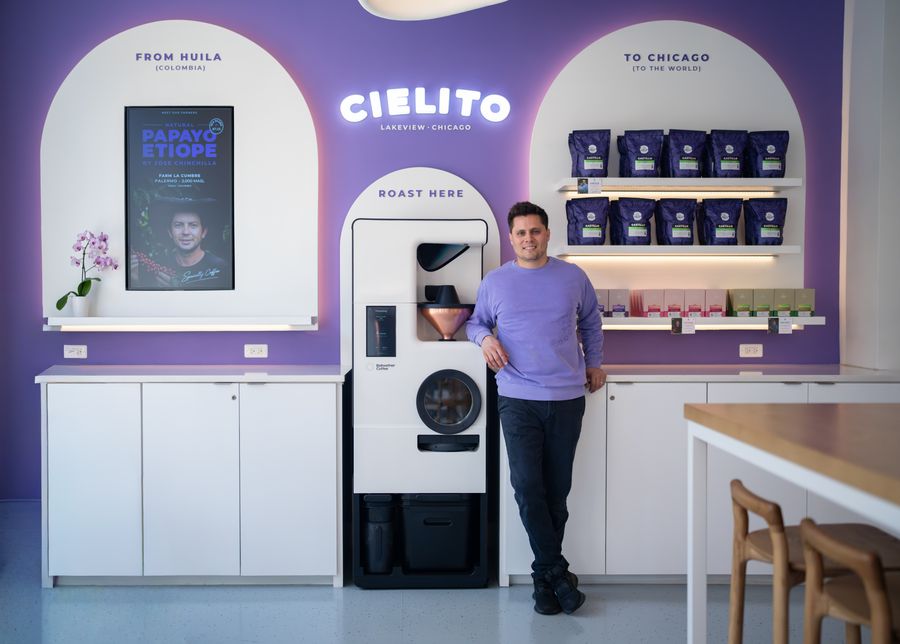
One decision that changes the long-term economics: whether to roast your own coffee. Adding an electric ventless roaster like the Bellwether Shop Roaster lets you cut coffee costs by 30–50% and creates a real differentiator your customers can taste. The roaster fits a 24.6" × 36.5" footprint, plugs into a 240V outlet (no gas lines or exhaust), produces 1.5 kg per batch at 3–4 batches per hour, and runs on automated profiles, so no roasting experience is required. Installation is $700–$2,500 vs. the $25,000–$80,000 needed for a traditional gas roaster setup.
On the inventory side, plan for two to four weeks of coffee, two weeks of milk and alternatives, an opening assortment of syrups and flavorings, two months of cups and consumables, and one week of pastries or food. Initial inventory typically runs $2,000–$6,000.
Step 7: Hiring and training (Weeks 30–38)
Build your team before opening, not on the fly during the first week. Staffing scales with format:
| Café size | Opening staff | Monthly payroll (estimate) |
|---|---|---|
| Kiosk | 2–4 part-time | $4,000–$8,000 |
| Small café | 4–6 (mix) | $8,000–$15,000 |
| Full café | 6–10 (mix) | $15,000–$25,000 |
Hire your opening manager or lead barista first — your most experienced person who can actually run the shop while you're learning. Then opening shift baristas (2–3 reliable people) and closing shift coverage (don't forget evening and weekend staff).
A real training program runs about 26–48 hours per new hire and covers six areas: coffee fundamentals (4–8 hours), espresso skills (8–16 hours), menu and recipes (4–8 hours), service standards (4–8 hours), operations including opening, closing, cleaning and inventory (4–8 hours), and POS and cash handling (2–4 hours). Start training two to four weeks before opening, then practice during the soft opening with real customers.
Step 8: Soft open and launch (Weeks 36–40)
A soft opening for one to two weeks is how you find every problem before the grand opening, when reviews and word-of-mouth start to set.
Run limited hours — start with 4–6 hours a day. Invite friends, family, and immediate neighbors. Use the time to work out equipment issues, refine processes and timing, train staff in real conditions, and gather feedback. The soft opening is the only chance you have to make mistakes in front of forgiving customers.
Marketing should ramp in parallel: build social media presence 4–8 weeks before opening to create anticipation, do local press outreach 2–4 weeks before for opening coverage, get signage and visibility up 2 weeks before so neighbors know, and plan a grand opening event in opening week to create buzz and traffic. Then sustain it with ongoing marketing.
Before grand opening, run through a final checklist: all permits posted, staff schedules confirmed, inventory stocked, equipment tested and working, POS and payments verified, opening cash ready, social media announcements scheduled, grand opening promotions planned, friends and family invited, and local press invited.
Common mistakes to avoid
Most first-time café owners fail in roughly the same ways. The financial mistakes: underestimating startup costs (always add a 20% contingency), insufficient working capital (budget 4–6 months of operating expenses), overspending on equipment before opening, and not accounting for a slow ramp-up period. The location mistakes: choosing based on rent cost alone, ignoring parking and accessibility, not verifying permitted use, and skipping demographic research. And the operational mistakes: opening with untrained staff, launching with full hours immediately, neglecting systems and processes, and ignoring early customer feedback. Each one is preventable with patience and a willingness to delay opening day if you're not actually ready.
Ready to build your coffee brand?
Take control of your margins
Save up to 50% on coffee costs with in-house roasting. Break even in month one, payback in six. Talk to our team about launching your roastery.