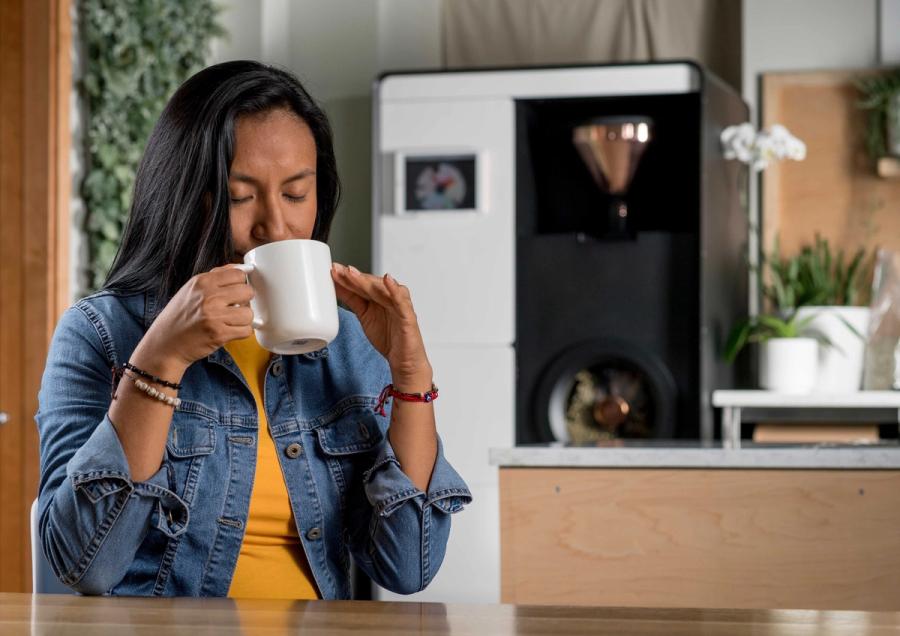
You want to roast your own coffee, but you don't have a warehouse. You have a café with limited counter space, a tight build budget, and a landlord who isn't excited about cutting a hole in the roof for an exhaust stack. The question isn't whether in-house roasting makes sense — the economics are hard to argue with. The question is whether a roaster small enough to fit your space can actually keep up with your business.
That's the real tension when you start shopping for a small commercial coffee roaster. Go too small and you're babysitting a machine all day. Go too big and you've spent money on capacity you don't need and infrastructure you can't install. Here's how to think about size, footprint, and scale so you buy the right machine the first time.
What "small" actually means for a café roaster
"Small" should describe the footprint, not the output. A roaster that fits on a counter shouldn't mean a roaster that can't feed your shop. The two things people conflate — physical size and production capacity — are separate problems, and a good small commercial roaster solves both.
The Bellwether Shop Roaster takes up about the same floor space as a commercial espresso machine. It roasts 1.5 kg (3.3 lb) per batch on demand, runs 15–20 kg (33–44 lb) in a standard 8-hour day, and scales to 80+ kg (176+ lb) a day with the Continuous Roasting upgrade and autoloader. For most single-location cafés doing a few hundred drinks a day, that base capacity is plenty, with room to grow into wholesale.
It's also the only electric, ventless, automatic commercial coffee roaster — which is exactly what makes "small" workable in a real café. It plugs into a standard 220V, 30-amp single-phase outlet. No gas line. No venting. No construction. An internal afterburner handles smoke and VOCs inside the machine, so you can put it in a customer-facing spot instead of hiding it in the back. It won the SCA Best New Product award in 2024, and it's UL 197, UL 710, NSF4, and CE certified.
Batch size, labor, and what your day actually looks like
A small roaster lives or dies on labor. A traditional drum roaster needs someone standing in front of it, watching the curve, the whole time. For a café owner already short on staff, that's a non-starter.
The difference is the automation. You load green coffee, pick a profile, press start. Labor runs about 2 minutes per roast, and you can train a new operator in under 20 minutes. Jorge at Hey My Coffee in Madrid put the contrast plainly:
"With our previous machine, someone had to be physically present throughout the entire roasting process, but with Bellwether you only need time to prepare and handle the roasted coffee afterward, saving us a lot in labor costs."
Doug at 1951 Coffee in Berkeley said the same about training: "We can teach someone in 20 minutes how to use the machine and roast. It really is that simple." For a startup where the owner wears every hat, that simplicity is the whole point. The roaster shouldn't become a second job.
Award-winning roasting technology
See the Shop Roaster
Best New Product 2024, Specialty Coffee Association. Electric, ventless, automatic — roast 1.5kg per batch or scale to 400 lbs/week with continuous roasting.
Counter space and install: what fits, what it needs
Here's the footprint math for planning your space:
| Need | Requirement |
|---|---|
| Counter footprint | Roughly the same as a commercial espresso machine |
| Power | 220V, 30-amp single-phase outlet |
| Gas line | None |
| Venting / ductwork | None |
| Construction / permits | None — plug in and roast |
Because there's no venting and no gas, you skip the part of in-house roasting that usually blows up the budget and the timeline. There's no exhaust hood, no rooftop penetration, no waiting weeks for a buildout. If you have a 240V outlet — and most commercial spaces do — an electrician can add a dedicated circuit in a couple of hours. That's the whole install.
Scaling without buying a second machine
The mistake startups make is buying for today's volume and outgrowing it in a year. A good small roaster should grow with you. With the Continuous Roasting upgrade and autoloader, you load the hopper once and the machine runs roast after roast — up to 80+ kg (176+ lb) a day. Tiffany at Tiabi Coffee & Waffle in Las Vegas described it this way: "The continuous roasting is a game changer. We can literally just load it, and it just goes."
That headroom is real. Donovan at Anchor and Tree Coffee in Sacramento runs a wholesale operation off Bellwether: "I am doing between 3,000 and 4,000 pounds a month as a wholesale coffee roaster, and I still have extra time to roast." And Barry at Recent Coffee Roasters in the UK credits the freed-up time for growth: "We're minimum 55% like-for-like year-on-year every year. And actually this last year with Bellwether, we've grown exponentially because we've been able to focus on other aspects of the business." A small footprint doesn't have to cap your ceiling.
The economics that make a small roaster worth it
A small commercial roaster only makes sense if the math works. It does. Roasters take roughly 67% of the gross margin in every pound of coffee — when you roast in-house, you keep it. A 24 lb bag of green runs about $140 (≈$5.83/lb), versus roasted wholesale at around $75 per 5 lb bag (≈$15/lb) — more than double per pound.
Most operators save up to 50% on coffee costs, which works out to $1,000–$5,000/month, with payback in as little as 6 months. You break even selling about 25 lb a week. The savings show up in real businesses:
- Doug, 1951 Coffee: "We were paying anywhere from $9 to $11 per pound for roasted coffee. Now, we're paying closer to $4 or $5 per pound."
- Peter, Wellborn Coffee: "We cut a lot out. At $20 a pound from our previous roaster, we'd lose money on every pound."
- Tony, Function Coffee Co.: "At the end of the year, we're able to actually see profit that we would not have been able to unlock had we gone with the third party wholesale vendor."
As Liam at High Grade Coffee in London put it: "Every coffee shop should eventually become its own roaster. It's the best way to control your margins. The coffee is one of the biggest costs in your cup."
Ready to roast in-house?
Take control of your margins
Save up to 50% on coffee costs with in-house roasting. Talk to our team about what Bellwether can do for your business.