You've priced a few roasters by now. Maybe you've got a tab open with a sticker number on it, and you're trying to figure out whether that number is the real number — or just the start of one. It almost never is. The machine is the part you see. The venting, the gas line, the buildout, the operator you'll have to train and pay — that's the part that shows up later, on a different invoice.
If you're already running a café and buying wholesale, you're paying for a roaster every single month. You just don't own it. So the better question isn't "how much does a roaster cost?" It's "what am I already spending, and what would it take to keep that money?" Let's break down both sides honestly.
The sticker price is only the first line item
Here's what commercial roasters actually run, before you've installed anything:
| Roaster | Type | Starting price |
|---|---|---|
| Mill City | Gas drum | $8,000–$50,000+ |
| Typhoon | Gas, fluid bed | ~$29,500+ |
| Stronghold | Electric, drum | ~$42,000+ |
| Bellwether Shop Roaster | Electric, ventless, automatic | $14,900 |
The spread is wide because these machines do not cost the same thing to *own*. A budget gas drum can look like a steal at $8,000 until you read the next section. And a premium electric like the Stronghold still requires exhaust venting, even though it doesn't burn gas.
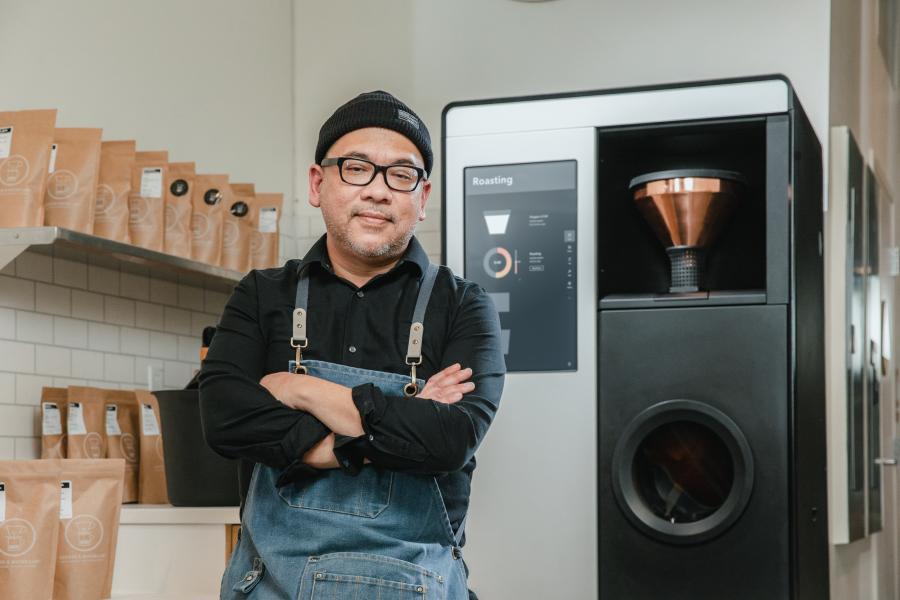
The Bellwether Shop Roaster is $14,900 (£11,900 in the UK, €13,900 in the EU), or $19,900 bundled with the Continuous Roasting Kit. That's the price. Not the price plus a contractor.
The hidden costs of gas roasters
This is where the real spending hides. A traditional gas roaster needs infrastructure before it can roast a single pound:
- A gas line run to the unit
- Exhaust venting and ductwork punched through your roof or wall
- An afterburner to handle smoke and emissions, often required by code
- Construction and permits to make all of that legal
Depending on your building, that's frequently tens of thousands of dollars on top of the machine — and weeks of downtime while it gets done. If you're in a leased space, a mall, a shared kitchen, or a historic building, you may not be allowed to do it at all.
The Bellwether skips that entire layer. It's the only electric, ventless, automatic commercial roaster — it plugs into a standard 220V, 30-amp single-phase outlet, the same kind of circuit your espresso machine uses. No gas. No venting. No construction. The afterburner is built inside the unit, so smoke is handled internally. It's UL 197, UL 710, NSF4, and CE certified, and it was named SCA Best New Product of 2024.
That's not a feature for a spec sheet. It's the difference between "roast next quarter, after the contractor finishes" and "roast this week."
Labor is a cost too — and most roasters charge you for it daily
A gas drum roaster needs someone standing at it. That's a wage, every roast, every day. Jorge at Hey My Coffee in Madrid switched from a previous machine and put it plainly:
"With our previous machine, someone had to be physically present throughout the entire roasting process, but with Bellwether you only need time to prepare and handle the roasted coffee afterward, saving us a lot in labor costs." — Jorge, Hey My Coffee
The Bellwether is automatic. About 2 minutes of labor per roast, and you can train an operator in under 20 minutes. Doug at 1951 Coffee in Berkeley said the same:
"We can teach someone in 20 minutes how to use the machine and roast. It really is that simple." — Doug, 1951 Coffee
That means you're not hiring a dedicated roaster. Your existing staff runs it between other tasks.
How much are you overpaying?
Calculate your savings
Your wholesaler takes 67% of the margin on every pound. See exactly how much you'd save roasting in-house with your current volume.
What you're already spending on wholesale
Here's the cost most owners never put on a spreadsheet: the roaster you're already renting. When you buy roasted coffee, the roaster takes roughly 67% of the gross margin in every pound. You're paying that markup whether you notice it or not.
The raw math: a 24 lb bag of green coffee runs about $140 — roughly $5.83/lb. Buy it roasted wholesale and you're looking at about $75 for a 5 lb bag, around $15/lb — more than double per pound. And someone else owns the freshness, the profile, and the brand.
Owners who switched feel it immediately. Doug at 1951 Coffee:
"We were paying anywhere from $9 to $11 per pound for roasted coffee. Now, we're paying closer to $4 or $5 per pound." — Doug, 1951 Coffee
Peter at Wellborn Coffee in Port Chester was losing money before the switch:
"We cut a lot out. At $20 a pound from our previous roaster, we'd lose money on every pound." — Peter, Wellborn Coffee
So what's the real cost — and the payback?
Put the two columns side by side and the picture changes. The Bellwether saves most operators $1,000–$5,000 per month on coffee — up to 50% of their coffee costs. Break-even comes at roughly 25 lb of roasted coffee per week, which most cafés clear without thinking. Payback can land in as little as 6 months.
Tony at Function Coffee Co. described what that does to the bottom line:
"Roasting in-house with the Bellwether has really unlocked a lot of margin for us because we're saving 40, 50% on what we would have otherwise spent, had we gone with third party beans for our cafe." — Tony, Function Coffee Co.
"At the end of the year, we're able to actually see profit that we would not have been able to unlock had we gone with the third party wholesale vendor." — Tony, Function Coffee Co.
Liam at High Grade Coffee in London put the principle bluntly:
"Every coffee shop should eventually become its own roaster. It's the best way to control your margins. The coffee is one of the biggest costs in your cup." — Liam, High Grade Coffee
Does cheaper roasting mean worse coffee?
The fear is fair: you're not just buying a price, you're buying quality. Tom Flay at Square Mile Coffee Roasters in London ran a blind test against his production gas roasters:
"We put our Bellwether roast on as well as production roast from our Probat machines. About 20-25 of our team were tasting. And no one could pick the production roast from the Bellwether roast. Most of them were the Bellwether roast as their favourite." — Tom Flay, Square Mile Coffee Roasters
The capacity scales when you grow, too. 1.5 kg per batch on demand, 15–20 kg in a standard 8-hour day, and 80+ kg per day with the Continuous Roasting upgrade and autoloader. Donovan at Anchor and Tree in Sacramento runs serious volume on it:
"I am doing between 3,000 and 4,000 pounds a month as a wholesale coffee roaster, and I still have extra time to roast." — Donovan, Anchor and Tree Coffee
If you want to see your own numbers, the *ROI calculator* takes about a minute — and our *wholesale vs. in-house roasting* breakdown walks through the full margin math.
Ready to roast in-house?
Take control of your margins
Save $1,000–5,000/month on coffee costs. Your wholesaler takes 67% of the margin on every pound — it’s time to take it back.