If you're shopping for a commercial roaster, the spec sheets start to blur together fast. One says "drum," another says "fluid bed," a third says "ventless," and the prices swing from $8,000 to over $80,000. Underneath all of it, the real question is simpler: what will this thing cost me to install, how much labor will it eat every week, and will the coffee actually be good?
This is a plain-English commercial coffee roaster comparison built around those three things. We'll line up the main roaster types — gas drum, electric drum, and electric ventless — and walk through where each one makes sense, so you can match the machine to the business you're actually running.
The three roaster types, side by side
Most commercial roasters fall into one of three buckets. The differences that matter to a buyer aren't really about the roasting chamber — they're about what you have to build around the machine and who has to stand in front of it.
| Heat source | Gas burner | Electric element | Electric element |
|---|---|---|---|
| Venting / exhaust | Required | Usually required | None — internal afterburner |
| Gas line | Required | Not needed | Not needed |
| Install | Full buildout (4–12 wks) | Buildout + exhaust | Plug in day one |
| Operation | Manual | Manual to semi | Fully automatic |
| Operator training | Days to weeks | Hours to days | Under 20 minutes |
| Starting price | ~$8,000–$80,000+ | ~$42,000+ | $14,900 |
| Examples | Mill City, Typhoon (fluid bed + gas) | Stronghold | Bellwether Shop Roaster |
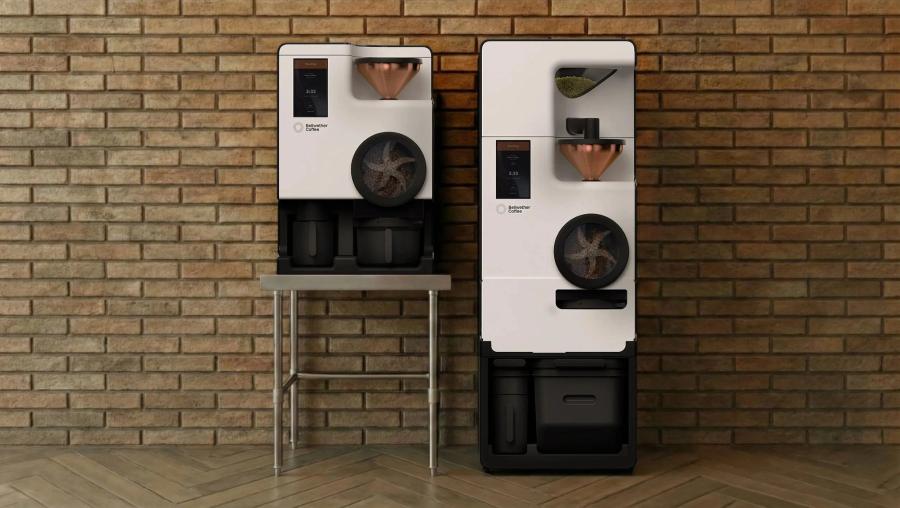
A few notes on the numbers above. Mill City gas drums start around $8,000 but require a full buildout and manual operation. Typhoon runs ~$29,500+ and uses a gas fluid-bed design that still needs venting. Stronghold is electric — a real advantage — but starts around $42,000+ and still requires exhaust venting and is only semi-automated. The Bellwether Shop Roaster is $14,900, plugs into a standard 220V / 30-amp outlet, and needs no gas, no venting, and no construction.
Gas drum roasters: the traditional default
Gas drum roasting is what most people picture when they hear "roaster." It's a proven craft format with decades behind it, and at the low end it can look cheap on the sticker.
The catch is everything around the machine. A gas roaster needs a gas line, an exhaust hood, ductwork, and usually a rooftop penetration — a buildout that can run weeks and add real money before you've roasted a single pound. It's also manual: someone has to stand there and run every batch. That's a fine fit if you have a dedicated roaster on staff, a back-of-house space already plumbed for gas, and the volume to justify the labor. For a café trying to add roasting alongside service, it's a heavy lift.
Award-winning roasting technology
See the Shop Roaster
Best New Product 2024, Specialty Coffee Association. Electric, ventless, automatic — roast 1.5kg per batch or scale to 400 lbs/week with continuous roasting.
Electric drum roasters: cleaner power, same plumbing
Electric drum roasters solve one big problem: no gas line. That's a genuine step forward, and machines like Stronghold roast well. But most electric drums still need exhaust venting, so you haven't escaped the ductwork and the buildout — and at $42,000+, the price is well above where a lot of single-location cafés want to be. You also stay in semi-automated territory, which means a trained hand is still part of the routine.
Electric drum is a solid middle ground if you want off-gas heating but already have an exhaust path and don't mind hands-on operation.
Electric ventless: built for the café that isn't a roastery
The Bellwether Shop Roaster is the only electric, ventless, automatic commercial coffee roaster — and it won the SCA's Best New Product award in 2024. The ventless part is the unlock: an internal afterburner neutralizes smoke and VOCs inside the machine, so nothing vents outside. No gas, no hood, no ductwork, no construction. It plugs into the same kind of outlet as your espresso machine and roasts on day one.
It's also automatic. You load green, pick a profile, press start. An operator can be trained in under 20 minutes, which means roasting gets delegated to existing staff instead of a specialist hire. Doug at 1951 Coffee in Berkeley put it simply: "We can teach someone in 20 minutes how to use the machine and roast. It really is that simple." Jorge at Hey My Coffee in Madrid felt the labor difference directly: *"With our previous machine, someone had to be physically present throughout the entire roasting process, but with Bellwether you only need time to prepare and handle the roasted coffee afterward, saving us a lot in labor costs."*
On capacity: each batch is 1.5 kg (3.3 lb) on demand, with 15–20 kg (33–44 lb) in a standard 8-hour day. Add the Continuous Roasting Kit and autoloader and you're at 80+ kg (176+ lb)/day. That's not a hobby ceiling — Donovan at Anchor and Tree in Sacramento said, *"I am doing between 3,000 and 4,000 pounds a month as a wholesale coffee roaster, and I still have extra time to roast."* It's certified to UL 197, UL 710, NSF4, and CE.
"But is automatic coffee actually good?"
Fair question — automation can sound like a shortcut on quality. The clearest answer comes from Square Mile in London, one of the most respected specialty roasters in the world. Tom Flay ran a blind tasting: "We put our Bellwether roast on as well as production roast from our Probat machines. About 20-25 of our team were tasting. And no one could pick the production roast from the Bellwether roast. Most of them were the Bellwether roast as their favourite."
The cost picture that doesn't show up on a spec sheet
Sticker price is only half the comparison. The bigger number is what you stop paying a wholesaler. Roasters take roughly 67% of the gross margin in every pound of coffee, and roasting in-house captures it. A 24 lb bag of green runs about $140 (≈$5.83/lb) versus two 5 lb bags of roasted wholesale at about $75 each (≈$15/lb) — more than double per pound.
That gap shows up in real P&Ls. Doug at 1951 Coffee: "We were paying anywhere from $9 to $11 per pound for roasted coffee. Now, we're paying closer to $4 or $5 per pound." Tony at Function Coffee Co.: *"Roasting in-house with the Bellwether has really unlocked a lot of margin for us because we're saving 40, 50% on what we would have otherwise spent."* Most operators save $1,000–$5,000/month, break even at about 25 lb/week, and reach payback in as little as 6 months.
Ready to roast in-house?
Take control of your margins
Save up to 50% on coffee costs with in-house roasting. Talk to our team about what Bellwether can do for your business.