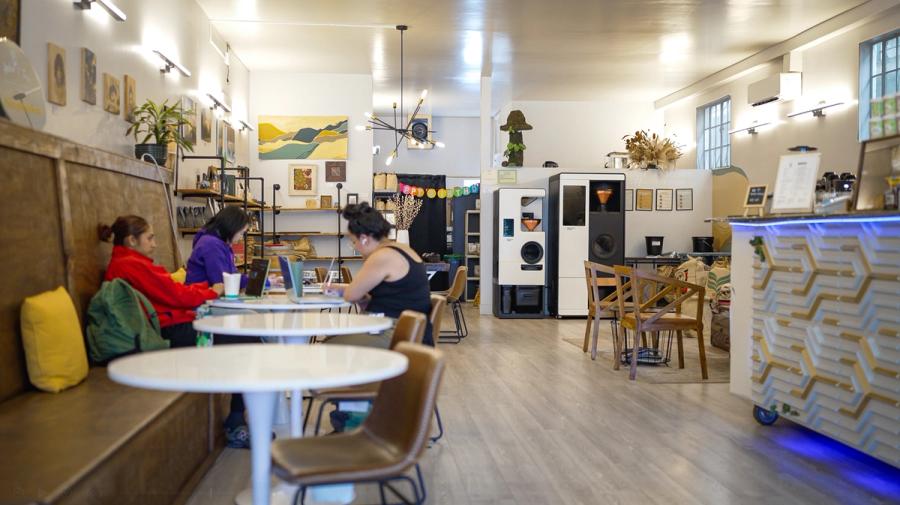
If you run a café, you already know coffee is one of the biggest costs in every cup you sell. At some point most owners start asking the same question: what would it take to roast our own? The honest answer used to be "a lot" — gas lines, an exhaust hood through the roof, permits, a trained roaster, and weeks of construction.
That answer has changed, and it's worth understanding why before you shop. This guide walks through what actually matters when you're sizing up a coffee roaster machine for a café — capacity, footprint, power, ease of use, and the money — so you can tell the difference between a machine built for a production warehouse and one built to live behind your counter.
Start With Capacity, Not Specs
Before you look at any machine, figure out how much coffee you actually go through. A café serving 150–400 drinks a day needs far less roasting capacity than most people assume, because fresh, on-demand roasting means you're never sitting on a warehouse of beans.
Here's a rough framework. The Bellwether Shop Roaster handles 1.5 kg (3.3 lb) per batch on demand, which is enough roasted coffee for roughly 75–100 drinks. Run a few batches across a normal shift and you're at 15–20 kg (33–44 lb) in a standard 8-hour day. That covers a single busy location with room to grow.
If you're running multiple sites, a wholesale program, or a high-volume bar, the math shifts. With the Continuous Roasting upgrade and autoloader, the same machine reaches 80+ kg (176+ lb) per day — you load green coffee once and it keeps going.
"I am doing between 3,000 and 4,000 pounds a month as a wholesale coffee roaster, and I still have extra time to roast." — Donovan, Anchor and Tree Coffee (Sacramento)
"The continuous roasting is a game changer. We can literally just load it, and it just goes." — Tiffany, Tiabi Coffee & Waffle (Las Vegas)
Footprint and Power: What Your Space Can Actually Handle
This is where most traditional coffee roaster machines knock themselves out of contention for a café. A gas drum roaster needs floor space, an exhaust hood, ductwork, a rooftop penetration, and often a separate room. That's a build-out, not an install.
The thing that makes in-counter roasting possible is ventless, all-electric design. The Bellwether Shop Roaster plugs into a standard 220V / 30-amp single-phase outlet — the same kind of circuit your espresso machine uses. No gas, no venting, no construction. An internal afterburner handles the smoke inside the unit, which is why it's the only electric, ventless, automatic commercial coffee roaster on the market and earned SCA Best New Product 2024.
It's also certified for the room it lives in: UL 197, UL 710, NSF4, and CE. That matters when you're dealing with a landlord or a health inspector — a machine that qualifies as food-prep equipment is a much easier conversation than one that reads as industrial roasting equipment.
A quick reality check on power and venting across common options:
| Machine | Power | Venting | Operation |
|---|---|---|---|
| Bellwether Shop Roaster | 220V electric outlet | None (internal afterburner) | Fully automatic |
| Stronghold (~$42,000+) | Electric | Exhaust venting required | Semi-automated |
| Typhoon (~$29,500+) | Gas | Gas + venting required | Semi-automated (fluid bed) |
| Mill City ($8,000–$50,000+) | Gas | Full venting + buildout | Manual |
Award-winning roasting technology
See the Shop Roaster
Best New Product 2024, Specialty Coffee Association. Electric, ventless, automatic — roast 1.5kg per batch or scale to 400 lbs/week with continuous roasting.
Ease of Use: Who's Actually Going to Run It
A traditional drum roaster is a craft skill. Someone has to learn it, stand at it, and watch every batch. For a café where the owner is already wearing six hats, that's a real cost — and a real risk every time that person takes a day off.
The dividing line between machines here is automation. With a fully automatic roaster, you load green coffee, pick a profile, press start, and walk back to the bar. Labor runs about 2 minutes per roast, and you can train an operator in under 20 minutes.
"We can teach someone in 20 minutes how to use the machine and roast. It really is that simple." — Doug, 1951 Coffee (Berkeley CA)
"With our previous machine, someone had to be physically present throughout the entire roasting process, but with Bellwether you only need time to prepare and handle the roasted coffee afterward, saving us a lot in labor costs." — Jorge, Hey My Coffee (Madrid)
And to be clear, automatic doesn't mean a worse cup. Square Mile Coffee Roasters in London put it to a blind test against their production machines:
"We put our Bellwether roast on as well as production roast from our Probat machines. About 20-25 of our team were tasting. And no one could pick the production roast from the Bellwether roast. Most of them were the Bellwether roast as their favourite." — Tom Flay, Square Mile Coffee Roasters
Reliability and the Numbers That Justify It
Two questions decide whether a coffee roaster machine is worth it for a café: will it hold up, and does the math work?
On durability, look for a published benchmark rather than a vague promise. The Shop Roaster averages 2,000 roasts before failure, which for a typical café is years of daily service.
On the money, this is the part that surprises owners. Roasters take roughly 67% of the gross margin in every pound of coffee — when you roast in-house, you capture it. A 24 lb bag of green coffee runs about $140 (roughly $5.83/lb) versus roasted wholesale at about $75 per 5 lb bag (around $15/lb) — more than double per pound. For most operators that's up to 50% savings, or $1,000–$5,000 a month, with payback in as little as 6 months and break-even at about 25 lb/week.
"We were paying anywhere from $9 to $11 per pound for roasted coffee. Now, we're paying closer to $4 or $5 per pound." — Doug, 1951 Coffee
"At $20 a pound from our previous roaster, we'd lose money on every pound." — Peter, Wellborn Coffee (Port Chester NY)
"Roasting in-house with the Bellwether has really unlocked a lot of margin for us because we're saving 40, 50% on what we would have otherwise spent, had we gone with third party beans for our cafe." — Tony, Function Coffee Co.
The Shop Roaster is $14,900 in the US, or $19,900 bundled with the Continuous Roasting Kit (£11,900 in the UK, €13,900 in the EU). As High Grade Coffee's Liam puts it: "Every coffee shop should eventually become its own roaster. It's the best way to control your margins. The coffee is one of the biggest costs in your cup."
Ready to roast in-house?
Take control of your margins
Save up to 50% on coffee costs with in-house roasting. Talk to our team about what Bellwether can do for your business.