If you run a café, you already know coffee is one of the biggest line items in your cup. At some point the question stops being "should we roast our own?" and becomes "which roaster is actually right for a space like ours?" That's a harder question than most buying guides admit, because the "best" roaster depends entirely on your space, your volume, your labor, and your building.
This is a practical guide to picking a commercial roaster for a café — not a back-of-house production facility. We'll walk through the real decision criteria first, honestly, and then show you where the Bellwether Shop Roaster fits.
What "best" actually means for a café
A roaster that's perfect for a 5,000-square-foot production roastery is often a terrible fit for a café. The criteria are different. Before you compare brands, compare your own constraints against these four:
- Space. Most café equipment guides assume you have a dedicated roasting room. You probably don't. The honest question is: do you have a corner, a counter, or a closet? A traditional drum roaster needs clearance, a hood, and ducting. That alone disqualifies a lot of machines for a lot of cafés.
- Building requirements. Gas line? Exhaust venting? Rooftop penetration? These aren't roaster costs — they're construction costs, and they often dwarf the price of the machine. If you lease, your landlord may not even allow them.
- Labor. Who's going to run it? A roaster that needs a trained operator standing over it for the whole cycle is a payroll decision, not just an equipment one. A roaster a barista can start between drinks is a different kind of machine entirely.
- Budget — and payback. Sticker price matters, but the number that actually matters is how fast the machine pays for itself in coffee savings. A cheaper roaster that needs $20,000 in buildout isn't cheaper.
Get clear on those four before you look at a single spec sheet. Now let's look at how the main options stack up against them.
The honest comparison
Here's a factual look at how a few commonly considered commercial roasters compare on the criteria that matter most to a café. Prices are starting points and change; treat them as ballpark.
| Roaster | Starting price | Gas? | Venting? | Operation |
|---|---|---|---|---|
| Bellwether Shop Roaster | $14,900 | No | No | Fully automatic |
| Stronghold | ~$42,000+ | No (electric) | Yes, exhaust required | Semi-automated |
| Typhoon | ~$29,500+ | Yes | Yes | Fluid bed, semi-automated |
| Mill City | ~$8,000–$50,000+ | Yes | Yes | Manual, full buildout |
A few honest takeaways. Mill City has the lowest entry price on the list, but it's a gas drum roaster that requires a full buildout and manual operation — the construction and labor costs can easily exceed the machine. Typhoon is a capable fluid-bed roaster, but it runs on gas and needs venting, so the building requirements still apply. Stronghold is electric, which is a real advantage, but it still requires exhaust venting and lands at roughly double the Bellwether's starting price.
The pattern: almost every commercial roaster forces you back to the same three problems — gas, venting, and a skilled operator. For a café, those three are usually the dealbreakers.
Award-winning roasting technology
See the Shop Roaster
Best New Product 2024, Specialty Coffee Association. Electric, ventless, automatic — roast 1.5kg per batch or scale to 400 lbs/week with continuous roasting.
Where the Bellwether Shop Roaster fits
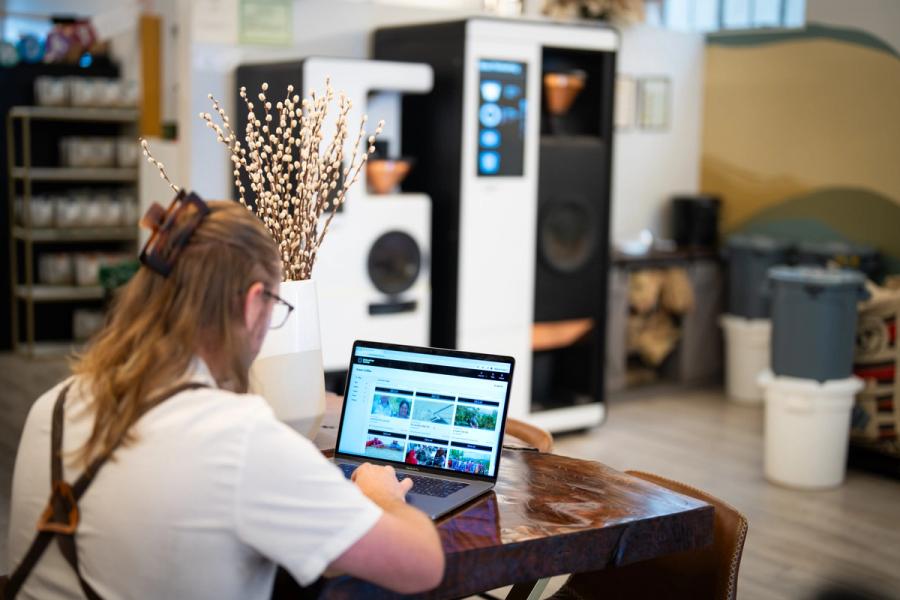
The Bellwether Shop Roaster is the only electric, ventless, automatic commercial coffee roaster — it won the SCA's Best New Product award in 2024. It's built specifically for the café case, which is why it answers those four criteria differently than everything else on the list.
On space and building requirements: it plugs into a standard 220V, 30-amp single-phase outlet — the same kind of circuit your espresso machine uses. No gas, no venting, no ductwork, no construction. An internal afterburner neutralizes smoke inside the unit, so nothing vents outside. It's certified to UL 197, UL 710, NSF4, and CE. That's what makes it work in spaces a traditional roaster can't go.
On labor: roasting is automatic. A roast takes about 2 minutes of labor, and you can train an operator in under 20 minutes. Doug at 1951 Coffee in Berkeley put it plainly: *"We can teach someone in 20 minutes how to use the machine and roast. It really is that simple."* Jorge at Hey My Coffee in Madrid framed the contrast with his old machine: *"With our previous machine, someone had to be physically present throughout the entire roasting process, but with Bellwether you only need time to prepare and handle the roasted coffee afterward, saving us a lot in labor costs."*
On capacity: it roasts 1.5 kg (3.3 lb) per batch on demand, 15–20 kg (33–44 lb) in a standard 8-hour day, and 80+ kg (176+ lb) per day with the Continuous Roasting upgrade and autoloader. That covers a single café with room to grow — and it scales further than people expect. Tiffany at Tiabi Coffee & Waffle in Las Vegas said of the upgrade: *"The continuous roasting is a game changer. We can literally just load it, and it just goes."* And Donovan at Anchor and Tree Coffee in Sacramento runs a full wholesale operation on it: *"I am doing between 3,000 and 4,000 pounds a month as a wholesale coffee roaster, and I still have extra time to roast."*
The number that decides it: payback
Here's the part that turns "nice equipment" into a business decision. Roasters take roughly 67% of the gross margin in every pound of coffee. When you buy roasted, you're handing that margin to someone else. A 24 lb bag of green coffee runs about $140 (roughly $5.83/lb), while roasted wholesale runs about $75 per 5 lb bag — roughly $15/lb, more than double per pound.
That gap is real money. Most operators save up to 50% on coffee costs — $1,000 to $5,000 a month — and reach payback in as little as 6 months. Break-even comes at about 25 lb per week, which is a modest café.
The customer numbers say it best. Peter at Wellborn Coffee in Port Chester: *"We cut a lot out. At $20 a pound from our previous roaster, we'd lose money on every pound."* Doug at 1951 Coffee: *"We were paying anywhere from $9 to $11 per pound for roasted coffee. Now, we're paying closer to $4 or $5 per pound."* And Tony at Function Coffee Co. on the bottom line: *"At the end of the year, we're able to actually see profit that we would not have been able to unlock had we gone with the third party wholesale vendor."*
If you want to skip the guesswork on freshness, see our freshness-gap guide; if you're weighing whether to roast in-house at all, our wholesale-vs-in-house breakdown walks through the economics.
The quick answer
The best commercial coffee roaster for your café is the one that fits your space, doesn't force a construction project, can be run by your existing staff, and pays for itself fast. For most cafés, that rules out gas-and-vented machines on practical grounds before quality ever enters the conversation. And on quality, the Bellwether holds up: Tom Flay of Square Mile Coffee Roasters in London ran a blind tasting against their Probat production roasters — *"About 20-25 of our team were tasting. And no one could pick the production roast from the Bellwether roast. Most of them were the Bellwether roast as their favourite."*
As Liam at High Grade Coffee in London put it: *"Every coffee shop should eventually become its own roaster. It's the best way to control your margins. The coffee is one of the biggest costs in your cup."*
Ready to roast in-house?
Take control of your margins
Save up to 50% on coffee costs with in-house roasting. Talk to our team about what Bellwether can do for your business.