You already know how much you spent on coffee last month. You signed the invoice. What you may not know is how that number breaks down once it leaves your supplier's loading dock — and how much of it you're handing over for work you could do yourself, in your own shop, in about two minutes a batch.
This is the comparison most café owners never run all the way to the bottom line. Not because they're lazy, but because "we've always bought wholesale" is a comfortable answer, and changing anything in a working business feels risky. So let's do the math honestly — including the parts where roasting in-house doesn't make sense — and let you decide.
Start with the per-pound number
Here's the cleanest way to see the gap. A 24 lb bag of green coffee runs about $140. That same coffee, bought already roasted at wholesale, runs about $15/lb — two 5 lb bags at roughly $75 each. You're paying more than double per pound for one step: someone else putting heat to the bean.
Real operators see this play out fast. At 1951 Coffee in Berkeley, Doug put it plainly: *"We were paying anywhere from $9 to $11 per pound for roasted coffee. Now, we're paying closer to $4 or $5 per pound."* At Wellborn Coffee in Port Chester, Peter was even blunter about the math that pushed him: *"We cut a lot out. At $20 a pound from our previous roaster, we'd lose money on every pound."*
For most operators, roasting in-house cuts coffee costs by up to 50%. That typically lands between $1,000 and $5,000 a month depending on your volume. Not a rounding error — that's a line item that changes whether your year ends in the black.
The 67% nobody talks about
Walk a pound of coffee back to the farm and the margin splits in a way that surprises people. The grower, the trader, and the shipper together take a minority share. The roaster takes roughly 67% of the gross margin in every pound. That's the single biggest cut between the cherry on the tree and the cup on your counter.
When you buy wholesale, that 67% belongs to your supplier. When you roast in-house, it belongs to you. That's the whole argument in one number. As Liam at High Grade Coffee in London said: *"Every coffee shop should eventually become its own roaster. It's the best way to control your margins. The coffee is one of the biggest costs in your cup."*
Tony at Function Coffee Co. watched it show up where it counts: *"At the end of the year, we're able to actually see profit that we would not have been able to unlock had we gone with the third party wholesale vendor."*
The freshness gap is the part your customers taste
Money is half the story. The other half is the cup. Wholesale coffee is roasted on someone else's schedule, then bagged, shipped, warehoused, and shelved. By the time it reaches your hopper, days or weeks have passed. That's the freshness gap — the distance between roasted last month and roasted this week.
When you roast on-site, you close it. You roast what you need, when you need it, and serve coffee at peak flavor. That's the difference customers notice without knowing why, and it's the difference that earns a second visit. It's also a brand you control: your roast, your profile, your name behind it.
A fair worry is whether a smaller automatic roaster can actually hit the quality bar. Square Mile Coffee Roasters in London ran the test. Tom Flay: *"We put our Bellwether roast on as well as production roast from our Probat machines. About 20-25 of our team were tasting. And no one could pick the production roast from the Bellwether roast. Most of them were the Bellwether roast as their favourite."* That's one of the world's most respected specialty teams, blind-tasting against their own production machines.
How much are you overpaying?
Calculate your savings
Your wholesaler takes 67% of the margin on every pound. See exactly how much you'd save roasting in-house with your current volume.
What roasting in-house actually costs you in labor and space
This is where a lot of owners assume the hidden costs eat the savings. They don't, but you should know the real numbers.
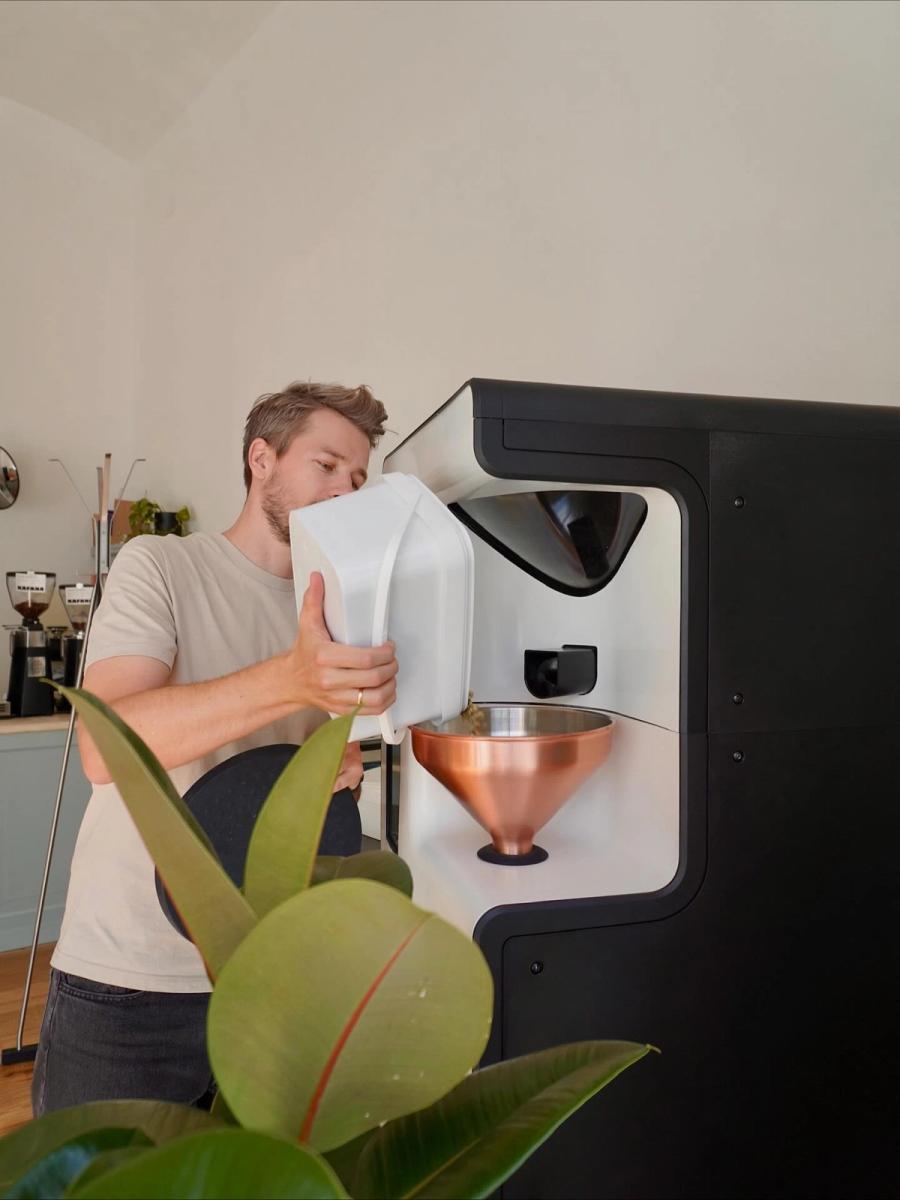
The Bellwether Shop Roaster is the only electric, ventless, automatic commercial roaster — SCA Best New Product 2024. It plugs into a standard 220V / 30-amp outlet. No gas line, no exhaust hood, no construction. The internal afterburner handles smoke and VOCs, so it can sit in a customer-facing spot.
- Labor: about 2 minutes per roast. You can train an operator in under 20 minutes. Doug at 1951 again: *"We can teach someone in 20 minutes how to use the machine and roast. It really is that simple."*
- No babysitting: Jorge at Hey My Coffee in Madrid: *"With our previous machine, someone had to be physically present throughout the entire roasting process, but with Bellwether you only need time to prepare and handle the roasted coffee afterward, saving us a lot in labor costs."*
- Footprint: less than 4.5 sq ft of counter — about the same as a commercial espresso machine.
- Capacity: 1.5 kg (3.3 lb) per batch on demand; 15–20 kg in a standard 8-hour day. With the Continuous Roasting upgrade and autoloader, 80+ kg/day. Tiffany at Tiabi Coffee & Waffle: *"The continuous roasting is a game changer. We can literally just load it, and it just goes."*
When it does — and doesn't — make sense
Honesty matters here, so let's draw the line.
It makes sense when you're moving meaningful volume. Break-even is around 25 lb/week — past that, every pound you roast instead of buy is money kept. Most operators see payback in as little as 6 months, after which the savings are pure margin. If you're a multi-location operator or want to add wholesale accounts, the case gets stronger. Donovan at Anchor and Tree in Sacramento: *"I am doing between 3,000 and 4,000 pounds a month as a wholesale coffee roaster, and I still have extra time to roast."*
It makes less sense when you sell very little coffee — a few pounds a week — or you're closing soon and can't capture the payback. If coffee is a minor afterthought on your menu, the wholesale convenience may be worth the premium. There's no shame in that math.
For most established cafés doing real coffee volume, though, the wholesale-vs-roasting-in-house decision isn't close once you write the numbers down. Barry at Recent Coffee Roasters captured the upside beyond the line item: *"We're minimum 55% like-for-like year-on-year every year. And actually this last year with Bellwether, we've grown exponentially because we've been able to focus on other aspects of the business."*
The roaster is $14,900 (US), or $19,900 bundled with the Continuous Roasting Kit. UK pricing is £17,000; EU is €20,000. Run your own volume through the ROI calculator and see where you land — the math is specific to your shop, not a generic claim.
Ready to roast in-house?
Take control of your margins
Save $1,000–5,000/month on coffee costs. Your wholesaler takes 67% of the margin on every pound — it’s time to take it back.