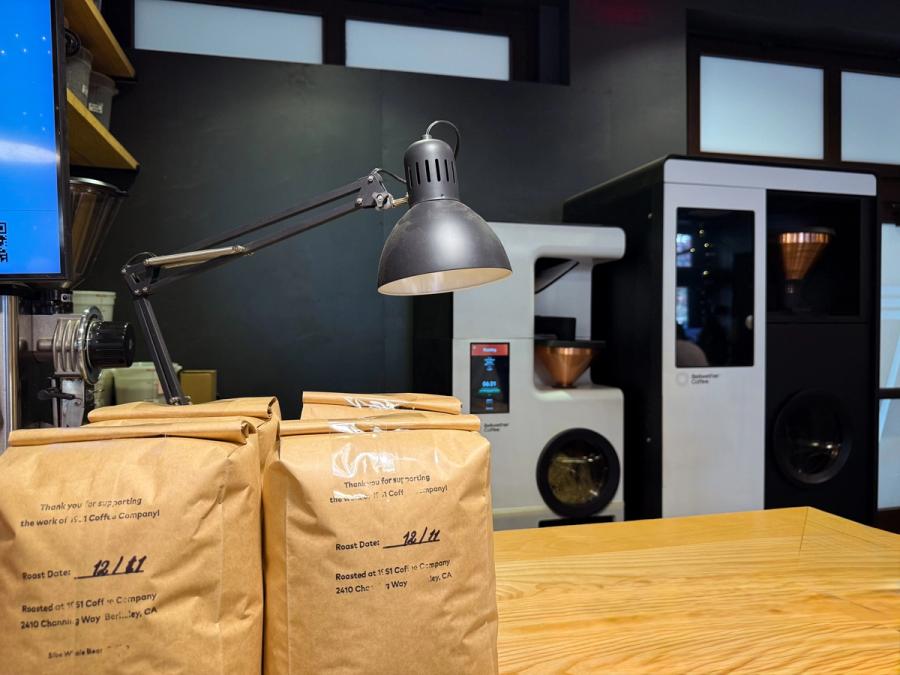
You've probably run a version of this math in your head while staring at a wholesale invoice. The price went up again. The margin on every cup got a little thinner. And somewhere in the back of your mind, a question keeps circling: would it actually be cheaper to roast this coffee myself?
It's a fair question, and the honest answer is *yes — but only if you do the real math, not the dream math.* Below is the green-vs-roasted comparison, the break-even volume, and the handful of variables that decide whether roasting your own coffee saves you money or just gives you a new chore.
The per-pound math: green vs. roasted
Start with the number that matters most — what you pay per pound. Roasted wholesale coffee typically runs a café somewhere in the $9 to $20 per pound range, depending on quality and supplier. Green coffee, the raw bean you'd roast yourself, costs a fraction of that.
Here's a concrete comparison. A 24 lb bag of green coffee runs about $140 — roughly $5.83/lb. That same coffee bought roasted runs far more: wholesale roasted commonly lands around $15/lb (about $75 for a 5 lb bag), more than double per pound. The roaster's markup is where the money goes, and it's not a small markup. Roasters take about 67% of the gross margin in every pound of coffee. When you roast in-house, you capture that.
| 24 lb of coffee | ~$280 | ~$140 (green) |
|---|---|---|
| Your share of the margin | ~33% | ~100% |
| Who controls freshness | Your supplier | You |
Doug at 1951 Coffee in Berkeley put real numbers on it after they switched: "We were paying anywhere from $9 to $11 per pound for roasted coffee. Now, we're paying closer to $4 or $5 per pound." That's not a rounding-error savings. That's cutting your single biggest coffee cost roughly in half.
For some operators the gap was even more stark. Peter at Wellborn Coffee in Port Chester was blunt about where they'd been: "We cut a lot out. At $20 a pound from our previous roaster, we'd lose money on every pound." When your roasted cost climbs that high, "is it cheaper to roast your own coffee" stops being a hypothetical and becomes a survival question.
What "cheaper" really means once you add the equipment
Of course, the per-pound savings have to pay for the roaster. So the real question isn't just *is green cheaper than roasted* — obviously it is — it's *how fast does the equipment pay for itself.*
A Bellwether Shop Roaster is $14,900 (or $19,900 bundled with the Continuous Roasting upgrade). That's a real number, and we won't pretend otherwise. But here's how it pencils out:
- Most operators save $1,000–$5,000 per month on coffee costs.
- That's up to 50% off what they were spending on roasted beans.
- Payback comes in as little as 6 months.
- You break even at roughly 25 lb of coffee per week — well within range for most single-location cafés.
Tony at Function Coffee Co. described the margin shift plainly: "Roasting in-house with the Bellwether has really unlocked a lot of margin for us because we're saving 40, 50% on what we would have otherwise spent, had we gone with third party beans for our cafe." And then the part every owner actually cares about at year-end: "At the end of the year, we're able to actually see profit that we would not have been able to unlock had we gone with the third party wholesale vendor."
That's the whole game. The savings aren't a one-time event — they compound every single month after payback. Once the roaster is paid off, the difference between green and roasted is pure margin.
How much are you overpaying?
Calculate your savings
Your wholesaler takes 67% of the margin on every pound. See exactly how much you'd save roasting in-house with your current volume.
The hidden cost people forget: labor
Here's where a lot of "should I roast my own coffee" calculations go wrong. People assume in-house roasting means hiring a roaster or burning hours of staff time. That's true on a traditional drum roaster. It is not true here.
The Shop Roaster is electric, ventless, and automatic. It plugs into a standard 220V / 30-amp outlet — no gas, no venting, no construction. A roast takes about 2 minutes of labor, and you can train an operator in under 20 minutes. Doug at 1951 Coffee confirmed it: "We can teach someone in 20 minutes how to use the machine and roast. It really is that simple."
Jorge at Hey My Coffee in Madrid had used a previous roasting machine and felt the labor difference directly: "With our previous machine, someone had to be physically present throughout the entire roasting process, but with Bellwether you only need time to prepare and handle the roasted coffee afterward, saving us a lot in labor costs."
So when you build your "is it cheaper" model, the labor line stays small. That's the variable that makes the savings real instead of theoretical.
What changes the answer
Roasting your own coffee is cheaper for most cafés, but not infinitely so. A few things move the needle:
- Volume. Below ~25 lb/week, the savings are thinner and payback is slower. The more coffee you sell, the faster the roaster pays for itself. At higher volumes — Anchor and Tree's Donovan in Sacramento runs "between 3,000 and 4,000 pounds a month as a wholesale coffee roaster, and I still have extra time to roast" — the economics get dramatic.
- What you currently pay. If your roasted cost is $9/lb, the gap is good. If it's $20/lb like Wellborn's was, the gap is enormous.
- Whether you can sell more because of it. Fresher coffee and your own brand can grow revenue, not just cut cost. Barry at Recent Coffee Roasters in the UK said they're "minimum 55% like-for-like year-on-year every year. And actually this last year with Bellwether, we've grown exponentially because we've been able to focus on other aspects of the business."
For higher-volume operations, the Continuous Roasting upgrade and autoloader push capacity to 80+ kg (176+ lb) per day. Tiffany at Tiabi Coffee & Waffle in Las Vegas called it "a game changer. We can literally just load it, and it just goes."
The bottom line: for the vast majority of cafés serving real volume, it is genuinely cheaper to roast your own coffee — and the savings keep compounding long after the equipment is paid off. As Liam at High Grade Coffee in London put it: "Every coffee shop should eventually become its own roaster. It's the best way to control your margins. The coffee is one of the biggest costs in your cup."
Ready to roast in-house?
Take control of your margins
Save $1,000–5,000/month on coffee costs. Your wholesaler takes 67% of the margin on every pound — it’s time to take it back.