If you serve coffee for a living, you've probably done the math at least once: the coffee in your cup is one of your biggest costs, and most of that money is going to whoever roasts it. Buying a coffee roasting machine is how you take that margin back — but the moment you start shopping, you hit a wall of decisions. Electric or gas? Drum or fluid bed? Do you need a hood and a gas line? How big is big enough?
This guide walks through what actually matters when you're choosing a coffee roasting machine for a café or growing coffee business. We'll cover the real differences between electric and gas, what installation actually costs, how much capacity you need, and the questions worth asking before you spend a dollar.
Why cafés are buying their own roasting machine
The case is simple and it's about money. In every pound of coffee, the roaster takes roughly 67% of the gross margin. When you buy roasted wholesale, that share leaves your business. When you roast in-house, you keep it.
The numbers from real operators are blunt. Doug at 1951 Coffee in Berkeley put it this way: "We were paying anywhere from $9 to $11 per pound for roasted coffee. Now, we're paying closer to $4 or $5 per pound." Peter at Wellborn Coffee in Port Chester was even more direct: "We cut a lot out. At $20 a pound from our previous roaster, we'd lose money on every pound."
A 24 lb bag of green coffee runs about $140 (about $5.83/lb). Bought roasted at wholesale, the same volume runs far more — roughly $15/lb, or two 5 lb bags at $75 each — more than double per pound. Across a year, most operators save $1,000–$5,000/month and capture up to 50% on their coffee costs. Tony at Function Coffee Co. described the payoff at the bottom line: "At the end of the year, we're able to actually see profit that we would not have been able to unlock had we gone with the third party wholesale vendor."
A coffee roasting machine isn't a cost — for most cafés it pays for itself. The question is which one fits your space, your staff, and your volume.
Electric vs. gas coffee roasting machines
This is the first real fork in the road, and it shapes everything else — your install bill, where you can put the machine, and how much your team has to learn.
Gas roasters are the traditional choice. They burn propane or natural gas to heat a drum. They produce excellent coffee in skilled hands, but they come with infrastructure: a gas line, an exhaust hood, ductwork, and usually a roof penetration to vent smoke outside. That means construction, permits, and a buildout timeline measured in weeks. Most also require a trained operator watching the roast the whole way through.
Electric roasters heat without combustion. That removes the gas line and lowers the carbon footprint — an all-electric machine roasts with up to 87% lower carbon than a comparable gas roaster. But here's the catch most buyers miss: being electric doesn't automatically mean ventless. Plenty of electric roasters still require an exhaust system to clear smoke and VOCs.
That distinction matters more than electric-vs-gas alone:
- Gas + venting — the traditional setup. Highest install cost, most construction, most operator skill.
- Electric + venting — cleaner energy, but you still need an exhaust path and the buildout that comes with it.
- Electric + ventless — no gas, no hood, no ductwork. Plugs in and roasts.
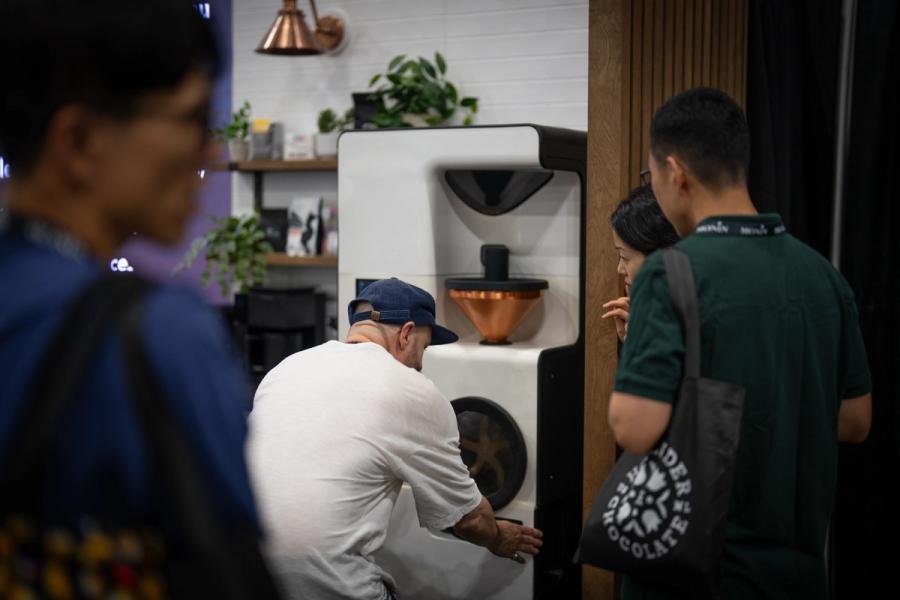
The Bellwether Shop Roaster is the only electric, ventless, automatic commercial roasting machine on the market — named SCA Best New Product 2024. It runs on a standard 220V / 30-amp single-phase outlet, the same kind of circuit your espresso machine uses. An internal afterburner neutralizes smoke and VOCs inside the unit, so nothing vents outside the building. No gas, no hood, no construction.
That's what unlocks locations a traditional machine can't touch — mall food courts, office cafés, historic buildings, shared kitchens. Anywhere with the right outlet.
Award-winning roasting technology
See the Shop Roaster
Best New Product 2024, Specialty Coffee Association. Electric, ventless, automatic — roast 1.5kg per batch or scale to 400 lbs/week with continuous roasting.
What a coffee roasting machine actually costs
Sticker price is only part of the story. Here's a rough comparison of commercial options:
| Machine | Starting price | Gas | Venting | Operation |
|---|---|---|---|---|
| Mill City | $8,000–$50,000+ | Yes | Yes | Manual, full buildout |
| Typhoon | ~$29,500+ | Yes | Yes | Semi-automated, fluid bed |
| Stronghold | ~$42,000+ | No (electric) | Yes (exhaust) | Semi-automated |
| Bellwether Shop Roaster | $14,900 | No | No | Fully automatic |
A few honest notes. A budget gas drum looks cheap until you add the gas line, the hood, the ductwork, and the permits — that hidden buildout often costs more than the machine. Electric machines that still need exhaust, like Stronghold, save you the gas line but not the venting. The Bellwether sits at $14,900 for the Shop Roaster, or $19,900 bundled with the Continuous Roasting Kit (base Shop Roaster £11,900 UK / €13,900 EU), with no buildout to add on top.
On ROI: most operators hit payback in as little as 6 months and break even at roughly 25 lb/week. So the right way to read the price tag is against the wholesale bill it replaces.
How to choose the right capacity
Don't overbuy, and don't undersize yourself into a corner. Think in terms of a normal week.
The Bellwether roasts 1.5 kg (3.3 lb) per batch on demand, which adds up to 15–20 kg (33–44 lb) in a standard 8-hour day — plenty for most single cafés. When you outgrow that, the Continuous Roasting upgrade with an autoloader pushes you to 80+ kg (176+ lb) per day: you load green once and it keeps cycling. Tiffany at Tiabi Coffee & Waffle in Las Vegas put it plainly: "The continuous roasting is a game changer. We can literally just load it, and it just goes."
And this scales further than people expect. Donovan at Anchor and Tree in Sacramento runs a full wholesale operation on it: "I am doing between 3,000 and 4,000 pounds a month as a wholesale coffee roaster, and I still have extra time to roast."
Don't forget labor and skill
A coffee roasting machine you can't staff isn't a machine — it's a bottleneck. Traditional roasters need a trained operator standing by for the whole roast. Automatic roasters don't.
This is where in-house roasting either frees you up or chains you down. Jorge at Hey My Coffee in Madrid switched and felt the difference immediately: "With our previous machine, someone had to be physically present throughout the entire roasting process, but with Bellwether you only need time to prepare and handle the roasted coffee afterward, saving us a lot in labor costs."
On the Bellwether, a roast takes about 2 minutes of labor, and you can train an operator in under 20 minutes. As Doug at 1951 Coffee said: "We can teach someone in 20 minutes how to use the machine and roast. It really is that simple." That means you delegate to existing staff instead of hiring a roaster.
And automatic doesn't mean lower quality. When Square Mile Coffee Roasters in London ran a blind test, Tom Flay reported: "We put our Bellwether roast on as well as production roast from our Probat machines. About 20-25 of our team were tasting. And no one could pick the production roast from the Bellwether roast. Most of them were the Bellwether roast as their favourite."
Ready to roast in-house?
Take control of your margins
Save up to 50% on coffee costs with in-house roasting. Talk to our team about what Bellwether can do for your business.