You don't need to be a barista or restaurant veteran to open a successful coffee shop. Plenty of thriving cafés are owned by career changers, first-time entrepreneurs, and people who simply love coffee. What you do need is a realistic understanding of what you don't know — and a plan to fill those gaps before you sign a lease.
This guide is for the aspiring café owner without industry experience: what's actually required, what skills you need to develop, what you can hire or outsource, and how to set yourself up so the gap between you and an experienced operator doesn't become the difference between a café that works and one that doesn't.
What experience do you actually need?
There are five core knowledge areas that matter, and most of them you can develop in a few months if you're committed:
| Area | Why it matters | How to learn |
|---|---|---|
| Coffee basics | Product quality and credibility | Training, practice, courses |
| Business fundamentals | Financial viability | Books, courses, mentors |
| Customer service | Repeat business | Any service job experience |
| People management | Team execution | Learn on the job, mentorship |
| Food safety | Legal requirement | Required certifications |
What you don't need is just as important. You don't need to be a professional barista — you can hire one. You don't need to be a chef — you can buy from a local bakery. You don't need to be a restaurant manager — you can learn. You don't need to be an expert roaster — you can buy great coffee or use automated equipment. Prior food service, coffee industry, management, or business ownership experience is helpful but not required. What successful inexperienced owners share are a strong work ethic, a willingness to learn, financial resources or access to them, a clear concept and vision, the ability to hire well, and a customer-first mindset.
Skills to develop before opening
Coffee knowledge first. At minimum, understand espresso extraction basics (what makes a good shot vs. a bad one), milk steaming fundamentals, common drink recipes, coffee freshness and storage, and basic quality assessment. You can learn this through barista training courses (1–5 days are widely available), YouTube tutorials and online courses, practice at home with a real espresso machine, work or volunteer at a café even briefly, and visiting many coffee shops to observe. Specialty Coffee Association courses, local roaster training programs, dedicated barista training schools, community college hospitality programs, and platforms like Udemy and Skillshare all work.
Business basics next. You need to be able to read financial statements (P&L, cash flow), do basic accounting and bookkeeping, develop a pricing strategy, control costs, and pick legal structures (LLC, permits). The free resources here are excellent — SCORE and SBA workshops are free, books on restaurant and café management are inexpensive, accounting basics courses run on most online platforms, and a business mentor or advisor is one of the highest-leverage investments you can make.
Management skills are the third area. Hiring and interviewing, training and development, scheduling and labor management, performance feedback, and conflict resolution — these can be learned from management books and podcasts, a mentor with management experience, and from your own hires (hiring experienced people is itself a way to learn).
What to hire and what to outsource
The single most important hire is a lead barista or manager with real café experience. They know coffee preparation, understand café operations, can train other staff, and handle day-to-day operations while you're learning. Look for 2+ years café experience, training capability, leadership qualities, and someone who shares your vision. Pay above market for experience — it's worth it. A good lead barista is the bridge that gets you from "I don't know how to run this" to "I know enough to run this" without paying tuition in lost customers.
Beyond that one critical hire, several functions are better outsourced than learned from scratch:
| Function | Outsource to | Approximate cost |
|---|---|---|
| Accounting | Bookkeeper / CPA | $200–$500/month |
| Legal setup | Business attorney | $500–$2,000 |
| Equipment install | Vendor technicians | Often included |
| Build-out | General contractor | Varies |
| Marketing | Freelancer / agency | $500–$2,000/month |
| HR / payroll | Payroll service | $50–$150/month |
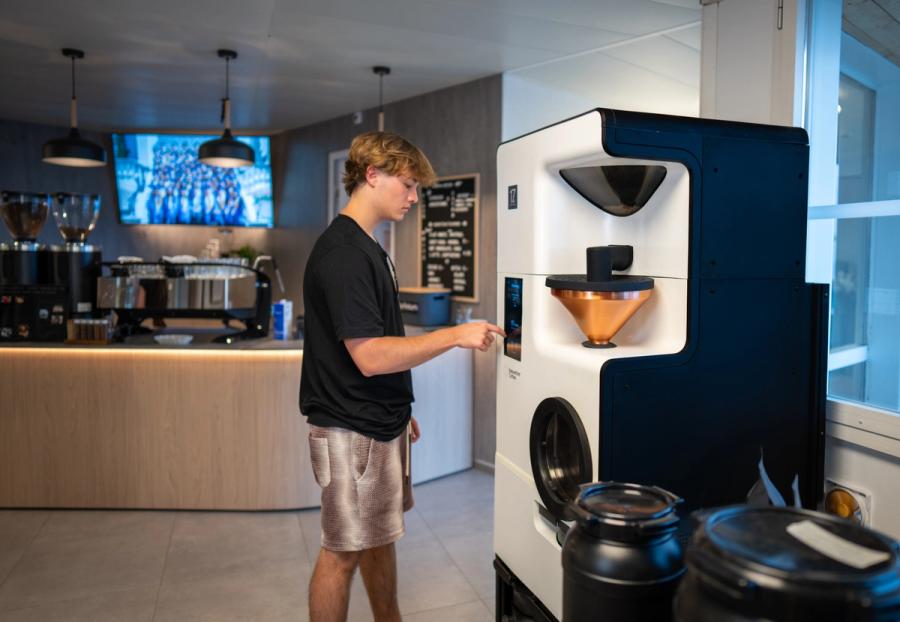
On the buy-vs-build question: buy your coffee from a quality roaster (or use an automated roaster like Bellwether with a profile library, which lets you produce specialty-grade coffee without becoming a roaster yourself); buy your baked goods from a local bakery partner; buy your website (templates or a hired designer); buy your accounting (software or bookkeeper). Develop the skills that compound: daily operations, customer relationships, staff management, and local marketing.
More than a roaster
Everything you need to roast, brand, and sell
From sourcing to packaging, Bellwether gives you a complete coffee program. Launch faster, with fewer mistakes, and predictable margins from day one.
Building knowledge before opening
The single highest-leverage thing you can do in the months before opening is work at a coffee shop. Even part-time, even volunteer. You learn what works and what doesn't, you see staffing challenges from the floor, you understand equipment and workflow at a level no course teaches, and you experience the customer side from the other counter. Three months of part-time café work is worth more than any class.
Layer structured learning on top of that. SCA courses, local barista training, small business workshops, and food safety certification are all worth the time. Read books in the coffee business genre, listen to coffee and small business podcasts, watch barista training videos and café tours on YouTube, and follow industry publications. None of this replaces hands-on time, but it builds the conceptual scaffolding that lets the hands-on time stick.
Then research and observe. Visit 20–30 coffee shops with a notebook. Note what you like, what you don't, and especially what you observe about operations rather than products. Talk to owners when you can. Map your local coffee competition. Understand their positioning. Identify gaps and opportunities. Study how they actually run.
Reducing risk without experience
Starting smaller is the most reliable way to bring down the cost of inexperience. A coffee kiosk has lower investment and simpler operations than a full café. A mobile cart lets you test markets and learn customers. A pop-up gives you a temporary, low-commitment way in. All three let you learn at lower stakes, build a customer base, generate cash flow, and prove the concept before bigger investment.
Partnering with experienced people is the second risk-reducer. Hire an experienced manager and offer equity or profit share. Partner with a café veteran. Find a mentor or advisor. Or join a café franchise for the structure and training, if you want a more turnkey path.
Simplifying operations is the third lever. Master the basics first with a simple menu, partner with a bakery instead of running a full food program, set standard hours instead of overextending, and pick a focused concept rather than trying to do everything. The cafés that fail in year one usually fail because they tried to do too much, not too little.
Finally, use technology that reduces skill requirements. Super-automatic espresso machines deliver consistent shots without skilled labor. Pre-programmed grinders take some variability out. Batch brewers require less skill than pour-over. Ventless roasters with built-in profiles like Bellwether let you produce great coffee without roasting expertise. On the software side, a POS with inventory tracking, a scheduling app, accounting software, and an HR/payroll platform together cover most of the operational complexity that used to require dedicated people.
A six-month learning plan
Three to six months before opening, run an intensive learning phase. Weeks 1–4: focus on coffee knowledge — take a barista course, practice daily. Weeks 5–8: business basics — SCORE workshop, two or three books on café operations. Weeks 9–12: market research — visit 30 cafés, study competition. Weeks 13–16: concept development — define your vision, draft your business plan. Weeks 17–20: network building — meet vendors, find mentors, hire a consultant if you can. Weeks 21–24: final preparation — food safety certification, finalize your team, secure your location.
In the final one to two months before opening, work alongside your lead barista or manager. Practice all operations yourself. Refine systems and processes. Soft-open with friends and family, and iterate based on real feedback. After opening, build in daily learning on the job, weekly reflection and adjustment, monthly financial review, quarterly skill development, and annual strategic planning. The work doesn't end at opening; it just changes shape.
The mistakes inexperienced owners make most often
Operationally, the patterns are predictable: underestimating the time commitment, not being present enough early on, hiring cheap instead of experienced, trying to do everything yourself, and ignoring staff training. Financially, the mistakes are undercapitalization, not tracking costs closely, pricing too low, over-building the space, and paying yourself too soon. On product, the mistakes are prioritizing décor over coffee quality, expanding the menu too quickly, not tasting your own products, and ignoring customer feedback. And on mindset: thinking passion is enough, not being coachable, comparing yourself to established shops, and getting discouraged by early struggles.
Each of these is preventable, and most of them are about humility — being willing to admit what you don't know yet, paying for the people who do know, and not skipping the unglamorous parts of the work.
Where lack of experience is actually an advantage
There are real upsides to starting without industry baggage. You bring fresh perspective: you can question "how it's always been done," see opportunities veterans miss, and try new approaches without being stuck in industry habits. You bring real customer connection: you remember what it's like to be a customer, you're focused on customer experience, you're not jaded by industry challenges, and your enthusiasm reads as genuine. And you bring motivation: proving yourself drives hard work, you have nothing to unlearn, you're hungry to succeed, and you're willing to do whatever it takes.
The customers don't care how long you've been in coffee. They care whether the coffee is good, the service is warm, and the experience makes them want to come back tomorrow. That's the bar.
Ready to build your coffee brand?
Take control of your margins
Save up to 50% on coffee costs with in-house roasting. Break even in month one, payback in six. Talk to our team about launching your roastery.