Opening a full café takes anywhere from three to six months of build-out and somewhere between $100,000 and $400,000 to get the doors open. That's a steep first step. A coffee kiosk is the version of this story where you start smaller, learn the business with real customers, and use early profit to fund whatever comes next. Most kiosks open in two to eight weeks for $25,000 to $75,000 — and reach break-even within six months.
This guide walks through the three kiosk models, what they actually cost to run, how to pick a location that pays back, what permits and equipment you'll need, and the math that tells you when you're ready to scale into something bigger.
Why start with a kiosk instead of a café
The math on a kiosk is fundamentally different from a café. You're trading sit-down ambiance for foot traffic, and a 100 sq ft footprint instead of 1,500. That smaller footprint is the whole point — every dollar you don't spend on build-out is a dollar that's still in the bank if your concept needs to pivot.
| Factor | Coffee Kiosk | Full Café |
|---|---|---|
| Startup cost | $25,000–$75,000 | $100,000–$400,000 |
| Build-out time | 2–8 weeks | 3–6 months |
| Monthly rent | $1,000–$4,000 | $3,000–$15,000 |
| Staff needed | 1–3 | 4–10 |
| Break-even | 3–6 months | 12–24 months |
The strategic case for starting with a kiosk goes beyond the money. You get to test your coffee, your brand, and your service approach against real customers before signing a five-year café lease. You build a base of regulars who are likely to follow you to a bigger location. You generate cash flow while you're planning your next move. And if something doesn't work — wrong neighborhood, wrong product mix, wrong partner — exiting a kiosk is a much smaller decision than unwinding a full café.
The three coffee kiosk business models
There are three flavors of kiosk, and the right one depends on whether you want consistency or flexibility, predictable hours or event income, and how much capital you have to put down up front.
Fixed kiosk
A fixed kiosk is a permanent or semi-permanent structure inside a host building — shopping malls, office building lobbies, transit stations, hospitals, universities, and grocery stores all work. Rent typically runs $1,500–$5,000 a month on a one to five year lease, sometimes with percentage rent (6–10% of sales) layered on top.
The upside is consistency: same hours, same audience, same climate-controlled environment. You can build a strong regular customer base because the same people walk past every day. The downside is you're tied to the host location's traffic. If the mall goes through a slow patch, your kiosk goes through a slow patch with it. Lease obligations are real, and most landlords have restrictions on what you can sell.
Mobile cart
A mobile cart is a wheeled setup you can move between locations: farmers markets, corporate campuses, festivals, street permits, pop-up activations. The cart itself runs $5,000–$20,000. Annual permits cost $500–$3,000 depending on your jurisdiction, and individual events charge $50–$500 per slot.
Carts win on flexibility — you can chase traffic, test different neighborhoods, and add event income on weekends. Fixed costs stay low. The trade-off: you're weather-dependent, setup and teardown eat into every shift, and you need somewhere to store and transport everything. Income is less predictable than a fixed location, which makes financial planning harder.
Food truck or trailer
A food truck or trailer is the most capital-intensive kiosk format but the only one that gives you real café-grade equipment capacity. Vehicles run $30,000–$100,000, equipment another $15,000–$30,000, and permits another $1,000–$5,000.
This is the right format if you want to serve large events at full speed, you need a professional appearance for corporate gigs, or you want to be able to relocate without rebuilding from scratch. The cost of vehicle maintenance, parking, commissary requirements, and the more complex permitting all push break-even further out than a fixed kiosk.
What it actually costs to start
Budget ranges are wide because every kiosk is a slightly different build. The numbers below cover the realistic spread for both ends of the quality spectrum — the low end being functional, the high end being durable and easy on the eye.
Fixed kiosk budget
| Category | Low end | High end |
|---|---|---|
| Kiosk structure / build-out | $5,000 | $25,000 |
| Espresso machine | $5,000 | $15,000 |
| Grinder | $1,500 | $3,500 |
| Refrigeration | $1,000 | $3,000 |
| Smallwares and supplies | $1,000 | $3,000 |
| POS system | $500 | $2,000 |
Mobile cart budget
| Category | Low end | High end |
|---|---|---|
| Cart (new or used) | $3,000 | $15,000 |
| Espresso machine (portable) | $3,000 | $8,000 |
| Grinder | $1,000 | $2,500 |
| Power solution | $500 | $2,000 |
| Water system | $300 | $1,000 |
| Smallwares and supplies | $500 | $1,500 |
Beyond equipment, plan for two to three months of operating expenses sitting in reserve. Coffee, milk, cups, labor, and rent all need to be covered before sales catch up. Most operators who fail in year one fail because they ran out of working capital, not because the concept didn't work.
Picking a location that pays back
A coffee kiosk lives or dies by foot traffic. Before you sign anything, sit at the location at the times you'd be operating and count people. Count again at off-peak hours. The peak might be impressive, but the off-peak is what tells you whether the location can carry you across a full day.
Beyond raw traffic, look at the quality of the traffic. Commuters at a transit station are great for fast espresso, but they won't sit. Mall shoppers will buy a latte and a pastry. Hospital staff drink coffee around the clock but the vendor process is brutal. Each location type comes with its own rhythm:
| Location type | Pros | Cons |
|---|---|---|
| Office building | Captive audience, weekday consistency | Weekends are dead, dependent on tenants |
| Shopping mall | High traffic, extended hours | High rent, percentage fees |
| Hospital | 24/7 potential, staff and visitors | Strict vendor requirements |
| University | High volume, loyal customers | Seasonal, summer slow |
| Transit hub | Massive traffic, commuter ritual | Fast service required, heavy competition |
| Grocery store | Add-on traffic, convenience | Lower coffee focus |
Demographics matter too. Income levels, age distribution, and existing coffee habits all affect what people will spend and how often. Practical considerations like power availability, water access, waste disposal, nearby storage, and parking or loading zones can break a deal that looks great on paper.
When you sit down with a landlord or property manager, the negotiation is where margin lives or dies. Ask about base rent, percentage rent, lease term, what build-out is allowed and required, what utilities are included, what operating hours you're locked into, what exclusivity protection you have against another coffee vendor moving in, and what happens if the host location underperforms its own projections.
More than a roaster
Everything you need to roast, brand, and sell
From sourcing to packaging, Bellwether gives you a complete coffee program. Launch faster, with fewer mistakes, and predictable margins from day one.
The equipment that actually matters
A kiosk lives in 80–150 sq ft, which means every piece of equipment has to earn its footprint. The non-negotiables are an espresso machine, a grinder, refrigeration, and a POS. Everything else is a nice-to-have.
For the espresso machine, a compact one or two group setup is the right call — La Marzocco Linea Mini and Nuova Simonelli Appia are the two most common picks, both in the $5,000–$15,000 range. Pay attention to the footprint. A two-group machine that's two inches deeper than your counter is a problem you'll deal with every shift.
On the grinder, on-demand grinding (one shot at a time) gives you the freshest possible cup and uses less counter space than a dosing grinder. The Mazzer Mini and Eureka Atom both work well in $1,500–$3,000 range. Refrigeration should be an under-counter unit sized for milk; budget $800–$2,000.
Layout matters more than equipment list. The espresso machine and grinder share a workspace; milk refrigeration needs to be within reach without crossing the work zone; cup and lid storage above or adjacent; POS facing the customer; syrup and supplies somewhere accessible but out of the way; and a clear waste path. If you're operating a mobile cart, you'll also need a power solution (generator, battery system, or negotiated host-location power) and a water setup with both fresh and gray water tanks plus a pump. Capacity vs. weight is a real trade-off — more water means more range but a much harder cart to move.
Permits and licenses
Permitting is more about patience than money. Most jurisdictions need most of these, and the cost ranges are usually small relative to your equipment budget.
| Permit / license | Purpose | Cost range |
|---|---|---|
| Business license | General operation | $50–$300 |
| Food handler's permit | Personal certification | $15–$50 |
| Health department permit | Food safety | $100–$500 |
| Mobile vendor permit | Cart or truck operation | $200–$2,000 |
| Fire department approval | Safety compliance | Varies |
| Commissary agreement | Mobile food requirement | Varies |
Mobile operators have an additional layer. Most jurisdictions require mobile food vendors to operate out of an approved commissary for storage, prep, and cleaning. You'll need to display permits visibly, follow location and route restrictions, pass regular inspections, and maintain proper waste disposal. Commissary options range from shared commercial kitchens to restaurant partnerships to dedicated commissary facilities — and some jurisdictions waive the requirement if you have approved water and waste systems on the cart itself.
Running it day-to-day
A kiosk shift has three phases: open, run, close. Opening takes 30–45 minutes before service starts. You're transporting and setting up if you're mobile, starting up and warming the espresso machine, dialing in your shots for the day, stocking supplies, and opening the POS. During service the work is efficient drink production, real customer engagement (the regulars are how you survive), inventory monitoring, and keeping the workspace clean. Closing is another 30–45 minutes: equipment cleaning, inventory reconciliation, cash handling, breakdown and transport for mobile, and prep for tomorrow.
On the staffing side, owner-operated is the lowest-cost option and gives you maximum control, but it caps the hours you can stay open. Adding one or two employees lets you extend hours and gives you backup coverage, but you're investing in training. Whichever model you start with, peak hours need full coverage, your opening and closing staff need to be trained, cross-training is non-negotiable, and you need a plan for sick days and vacations before you need it.
The numbers that tell you it's working
Coffee kiosk revenue follows daily customer counts more than anything else. At a $5 average ticket — typical for a kiosk menu — here's what realistic traffic looks like:
| Daily customers | Daily revenue | Monthly revenue | Annual revenue |
|---|---|---|---|
| 50 | $250 | $6,500 | $78,000 |
| 75 | $375 | $9,750 | $117,000 |
| 100 | $500 | $13,000 | $156,000 |
| 150 | $750 | $19,500 | $234,000 |
Profit at 100 daily customers — the rough median for a working kiosk — looks like this:
| Category | Monthly | % of revenue |
|---|---|---|
| Revenue | $13,000 | 100% |
| COGS (coffee, milk, cups, syrups) | $3,900 | 30% |
| Labor | $3,900 | 30% |
| Rent | $2,000 | 15% |
| Other operating | $1,300 | 10% |
| Net profit | $1,900 | 15% |
Most kiosks break even at fixed costs of $4,000–$6,000 a month, with a contribution margin of 60–70%. That puts break-even revenue around $6,000–$10,000 a month, or 40–70 customers a day. Once you're consistently above that line, every additional customer is mostly profit.
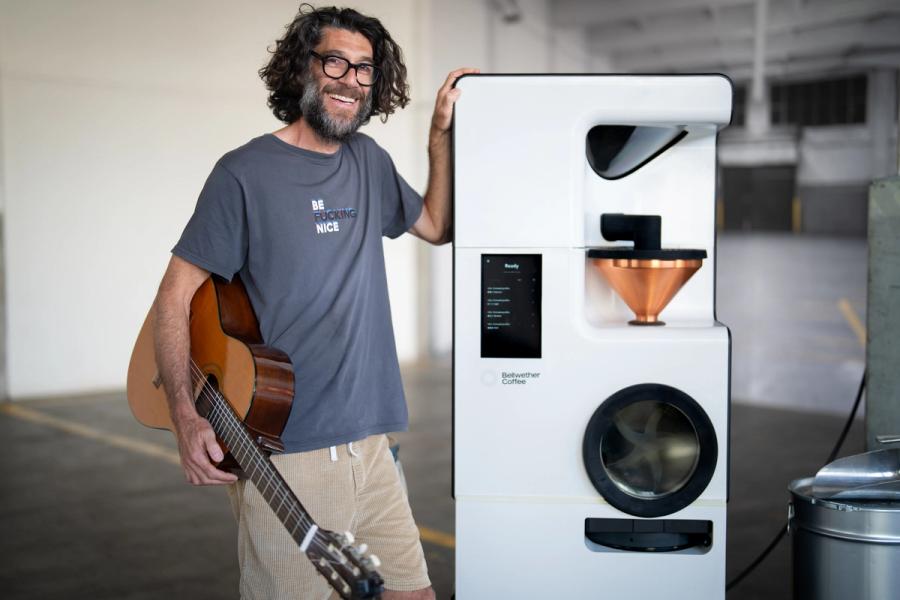
One lever that changes the COGS line dramatically: roasting your own coffee. Wholesale roasted coffee runs $10–$14 a pound. The same green coffee, roasted in-house on a Bellwether Shop Roaster, runs closer to $5 a pound. For a kiosk doing 100 customers a day, that's roughly $1,000–$1,500 a month in margin you'd otherwise pay your wholesaler — and a story your customers can taste.
When you're ready to grow
Expansion from a successful kiosk falls into three rough paths, and the right one depends on what you've learned from your first location.
If your kiosk model is working and you've documented the systems that make it work, the cleanest growth is a second kiosk. You replicate what's already proven, leverage your existing training and supply chain, and build brand presence across more locations without taking on café-level overhead. This is how a lot of small chains start.
If your kiosk has built a customer base and you want to give them a real place to sit, transitioning to a café is the second path. Use kiosk profits as the down payment, bring your established customer base across, and apply everything you've learned operationally. Some operators close the kiosk; others keep it running as a second revenue stream during the café build-out.
If your volume is high enough and you want vertical integration, the third path is adding roasting. You start roasting for your own kiosks, then layer on wholesale accounts and online retail. The Bellwether Shop Roaster fits in the same kind of small commercial footprint a kiosk operator is already used to working with.
The signal that you're ready: six or more months of consistent profitability, demand that's exceeding your capacity, a customer base that's loyal beyond just the location, operational systems that are running without you, and capital available or accessible.
Ready to build your coffee brand?
Take control of your margins
Save up to 50% on coffee costs with in-house roasting. Break even in month one, payback in six. Talk to our team about launching your roastery.