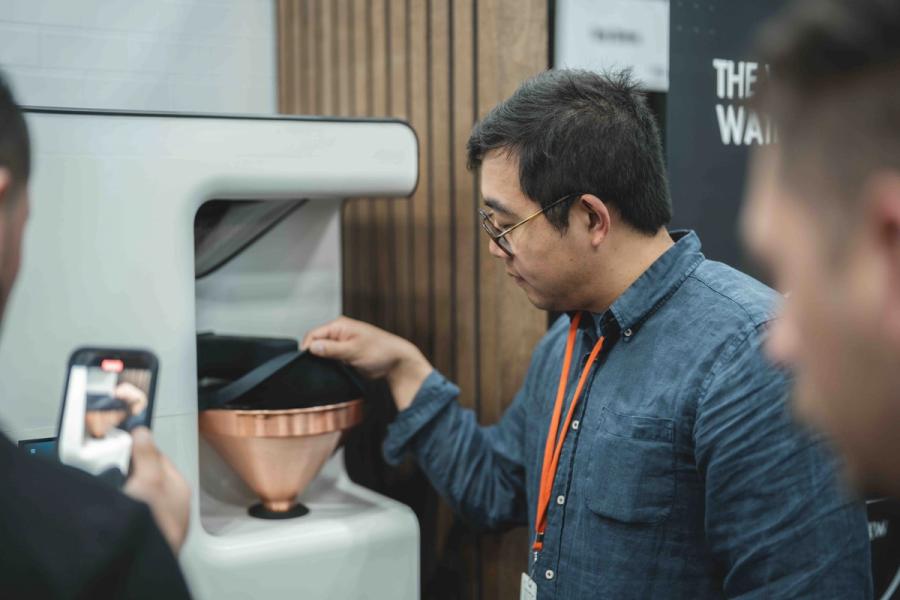
Limited space doesn't mean you can't roast your own coffee. Countertop and compact commercial roasters bring in-house roasting within reach for cafés, bakeries, and small roasteries that can't dedicate a room to traditional equipment. The category has changed significantly in the last few years — what used to require gas lines, exhaust hoods, and a separate roasting room can now run from a 240V outlet on a back-of-house counter.
This guide compares the realistic space-efficient options, with a focus on equipment that fits in existing retail spaces without major infrastructure changes.
Why space-efficient roasting matters now
Traditional commercial roasting carries a heavy infrastructure footprint:
| Requirement | Traditional setup | Cost |
|---|---|---|
| Gas roaster | 3–15 kg capacity | $15,000–$60,000 |
| Afterburner | Smoke elimination | $10,000–$25,000 |
| Exhaust system | Ducting, fans, roof penetration | $5,000–$20,000 |
| Gas line | Installation and permits | $5,000–$15,000 |
| Dedicated space | Separate roasting room | Varies |
| Permits | Air quality, fire, building | $500–$2,000 |
| Total | $50,000–$125,000+ |
For most cafés, that combination of capital and physical real-estate requirement makes traditional roasting effectively impossible. Modern compact roasters address it in three different ways: they fit in existing retail or production spaces, they require minimal or no infrastructure changes, and they bring lower total investment while still producing commercial-grade quality.
Three categories of compact roasters
Sample and small-batch roasters (under 1 kg)
This is the entry tier — Aillio Bullet R1, Ikawa Pro, Mill City 500g, and similar. Batch capacity runs 100–500g, prices range $3,000–$10,000, and most run on standard electrical (120V or 240V depending on model). The footprint is very small, and they're typically the right pick for sample roasting, very small cafés, and home roasters going commercial.
The production reality is the catch: a 500g roaster at four roasts per hour produces 2 kg per hour. A 10-hour roasting week is 20 kg, or about 44 lbs. That's enough for a very small café and that's about it. Many of these aren't truly commercial-grade either — they may not handle continuous duty — and most still require some ventilation for smoke.
Compact gas roasters (1–3 kg)
Mill City 1kg or 3kg, Diedrich IR-1 or IR-2.5, Probat Probatino. Batch capacity is 1–3 kg, prices $15,000–$35,000. They require gas connection and either an afterburner or excellent ventilation. Footprint is moderate, but the supporting infrastructure adds significant space requirements.
Production capacity scales appropriately — a 3 kg roaster at three roasts per hour is 9 kg per hour, or about 90 kg (200 lbs) per 10-hour week. That's enough for a medium café with a retail bag program. The catch is the same as traditional roasting: gas infrastructure, smoke management, and permits in most jurisdictions.
Ventless electric roasters
This is the third category, currently best represented by the Bellwether Shop Roaster — a fully ventless electric system that eliminates infrastructure requirements rather than just reducing them:
| Feature | Traditional compact | Ventless electric |
|---|---|---|
| Gas required | Yes | No |
| Afterburner required | Yes | No (internal) |
| Exhaust system | Yes | No |
| Permits beyond food service | Yes (air quality, fire) | No |
| Installation time | Weeks | Days |
| Total infrastructure | $30,000–$80,000 | $500–$2,000 (electrical) |
That infrastructure delta — $30,000–$80,000 vs. $500–$2,000 — is the reason ventless electric is the category most space-constrained operators end up choosing.
The Bellwether Shop Roaster: details
Specifications:
| Specification | Value |
|---|---|
| Batch capacity | 1.5 kg (3.3 lb) |
| Roasts per hour | 3–4 |
| Daily capacity (standard) | 36–48 kg |
| Daily capacity (with autoloader) | 80+ kg |
| Labor per roast | 2 minutes |
| Dimensions (W × D × H) | 24.6" × 36.5" × 28.2" |
| Weight | 405 lbs roaster, 527 lbs with autoloader |
| Electrical | 200–240 VAC, 30A, 5kW |
| Plug | NEMA L6-30P, 8 ft cable |
| Clearance | 2" (50 mm) on both sides |
On space, the base footprint is 24.6" × 36.5" — about 6.2 sq ft. With clearance, plan for roughly 8 sq ft total, which is comparable to a commercial espresso machine. The 28.2" depth fits under standard counters in many configurations. Common placement options include a back-of-house production area, customer-visible (the marketing-theater pick), under-counter where height permits, or a corner of the café floor.
Production capacity tracks with weekly volume:
| Weekly need | Roasts required | Time (labor) | With autoloader |
|---|---|---|---|
| 25 kg (55 lbs) | 17 | 34 minutes | Easier batching |
| 50 kg (110 lbs) | 34 | 68 minutes | 3 autoloader cycles |
| 75 kg (165 lbs) | 50 | 100 minutes | 4 autoloader cycles |
| 100 kg (220 lbs) | 67 | 134 minutes | 5 autoloader cycles |
The autoloader's 20 kg hopper handles 13 consecutive roasts without intervention, which transforms the workflow at higher volumes — load it once, walk away, come back to a full container of roasted coffee.
On total investment, the math is straightforward:
| Component | Cost |
|---|---|
| Bellwether Shop Roaster | $25,000–$35,000 |
| 240V circuit installation | $500–$2,000 |
| Total | $25,500–$37,000 |
Compared to a traditional small roasting setup:
| Component | Traditional | Ventless |
|---|---|---|
| Roaster | $20,000–$35,000 | $25,000–$35,000 |
| Afterburner | $10,000–$20,000 | $0 (internal) |
| Exhaust | $5,000–$15,000 | $0 |
| Gas installation | $5,000–$12,000 | $0 |
| Electrical | Minimal | $500–$2,000 |
| Permits | $1,000–$3,000 | Minimal |
| Total | $41,000–$85,000 | $25,500–$37,000 |
That's $15,000–$48,000 in savings, plus a faster installation timeline and no ongoing permit requirements.
Your customers can taste the difference
Fresher coffee starts here
Coffee roasted this week vs. last month — your customers notice. The most profitable way to serve great coffee, with zero disruption.
Where countertop roasting works best
The strongest fits are small to medium cafés with 25–100 lbs of weekly coffee needs and limited back-of-house space; bakeries adding coffee programs (the production area is already there, and the "house-roasted" angle adds marketing value); multi-location operations roasting at a flagship and supplying 3–5 cafés from there; and new concepts where a specialty coffee focus and limited build-out budget make traditional roasting impractical.
Countertop is less ideal if you're doing high-volume wholesale at 500+ lbs per week (production roasters become more efficient at that scale), if you're already building out a dedicated production facility where traditional equipment offers economies, or if you genuinely don't have eight square feet of available space — in which case an off-site roasting partnership may be the better path.
Side-by-side comparison
| Factor | Sample roasters | Compact gas | Ventless electric |
|---|---|---|---|
| Batch size | 0.1–0.5 kg | 1–3 kg | 1.5 kg |
| Hourly capacity | 1–2 kg | 6–12 kg | 4.5–6 kg |
| Price range | $3,000–$10,000 | $15,000–$35,000 | $25,000–$35,000 |
| Infrastructure | Some ventilation | Full ($30K–$80K) | 240V outlet only |
| Footprint | Very small | Small + infrastructure | Small |
| Labor per roast | 15–30 min | 20–45 min | 2 min |
| Best for | Samples, micro-batch | Small roasteries | Cafés, bakeries |
Choose sample roasters if you're at very low volume (under 20 lbs/week), running sample roasting for a larger operation, working with an extremely limited budget, or able to manage some ventilation requirements. Choose compact gas if you have or can install gas infrastructure, prefer hands-on roasting control, run medium volume (50–200 lbs/week), and have dedicated roasting space available. Choose ventless electric if no gas is available or desired, infrastructure investment isn't feasible, space constraints are significant, minimal labor is preferred, or customer-visible roasting is part of the experience you want to create.
What installation actually looks like
For ventless (Bellwether), the steps are: verify a 240V, 30A circuit is available or have one installed, confirm the floor or counter can support 405–527 lbs, ensure 2" clearance on both sides, position within 8 feet of the outlet. Total timeline is 1–3 days. For traditional compact, you're looking at gas line installation and inspection, afterburner installation, exhaust system build-out, electrical connections, permit applications and approvals, and final inspections — typically 4–12 weeks.
Training: ventless electric needs 2–4 hours of basic operation training, with profile development handled through self-guided software. Traditional gas takes 1–2 days of basic operation training with 2–4 weeks before reaching real proficiency, and ongoing experience-based refinement after that.
Ongoing costs differ too:
| Cost | Traditional | Ventless |
|---|---|---|
| Gas | $200–$500/month | $0 |
| Electricity | Minimal | $50–$150/month |
| Afterburner maintenance | $500–$1,500/year | $0 (internal) |
| Software / support | Varies | Included |
| Green coffee | Same | Same |
Over a 3-year horizon, the ongoing cost difference compounds the upfront infrastructure savings.
Ready to roast in-house?
Take control of your margins
Save $1,000–5,000/month on coffee costs. Your wholesaler takes 67% of the margin on every pound — it’s time to take it back.