Subscription coffee offers what every business wants: predictable recurring revenue. Customers receive fresh coffee on a schedule, you get reliable income, and the relationship deepens with every shipment instead of resetting after every sale. Whether you're a café layering subscriptions onto retail or starting a subscription-first business, the model has structural advantages over one-time sales — but only when the operations and pricing are dialed in.
This guide walks through the four common subscription models, how to price them, the operations behind shipment, where customers actually come from, and how to keep churn low once you have them.
Why subscriptions work
The case for subscriptions is structural:
| Factor | One-time sales | Subscription |
|---|---|---|
| Revenue predictability | Variable | Predictable |
| Customer lifetime value | Lower | 3–5× higher |
| Cash flow | Irregular | Consistent |
| Customer relationship | Transactional | Ongoing |
| Marketing efficiency | Constant acquisition | Retain + acquire |
| Inventory planning | Difficult | Easier forecasting |
Coffee subscriptions specifically benefit from a tailwind: convenience (doorstep delivery), discovery (new coffees regularly), freshness (roast-to-order is possible), value (often cheaper than retail), and personalization (tailored selections). All five reasons compound.
The four subscription models
A fixed subscription is the simplest version: same coffee, same quantity, same schedule. A 12 oz bag of House Blend, delivered every two weeks, $16 per shipment. Operations are simple, inventory planning is straightforward, and customers know what they're getting. The trade-off is that excitement decays over time — there's limited upsell opportunity, and some subscribers will eventually get bored.
A rotating or curated subscription sends a different coffee each shipment, curated by you. "Roaster's Choice" — 12 oz of a different single origin every delivery, $18 per shipment. The discovery and excitement keep subscribers engaged, you get to showcase your range, and the perceived value goes up. The risk is sending something a customer dislikes, and operations get more complex with harder inventory forecasting.
A customizable subscription lets the customer choose coffee, quantity, frequency, and grind. Maximum flexibility, higher customer satisfaction, lower churn — but it requires meaningful technology, more SKUs, and more complex fulfillment logistics. This is best for larger operations with diverse product lines.
A prepaid or gift subscription has the customer pay upfront for multiple shipments. A three-month gift at $60 prepaid (4 shipments) gives you cash up front and works well for holidays and corporate gifts. The catch: you're obligated to deliver every shipment, and conversion to ongoing paying subscribers isn't automatic.
Pricing strategy
Per-shipment cost typically breaks down as $4–$7 in coffee (if roasting your own), $1.50–$3.00 in packaging, $4–$8 in shipping (varies by zone), 2.9% + $0.30 in payment processing — total $10–$18 per shipment.
Three pricing models work for most operators. Flat-rate shipping included is simplest for the customer; you absorb shipping variance and price the bag at $18–$24 for 12 oz, with 30–50% margin. Shipping calculated and added shows the true cost (fair across zones, but can be a barrier in high-cost zones). A free shipping threshold encourages larger orders — "free shipping on 2+ bags" balances simplicity and margin.
On subscription vs. retail pricing:
| Option | 12 oz bag price | Strategy |
|---|---|---|
| Retail (one-time) | $18 | Full price |
| Subscription | $15–$16 | 10–15% discount |
| Prepaid subscription | $14–$15 | 15–20% discount |
The discount is justified by guaranteed recurring revenue, lower customer acquisition cost, reduced ongoing marketing spend, and predictable operations. You're not just discounting; you're paying for stability.
More than a roaster
Everything you need to roast, brand, and sell
From sourcing to packaging, Bellwether gives you a complete coffee program. Launch faster, with fewer mistakes, and predictable margins from day one.
Operations and fulfillment
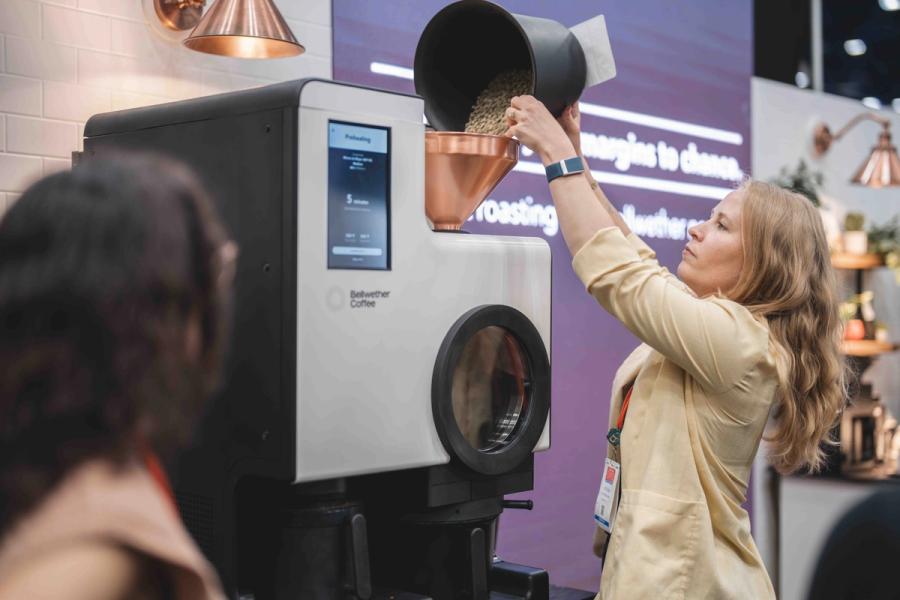
On the roasting side, the freshness approach varies by scale. Roast-to-order is ideal at small scale; weekly batch roasting works at medium scale; the freshness window you're communicating to customers is typically 7–21 days. Bellwether is well-suited to subscription operations: small 1.5 kg batches enable roast-to-order, multiple daily roasts handle subscription fulfillment, quality stays consistent across batches, and 2-minute labor per roast keeps fulfillment efficient. A worked example: 100 subscribers shipping biweekly is 50 shipments per week, requiring about 40 lbs of coffee — that's 12 roasts at 3.3 lbs each, totaling about 2 hours of roast time and 25 minutes of labor.
Packaging needs valve bags for degassing, a protective mailer or box, branded unboxing experience, and a packing slip or invoice. Shipping options:
| Carrier | Speed | Cost (1 lb) | Best for |
|---|---|---|---|
| USPS First Class | 2–5 days | $4–$5 | Under 16 oz |
| USPS Priority | 1–3 days | $8–$10 | Speed priority |
| UPS Ground | 1–5 days | $8–$12 | Larger shipments |
| FedEx Ground | 1–5 days | $8–$12 | Reliability |
Use shipping software (Pirate Ship, ShipStation) for discounted rates, batch print labels, schedule carrier pickups, and consider regional carriers for local routes.
Subscription management platforms vary in cost and integration:
| Platform | Cost | Features |
|---|---|---|
| Recharge | $99/month + 1% | Shopify integration, robust |
| Bold Subscriptions | $49.99/month | Shopify, good features |
| Cratejoy | $39–$149/month | Marketplace exposure |
| Subbly | $29–$79/month | Standalone platform |
| WooCommerce Subscriptions | $199/year | WordPress sites |
The features that matter most: easy customer self-management, flexible scheduling, dunning management for failed payments, analytics, and integration with the rest of your stack.
Customer acquisition
Acquisition channels vary in cost and quality:
| Channel | Cost | Quality | Volume |
|---|---|---|---|
| Café conversion | Low | High | Limited |
| Email marketing | Low | High | Medium |
| Social media organic | Low | Medium | Medium |
| Paid social ads | Medium | Medium | High |
| Influencer partnerships | Variable | Medium | Variable |
| Subscription boxes | Medium | Medium | Medium |
| Referral program | Low | High | Medium |
If you have a café, your existing customers are the warmest leads — tent cards on tables, QR codes to subscribe, baristas mentioning subscriptions during purchase, receipt messaging, loyalty program integration, and a free first bag for subscribers all work. For digital acquisition, start with retargeting (website visitors), expand to lookalike audiences, test platforms (Meta, Google, TikTok), and track CAC against lifetime value.
Referral programs are the highest-converting paid channel. Structure them as give-$5-get-$5, free bag for the referrer when a friend subscribes, or tiered rewards that improve with referral volume. Software like ReferralCandy or Friendbuy automates unique referral links and reward fulfillment.
Retention and reducing churn
Coffee subscription churn typically averages 8–12% monthly; under 6% is good and under 4% is excellent. The most common reasons subscribers leave: accumulated too much coffee, found cheaper alternatives, quality inconsistency, boredom with selection, financial constraints, or simply forgot they subscribed.
Three categories of retention strategy work. Flexibility reduces churn — easy pause options, skip shipments without canceling, frequency adjustment, swap coffee selections. Engagement reduces churn — tasting notes with each shipment, origin stories and education, online community and events, exclusive subscriber offerings. Value perception reduces churn — subscriber-only coffees, early access to new releases, accumulating loyalty points, anniversary rewards.
For canceled subscribers, run a win-back sequence: an exit survey to understand why, win-back emails at 30/60/90 days, a special offer to return, and content highlighting what's new since they left.
Subscription unit economics
A representative subscriber:
| Metric | Value |
|---|---|
| Average order value | $18 |
| COGS (coffee, packaging) | $7 |
| Shipping | $5 |
| Processing (3%) | $0.54 |
| Contribution margin | $5.46 |
| Contribution margin % | 30% |
Growth projections for a starting subscription program (assumptions: $18 average, biweekly shipments, 30% contribution margin, 6% monthly churn, 15% monthly growth):
| Month | Subscribers | Revenue | Contribution |
|---|---|---|---|
| 3 | 50 | $900 | $270 |
| 6 | 150 | $2,700 | $810 |
| 12 | 350 | $6,300 | $1,890 |
| 24 | 750 | $13,500 | $4,050 |
Break-even depends on fixed costs. With $500/month in fixed costs (platform plus dedicated labor) and a $5.46 contribution margin per shipment, break-even is 92 shipments per month — about 46 biweekly subscribers.
Ready to build your coffee brand?
Take control of your margins
Save up to 50% on coffee costs with in-house roasting. Break even in month one, payback in six. Talk to our team about launching your roastery.