Not all coffee businesses are equally profitable. A busy café can struggle to break even while a smaller roasting operation generates healthy margins on a fraction of the revenue. Understanding which models offer the best profit potential — and how to maximize margins inside each one — helps you choose the right path or optimize the business you already have.
This guide compares the major coffee business models with real margin data, lays out the trade-offs, and walks through what it takes to build sustainable profitability in each.
Comparing the major models
Here's how the dominant models stack up:
| Business model | Gross margin | Net margin | Startup cost | Complexity |
|---|---|---|---|---|
| Coffee shop (buying roasted) | 65–75% | 5–12% | $75,000–$300,000 | High |
| Coffee shop (roasting in-house) | 70–80% | 12–20% | $100,000–$350,000 | High |
| Roasting only (wholesale) | 35–50% | 15–25% | $30,000–$100,000 | Medium |
| Online coffee brand | 45–65% | 15–30% | $5,000–$50,000 | Low–Medium |
| Subscription service | 50–65% | 20–35% | $10,000–$40,000 | Medium |
| Mobile / cart | 65–75% | 20–30% | $15,000–$50,000 | Low–Medium |
The thing worth internalizing: net margin (what you actually keep) matters more than gross margin. Roasting operations often have lower gross margins than cafés but higher net margins because their operating costs are dramatically lower.
Traditional coffee shop
A traditional coffee shop generates $200,000–$600,000+ annually depending on size and location. Buying roasted coffee, the typical margin profile is 65–75% gross, 25–35% COGS, 30–40% labor, 8–15% rent and occupancy, 10–15% other operating, ending at 5–12% net. The math on a $350,000 revenue café: $105,000 in COGS, $245,000 gross profit, $210,000 in operating expenses, $35,000 net profit (10%).
The structural challenges are well known. Labor is the largest expense, and your baristas are essentially the product, so cutting labor cuts product quality. Rent doesn't scale with sales — fixed occupancy costs eat into your downside on slow days. Most revenue concentrates in the morning rush, leaving the rest of the day underutilized. And if you're buying roasted coffee, you're paying your roaster's margin on every cup.
The strategies that move margins are concrete. On the revenue side: increase average ticket through size and add-on upsells, food programs (pastries, sandwiches), retail coffee and merchandise, and premium drink options. On the cost side: roast your own coffee for 30–50% savings, negotiate supplier terms, reduce waste with better inventory management. On labor: cross-train staff for flexibility, match staffing to demand curves, invest in efficiency equipment. And on revenue diversification: wholesale coffee sales, catering and events, private label, evening programming.
Coffee shop with in-house roasting
Adding roasting transforms the P&L. Revenue scales to $250,000–$700,000+ (base café plus retail and wholesale streams). The margin profile improves to 70–80% gross, 20–30% COGS (because green coffee is roughly half the cost of roasted), 28–35% labor (roasting labor is minimal with modern automated equipment), 8–12% rent, 10–15% other operating, and 12–20% net.
The math on a $425,000 revenue café-roastery: base café revenue of $350,000, additional retail and wholesale of $75,000, COGS of $106,250 (25%), gross profit of $318,750, operating expenses of $265,000, net profit of $53,750 (12.6%).
Why roasting changes the margin picture. The COGS reduction alone is significant — buying roasted coffee runs $10–$14/lb vs. $4–$7/lb roasting in-house. For a café using 200 lbs a month, that's roughly $1,100 in monthly savings, or $13,200 a year. New revenue streams compound that: retail bags ($5–$10 margin per bag), wholesale accounts ($4–$6 margin per pound), online sales (50%+ margin after shipping).
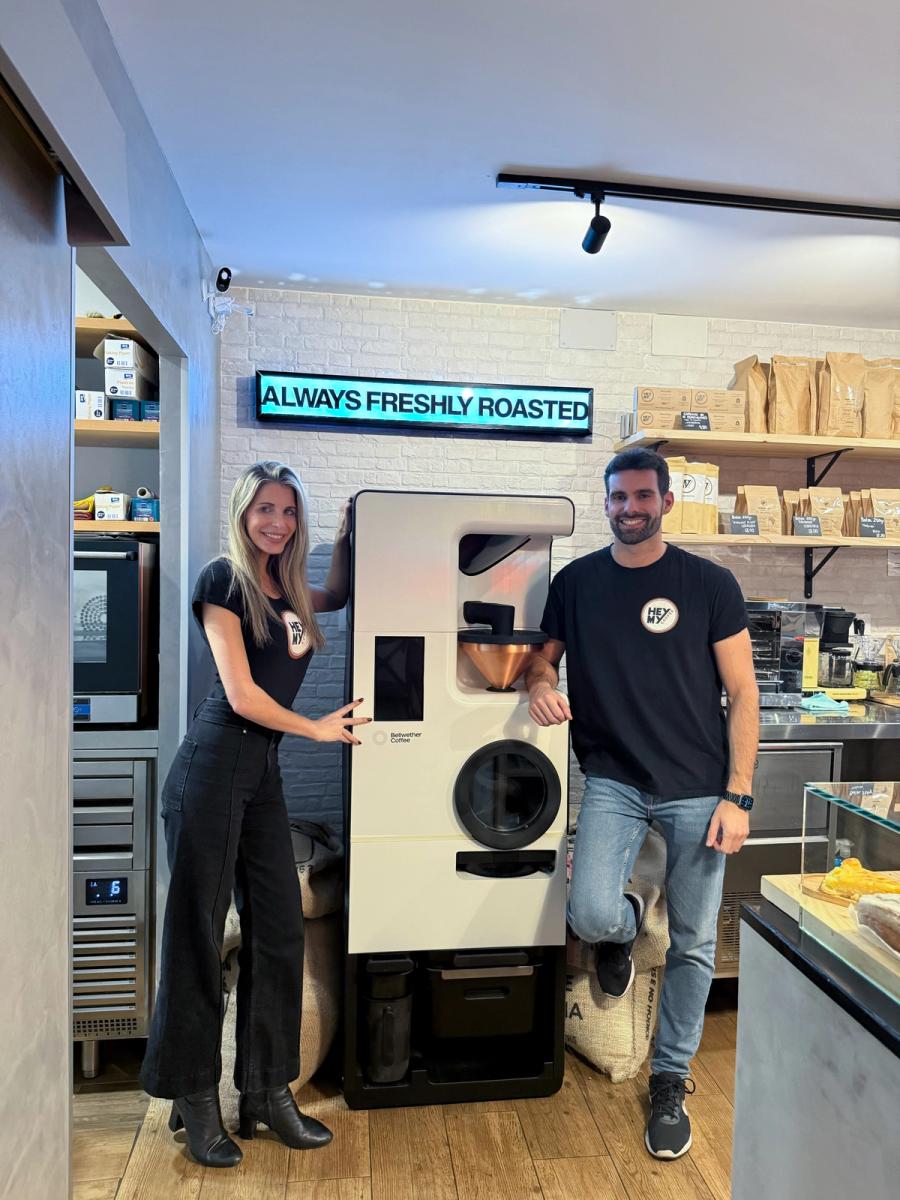
Implementation looks very different depending on which roasting path you take. Traditional roasting infrastructure runs $38,000–$120,000 (gas roaster, afterburner, exhaust system, gas line) plus permits and dedicated space. Ventless electric roasting (Bellwether) runs $15,400–$21,900 all-in (roaster plus electrical circuit), no permits beyond food service, and fits in existing café space with a 24.6" × 36.5" footprint, 2 minutes labor per roast, and 3–4 batches per hour at 1.5 kg each. With $12,000–$15,000/year in coffee cost savings plus $20,000–$50,000/year in new revenue potential, the ventless roaster typically pays back in about 12–15 months.
Wholesale roasting operation
B2B-only roasting for cafés, restaurants, and offices runs $100,000–$500,000+ in revenue depending on account count. Margins look like 35–50% gross, 50–65% COGS (green coffee plus packaging), 15–25% labor, 5–10% facility, 10–15% sales and marketing, and 15–25% net.
On a $250,000 wholesale roastery: $137,500 in COGS (55%), $112,500 gross profit, $65,000 in operating expenses, $47,500 net profit (19%).
Wholesale can outperform retail on net margin because the operating cost structure is fundamentally different. No retail rent (you can operate from industrial space), minimal customer-facing staff, simpler operations (roasting, packaging, delivery). Wholesale accounts reorder regularly, predictable volume enables better planning, and relationships span years rather than transactions. One roaster can serve 10–50+ accounts, so growth doesn't require new locations.
The challenges are real. You need active sales capability — wholesale customers don't walk through the door. Sales cycles are longer than retail, and the business is relationship-driven. You need critical mass for efficiency (minimum 100–200 lbs/week to justify equipment), and you're competing against established roasters who can pressure pricing. Differentiating on quality, service, or specialty is what wins, not price.
Best practices are predictable: secure 3–5 anchor accounts before equipment purchase (target 200+ lbs weekly commitment), differentiate on service rather than price (training for client baristas, menu development support, flexible ordering and delivery, private label options), and expand to multiple revenue streams (wholesale plus retail bags plus online plus subscriptions).
Your customers can taste the difference
Fresher coffee starts here
Coffee roasted this week vs. last month — your customers notice. The most profitable way to serve great coffee, with zero disruption.
Online coffee brand
Direct-to-consumer e-commerce ranges $50,000–$500,000+ in revenue, with margins of 45–65% gross (after shipping), 20–30% product cost, 15–25% shipping, 15–30% marketing, 3–5% platform fees, and 15–30% net margin (highly variable depending on customer acquisition cost).
On $150,000 in revenue: $37,500 product cost (25%), $30,000 shipping (20%), $30,000 marketing (20%), $15,000 fulfillment and ops, $37,500 net profit (25%). Online can be highly profitable when you control costs — no retail rent, minimal staff, home-based operation possible. Premium pricing for specialty coffee, no middleman, and subscription models that reduce customer acquisition cost over time. Geographic reach extends beyond local — your customer base is the entire country.
The challenges are real and concentrated. Customer acquisition is expensive, the market is crowded, and you need a strong brand or marketing skills to differentiate. Shipping costs eat into margins, and freshness is a constant concern. At higher volumes, marketing costs increase and margins compress — competing with large players is hard.
Three best practices separate the online brands that work from the ones that don't. First, niche positioning — specialty focus (single origin, sustainability, etc.), targeting a specific customer segment, story and brand that mean something. Second, subscription-first models — they reduce acquisition cost per order, generate predictable recurring revenue, and produce higher customer lifetime value. Third, fulfillment cost control — negotiated shipping rates, flat-rate shipping above a threshold, fulfillment center partnerships at scale.
Subscription coffee service
Recurring revenue subscriptions earn $180–$360 per subscriber annually ($15–$30/month), with 50–65% gross margin, 20–30% product cost, 15–20% shipping, 10–20% marketing (amortized across the lifetime of the subscriber), and 20–35% net margin.
On 500 subscribers averaging $20/month: $120,000 annual revenue, $30,000 product cost (25%), $18,000 shipping (15%), $12,000 marketing (10%), $15,000 operations, $45,000 net profit (37.5%).
Subscription is structurally attractive because revenue is predictable — you know what's coming each month, planning gets easier, and revenue volatility drops. Customer acquisition cost gets amortized across many orders, and a happy subscriber stays for 6–12 months on average, generating 6–12 orders versus the 1–2 from a one-time buyer.
The metrics that matter:
| Metric | Target | Calculation |
|---|---|---|
| Subscriber acquisition cost | $20–$50 | Marketing spend ÷ new subscribers |
| Monthly churn rate | <5% | Lost subscribers ÷ total subscribers |
| Customer lifetime value | $200–$500+ | Avg revenue × avg subscription length |
| LTV:CAC ratio | 3:1+ | Lifetime value ÷ acquisition cost |
Best practices: reduce churn with flexible pause options, easy modification (frequency, products), surprise bonuses for loyalty, and personalized recommendations. Optimize pricing with discounts for commitment (3, 6, 12 months), pricing tiers for different consumption patterns, bundled options (coffee plus gear). Build community with subscriber-only content, early access to new offerings, and feedback loops on products.
Mobile and cart operations
Mobile generates $75,000–$200,000 annually with margins of 65–75% gross, 25–35% COGS, 30–40% labor (often owner-operated), 5–10% location fees, 5–10% vehicle and equipment, and 20–30% net margin.
On $120,000 in revenue: $36,000 COGS (30%), $42,000 labor (35%), $8,000 location fees, $6,000 vehicle and equipment, $28,000 net profit (23%).
Mobile works because the cost structure is dramatically smaller. Cart or trailer at $15,000–$40,000 plus equipment at $8,000–$15,000 totals $23,000–$55,000 — a fraction of the $100,000+ for a café. No long-term lease, minimal utilities, flexible locations. Owner-operated mobile is highly profitable because the owner's labor is profit, with no management layer between owner and customer.
The limits: weather dependency means seasonal income fluctuation, location constraints come from permit requirements and competition for good spots, and scale is limited by per-cart volume ceilings. Many successful coffee businesses use mobile as a first stage in a longer plan: Year 1 with a single cart proving the concept, Year 2 adding a second cart or farmers market presence, Year 3 opening a small fixed location with a built customer base, Year 4+ a full café with roasting.
Hybrid models for maximum profitability
The most profitable coffee businesses tend to combine models. Café plus roasting plus retail layers café traffic and brand on top of roasting that reduces COGS and enables high-margin retail bags. A representative revenue mix: café drinks 60%, retail bags 15%, wholesale 25%.
Roasting plus wholesale plus online plus subscription combines volume from wholesale, direct-to-consumer margin from online, and predictable revenue from subscription. A representative mix: wholesale 50%, online one-time 25%, subscription 25%.
Mobile plus events plus catering plus pop-up uses the same equipment across multiple revenue opportunities, with the flexibility to chase the highest-margin work at any given time and a testing ground for a future fixed location.
To choose your model, the simplest matchup:
| Factor | Best for |
|---|---|
| Limited capital | Online brand, subscription, mobile |
| Prefer customer interaction | Café, mobile cart |
| Prefer production / craft | Roasting operation |
| Value predictable revenue | Subscription, wholesale |
| Limited time / side project | Online brand |
| Maximum profit potential | Café + roasting hybrid |
Ready to roast in-house?
Take control of your margins
Save $1,000–5,000/month on coffee costs. Your wholesaler takes 67% of the margin on every pound — it’s time to take it back.